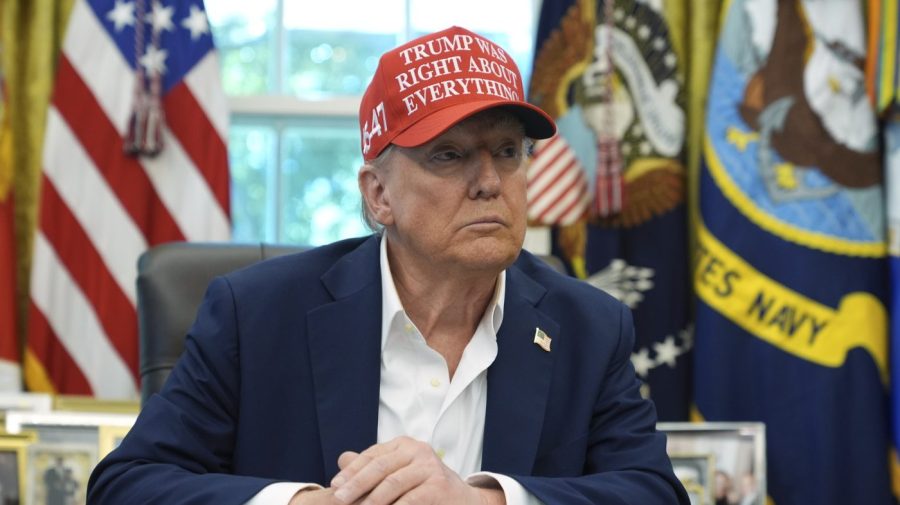


President Trump’s declaration that the federal government will acquire a 10 percent stake in Intel, once the leading chip manufacturer in the nation, has caused concern among conservative Republicans. They view this move as part of a larger pattern of government intervention in corporate decisions during Trump’s tenure.
Trump revealed his Intel initiative following a separate agreement made earlier this month with two other U.S. chipmakers, Nvidia and Advanced Micro Devices (AMD). Under this agreement, they will remit 15 percent of their AI-chip sales revenue from China to the U.S. government.
Last June, Trump stirred discomfort within his party when his administration permitted Japan’s Nippon Steel to acquire U.S. Steel. The deal granted the U.S. government a “golden share,” providing it with extensive authority over U.S. Steel’s operations.
Critics from the conservative Republican camp caution that the Intel agreement is yet another step towards “socialism,” which could erode the free market. They fear it sets a dangerous precedent that Democrats could exploit once they regain power.
Several well-known Republican lawmakers and former officials are challenging Trump’s justification and questioning whether Intel stands to gain or lose with federal partial ownership. This move invites comparisons to state-controlled enterprises in countries like China and Russia.
Senator Thom Tillis (R-N.C.) expressed his discomfort with Trump’s application of federal power to influence key corporate decisions, not only at Intel but also at other large firms. He pointed to companies like Apple, which recently pledged to increase its U.S. investments to $600 billion, seeking favor with the White House.
“I don’t care if it’s a dollar or a billion-dollar stake,” Tillis told journalist Major Garrett. “That starts feeling like a semi state-owned enterprise à la CCCP,” referring to the acronym for the USSR.
“I don’t believe the U.S. government should be picking winners and losers,” he added.
Sen. Rand Paul (R-Ky.) called it a “terrible idea.”
“If socialism is government owning the means of production, wouldn’t the government owning part of Intel be step toward socialism?” he posted on social media.
Former Republican Sen. Jeff Flake (Ariz.) applauded Paul for speaking out against Trump’s deal with Intel and called on other Republicans to “speak out as well.”
Republican critics of the deal are pointing out that the fact that self-described democratic socialist Sen. Bernie Sanders (I-Vt.) has applauded it as a bad sign.
Sanders argues that American taxpayers “have a right to a reasonable return” on the subsidies they have provided to Intel and other domestic chip-making companies.
Mike Pence, Trump’s former vice president, however, told Bloomberg that he has “great concerns” about the U.S. government having “golden shares” in Nippon Steel or “taking a percent of Intel.”
Pence specifically questioned the logic behind allowing Nvidia and AMD to sell high-tech chips to China in exchange for the U.S. government sharing in the profits.
“The limitations on the ability of Nvidia to sell chips to China was on the basis of our national security. Simply taking 15 percent of those sales doesn’t serve our national interest or our national security, I would argue,” he said.
“If I was speaking to the president, I’d encourage him: It’s time to think twice. State-owned enterprise is not the American way. Free enterprise is the American way,” he added.
Larry Kudlow, who served as Trump’s National Economic Council director during his first term, said during his show on Fox Business that he is “very, very uncomfortable” with the government taking a 10 percent stake in Intel, while conservative economist Stephen Moore, who appeared as a guest on the program, argued the government should “divest of assets, not buy assets.”
The conservative National Review warned in an editorial that the “government shouldn’t get into the chip business,” arguing that if the government isn’t getting involved in Intel’s business decisions, “there would be little point in becoming a shareholder.”
The criticisms appear to have bounced off Trump, who declared on Monday that he’s willing to make deals like the one he struck with Intel “all day long.”
“Why are ‘stupid’ people unhappy with that?” he said of the deal in a post on Truth Social. “I will also help those companies that make such lucrative deals with the United States. … I love seeing their stock prices go up, making the USA RICHER, AND RICHER.”
Most Republican senators, with a few exceptions, are leery of calling out Trump for blurring the lines between private and public enterprise for fear of becoming the target of Trump’s wrath, which is quick to rise whenever a fellow Republican criticizes the president.
GOP senators — including lawmakers who voted for the CHIPS and Science Act in 2022, which provided $53 billion in federal incentives for domestic semiconductor manufacturers — will have to answer questions next month when they return to Washington about the authorities Trump invoked to gain a substantial share of Intel.
Sen. John Cornyn (Texas), a leading Republican supporter of the CHIPS and Science Act, on Sunday reposted on social media a New York Times article about “The Long, Painful Downfall of Intel,” which detailed the business mistakes that led to the federal government taking a big stake in the company.
Trump’s National Economic Director Kevin Hassett explained in a CNBC interview Monday that Trump acquired a federal stake in Intel in exchange for the CHIPS funding Congress approved three years ago.
He emphasized that the federal government would receive nonvoting shares of the company and would not intrude on business decisions.
“The equity is not voting so there’s not going to be government intrusion into the business of Intel. It’s more like a downpayment on a sovereign wealth fund, which many, many countries have,” he told CNBC’s “Squawk Box.”
A Republican strategist who requested anonymity to comment argued that the president is justified in seeking more federal control of U.S. Steel and Intel because steel and semiconductors are vital to U.S. defense needs and national security.
“The list of companies that are on the table now, chipmakers, steel, I think there’s a national security nexus you can argue. People don’t love it but you understand the argument,” the strategist said. “Intel is the only domestic fabricator, if they went under it would be a big problem for us.”
But the source raised concerns about statements that Trump is willing to pursue similar deals more broadly and Hassett’s argument that federal equity in Intel could be viewed as a downpayment on a sovereign wealth fund.
“When Kevin Hassett was talking about we’re going to do this with other companies, that’s the bigger question mark. I don’t think anybody wants a managed economy. I don’t understand how a sovereign wealth fund is going to work in the United States. We’re not a kingdom,” the strategist said.
Other Republican strategists are predicting bigger blowback from Congress after the August recess.
Brian Darling, a GOP strategist and former Senate aide, said Trump’s decision to take a stake in the semiconductor company is puzzling given that it’s a major departure from conservative economic principles.
“It’s head-scratcher, it really is. When you get the government involved in owning private enterprise, you are creeping toward managed capitalism, a model that China has used,” he said. “It’s not something that free market-oriented conservatives like. They’re horrified by the idea of the government trying to control corporations,” he said.
Darling suggested that the partial takeover of Intel is at odds with Trump’s efforts to deregulate industries.
“You got a Trump administration on the one hand reducing regulations and freeing the hands of the private sector to expand and then on the other hand they’re purchasing ownership interests in a chip company that’s going to make the company less efficient and it’s going to create a precedent for more government ownership of private enterprises. It’s conflicting,” he said.
A second Republican strategist and former Hill leadership staffer who requested anonymity to speak warned that Trump could be setting a bad precedent that Democrats will use to push their own agenda in the business sector when they regain control of Washington.
“It’s socialism. It’s nationalizing the means of production. You think the horrifying things that a Democratic administration could do when they’re in power,” said the strategist.
The source warned that “as soon as a Democrat gets in” to the White House, they could potentially order companies to “restore DEI [diversity, equity and inclusion]” and “kowtow” to other liberal priorities.