

President Donald Trump has vowed to deport millions of individuals from the United States in what would be the nation’s largest deportation effort. However, his immigration policies are encountering several legal challenges in U.S. courts.
Recently, a federal appeals court decided that the Trump administration cannot utilize an 18th-century wartime statute to expedite the deportation of alleged Venezuelan gang members, a move that is anticipated to lead to a likely Supreme Court challenge.
Many of the president’s policies could impact hundreds of thousands, if not millions, of people. Below are some of the Trump administration’s initiatives that are being contested in court:
Alien Enemies Act
The Trump administration has invoked the Alien Enemies Act of 1798 to deport individuals suspected of belonging to the Tren de Aragua gang, claiming the gang is an invading entity.
Deportees labeled as members of this gang were sent to a notorious prison in El Salvador, with the administration asserting that American courts do not have the authority to release them. Historically, the Alien Enemies Act has been applied only three times—during the War of 1812 and the two world wars.
Over the summer, more than 250 deported men were eventually sent back to Venezuela from El Salvador in a complex three-country negotiation. Nonetheless, legal proceedings concerning this issue continue.
In Tuesday’s ruling by the 5th U.S. Circuit Court of Appeals, two judges on a three-judge panel agreed with immigrant rights lawyers and lower court judges who argued the Alien Enemies Act of 1798 was not intended to be used against gangs such as Tren de Aragua.
Lee Gelernt, who argued the case for the ACLU, said the ruling reined in “the administration’s view that it can simply declare an emergency without any oversight by the courts.”
But Abigail Jackson, a White House spokeswoman, said the president has the authority “to conduct national security operations in defense of the United States and to remove terrorists.”
“We expect to be vindicated on the merits in this case,” she said.
Birthright citizenship
President Trump issued an executive order that attempts to redefine birthright citizenship under the 14th Amendment.
The amendment’s Citizenship Clause says all people born or naturalized in the U.S., and subject to U.S. jurisdiction, are citizens. The Trump administration asserts that a child born in the U.S. is not a citizen if the mother does not have legal immigration status or is in the country legally but temporarily, and the father is not a U.S. citizen or lawful permanent resident.
States that have sued over the order — Washington, Arizona, Illinois and Oregon — argue that it ignores the plain wording of the Citizenship Clause as well as a landmark birthright citizenship case in 1898. The Supreme Court had found that a child born in San Francisco to Chinese parents was a citizen by virtue of his birth on American soil.
A federal appeals court in San Francisco ruled in late July that Trump’s order is unconstitutional, affirming a lower-court decision in New Hampshire that blocked the order’s enforcement nationwide.
Third-country deportations
The Trump administration has been sending people to countries where they have no ties, including El Salvador in Central America and the African nation of South Sudan.
Trump officials have said these immigrants often come from countries that won’t take them back or were convicted of violent crimes. Advocacy groups sued this year, arguing that people’s due process rights were being violated and that immigrants were being sent to countries with long histories of human rights violations.
In late March, a federal judge temporarily blocked third-country deportations of people without first being allowed to argue that it would jeopardize their safety. But in June, a divided Supreme Court halted that order, allowing the swift removal of immigrants to countries other than their homelands.
Lawyers for five men who were deported to the African country of Eswatini in July said Tuesday that the men have held prison for seven weeks without charges and no access to legal counsel.
Attorneys for one of the men, Jamaican national Orville Etoria, said his home country was willing to accept him back.
California immigration stops
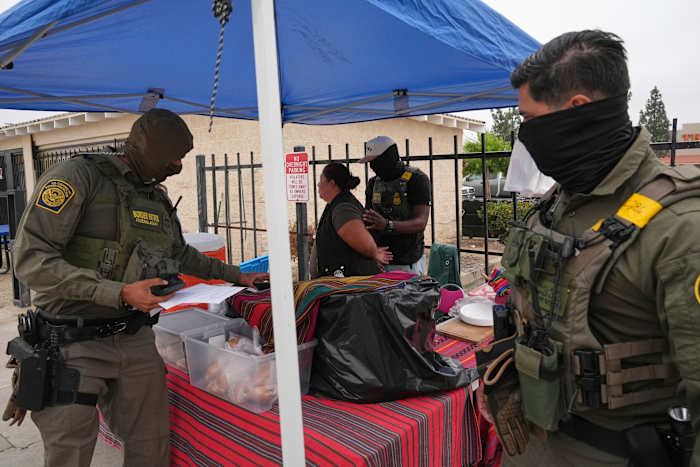
Earlier this year, U.S. immigration authorities began conducting mass immigration raids in Southern California, rounding up predominantly Latino immigrants from locations like car washes, Home Depots, and bus stops, even sometimes ensnaring U.S. citizens.
The practice prompted a lawsuit by immigrant advocacy groups that accused the administration of systematically targeting brown-skinned people in the region. The Justice Department has argued that federal agents are allowed to consider factors like race or ethnicity and occupations in an area it considers a “top enforcement priority.”
A federal judge ordered the administration to halt such tactics in seven California counties, including Los Angeles, writing that they violated the U.S. Constitution. A federal appeals court upheld the judge’s temporary order.
The Trump administration filed an emergency petition in early August that asks the Supreme Court to halt the lower court’s ruling, with Solicitor General D. John Sauer arguing that it puts a “straitjacket” on federal agents.
Temporary Protected Status
The Trump administration has sought to end programs that offer legal yet temporary authorization for people to live and work in the U.S. if conditions in their homelands are deemed unsafe.
The efforts have prompted lawsuits across the country that say more than 1.5 million people are under what’s known as Temporary Protected Status, or TPS, or humanitarian parole.
Temporary Protected Status allows people already living in the U.S. to stay and work legally for up to 18 months if their homelands are unsafe because of civil unrest or natural disasters. The status can be repeatedly renewed.
More than 500,000 people from Cuba, Haiti, Nicaragua and Venezuela live in the U.S. under humanitarian parole, which allows people from countries where there’s war or political instability to enter and temporarily live in the U.S.
To qualify, they had to fly to the U.S. at their own expense and have a financial sponsor. For most people, the designation lasts for two years.
In May, the Supreme Court allowed the Trump administration to revoke TPS and humanitarian protections while the lawsuits proceed. As a result, it’s possible that people who had protections could be deported before the legal cases are completed.
On Friday, U.S. District Judge Edward Chen restored TPS protections for 1.1 million Venezuelans and Haitians, ruling that Homeland Security Secretary Kristi Noem had no legal authority to revoke extensions granted under the Biden administration. In August, the 9th U.S. Circuit Court of Appeals backed him up in a related appeal.
On the East Coast, the 1st U.S. Circuit Court of Appeals is deciding whether to uphold a Boston judge’s order halting humanitarian parole terminations for roughly 430,000 migrants from Cuba, Haiti, Nicaragua and Venezuela.
Fast-track deportations
The Department of Homeland Security announced in January that it was expanding the use of expedited removal, a fast-track deportation process for migrants who came to the country illegally and have been here less than two years.
It allows for their removal without appearing before a judge first.
Before Trump’s second term, expedited removal was only used for migrants who were stopped within 100 miles of the border and who had been in the U.S. for less than 14 days.
The change has triggered lawsuits by the American Civil Liberties Union and immigrant rights groups. In late August, U.S. District Judge Jia Cobb temporarily blocked the administration’s expansion, suggesting that it’s trampling on people’s due process rights.
In another case, Cobb agreed in early August to temporarily block the administration’s efforts to expand fast-track deportations of immigrants who legally entered the U.S. under humanitarian parole.
Cobb said the case’s “underlying question” is whether people who escaped oppression will have the chance to “plead their case within a system of rules.”
Copyright 2025 The Associated Press. All rights reserved. This material may not be published, broadcast, rewritten or redistributed without permission.