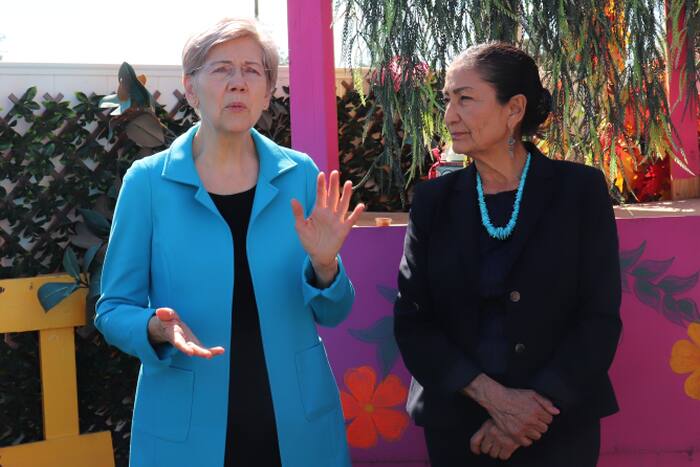


With one of the broadest and most diverse fields of Democratic and Republican candidates in years, this midterm election could produce a remarkable series of historic firsts across the United States.
Voters Tuesday may elect the nation’s first Native American woman governor, its first Native women senators, its first Black woman governor, its first openly gay U.S. senator and its first Muslim U.S. senator, among other milestones. Democrats account for most of those possibilities, though Republicans could also make history.
Some candidates have deliberately avoided making their race, gender, religion or sexual orientation the centerpiece of their campaigns. Still, voting-rights and democracy advocates say the expanding field reflects a changing electorate.
“These firsts show how our country is changing,” Alexis Anderson-Reed, president and CEO of State Voices, a network that promotes civic engagement and equity in democracy, said in an email.
“For years, people of color and LGBTQ+ communities have organized, knocked on doors, talked to voters, held conversations, and done the hard work of saving our democracy,” Anderson-Reed said. “These wins are because of them.”
Here are several contests in which voters could help break new ground.
First Native American female governor
Democrat Deb Haaland shattered political barriers in 2018, when she became one of the first two Native American women elected to Congress. She later became the first Native American Cabinet secretary while leading President Joe Biden’s Department of the Interior. Charles Curtis, a member of the Kaw Nation, previously served as Vice President under President Herbert Hoover.
Now Haaland, a citizen of Laguna Pueblo, could add another distinction by defeating Republican Gregg Hull, a former mayor, in New Mexico and becoming the first Native American woman elected governor.
Oklahoma remains the only state to have elected a tribal citizen governor, with Democrat Johnston Murray winning in the 1950s and Republican Gov. Kevin Stitt serving today.
In a recent interview with The Associated Press, Haaland played down a question about the many historic identities she represents.
“I mean, somebody has to be the first,” she said. “I just don’t want to be the last, right?”
She said she is encouraged by the importance Indigenous communities place on representation as more Native women seek office. “It truly does matter,” Haaland said. “It’s not just a slogan.”
First Native woman senators
Mary Peltola, a Yup’ik Democrat, made history in 2022 as the first Alaska Native elected to the U.S. House. The former congresswoman is now seeking another breakthrough: unseating Republican Sen. Dan Sullivan and becoming the first Native American woman elected to the Senate.
Minnesota Lt. Gov. Peggy Flanagan could claim the distinction as well. The progressive Democrat and citizen of the White Earth Band of Ojibwe is facing Republican Michele Tafoya, a former NFL sideline reporter.
A Tafoya victory would also mark a first: She would become the first Republican senator of Latina heritage.
First Black female governor
Democrat Keisha Lance Bottoms and Republican Lisa Demuth could bring an end to a 250-year stretch in which no Black woman has served as a state governor.
Bottoms, who previously served as Atlanta’s mayor, is challenging Republican businessman Rick Jackson for the Georgia governorship. A win would make her Georgia’s first governor of color; every one of the state’s 83 previous governors has been a white man.
In Minnesota, Demuth, a former speaker of the state House, is competing against longtime U.S. Sen. Amy Klobuchar. Regardless of who prevails, Minnesota is poised to elect its first female governor.
Stacey Abrams remains the only Black woman to come close to winning a governor’s race, after securing the Georgia Democratic Party’s nomination in 2018 and again in 2022.
First Muslim U.S. senator
Abdul El-Sayed could become the first Muslim American elected to the U.S. Senate.
The progressive Michigan Democrat must defeat Republican Mike Rogers in a race that has remained close and deeply contentious.
El-Sayed has faced attacks from Republicans, including former President Donald Trump, who have suggested or directly claimed that the Michigan-born epidemiologist is not American and supports terrorism. Trump has described him as “dangerously radical” and “too extreme,” while also referring to him as “Mohammed.” El-Sayed and his supporters have condemned the remarks as Islamophobic and racist attacks on religious freedom.
First openly gay U.S. senator
Democratic Rep. Chris Pappas could become the nation’s first openly gay U.S. senator if he wins in New Hampshire. He is running against former Republican Sen. John E. Sununu.
Pappas was already the first openly gay member of Congress when voters elected him in 2018.
Although he has not made the possible milestone a central campaign theme, Pappas has said, “I’m not running to make history.” He has also welcomed the fact that his sexual orientation has not dominated conversations with voters.
First Black governors
The country could go from just three elected Black governors in its 250-year history to seven more overnight.
Maryland Gov. Wes Moore, the nation’s third Black governor and its only current one, is projected to win reelection. He could soon be joined by new Black governors from Florida, Wisconsin, Nevada, South Carolina and Michigan, in addition to Georgia and Minnesota.
Moore, who chairs the National Governors Association, has called the number of Black candidates running for governor “a unique moment.” He said the development should be viewed not as “an applause line,” but as a challenge to make diverse gubernatorial nominees more routine.
Record year of women running for governor and Congress
Women are also running for state and federal office in record numbers this midterm cycle. According to the Center for American Women and Politics at Rutgers University, Democrats have increased their 2022 total to 19 women seeking governorships. Seven Republican women are also running for governor.
Like Minnesota, Tennessee is guaranteed to elect its first female governor. The leading candidates are Republican U.S. Sen. Marsha Blackburn and Democrat Jerri Green, a Memphis city councilwoman.
Vermont could elect the first Democratic Asian American woman governor with Amanda Janoo, who is half Malaysian, while Oklahoma could reach the same milestone with Cyndi Munson, a former state lawmaker of Korean descent. Nikki Haley, the former Republican governor of South Carolina, was the first Asian American woman to serve as a governor.
Nearly 300 women, including incumbents, are seeking seats in the U.S. House and Senate, according to Rutgers’ Center for American Women and Politics.
Democrat Juliana Stratton is among them in Illinois. If the Black candidate wins her Senate race, she and fellow Democrat Sen. Tammy Duckworth, who is of Thai heritage, would make Illinois the first state represented by two female senators of color.
____
Associated Press writers Becky Bohrer in Juneau, Alaska, and Savannah Peters in Albuquerque, New Mexico, contributed to this report.


