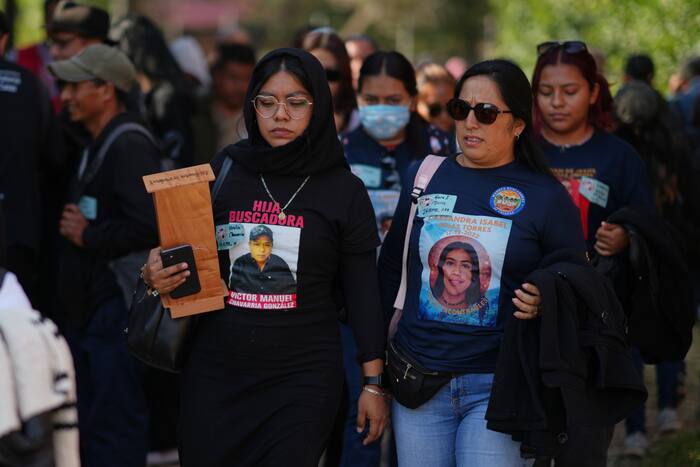

SAN CRISTÓBAL DE LAS CASAS – More than 1,500 members of Mexico’s Zapatista movement will set out Saturday on a “Tour for Life,” traveling from Chiapas to Mexico City to meet families searching for missing loved ones and join efforts to confront the country’s disappearance crisis, which has claimed more than 130,000 people.
The Zapatista Army of National Liberation, or EZLN, launched its armed uprising against the Mexican government in 1994. Although the guerrilla movement never formally surrendered its weapons, it has spent decades advancing its cause through social activism and self-governance in Indigenous territories, continuing its fight for Indigenous rights and broader human rights.
The group will leave San Cristóbal de las Casas in a convoy of 35 buses. Once in Mexico City, the Zapatistas plan to offer what their spokesperson, Subcomandante Moisés, described as “thousands of ears” to listen to and stand beside families searching for relatives.
Before the caravan’s departure, relatives of missing people gathered in San Cristóbal de las Casas to share their stories with the Zapatistas.
Adriana Pérez said her brother disappeared six years ago in San Cristóbal de las Casas while traveling from home to work. Liliana Pérez, who is not related to Adriana, said two of her sons are missing and criticized the Mexican army for failing to help locate them, despite the fact that her eldest son was an active-duty soldier in Chiapas. Guadalupe Morales recounted that her brother vanished in 2015 while harvesting grapes in Sonora, in northern Mexico, before deciding to cross into the United States.
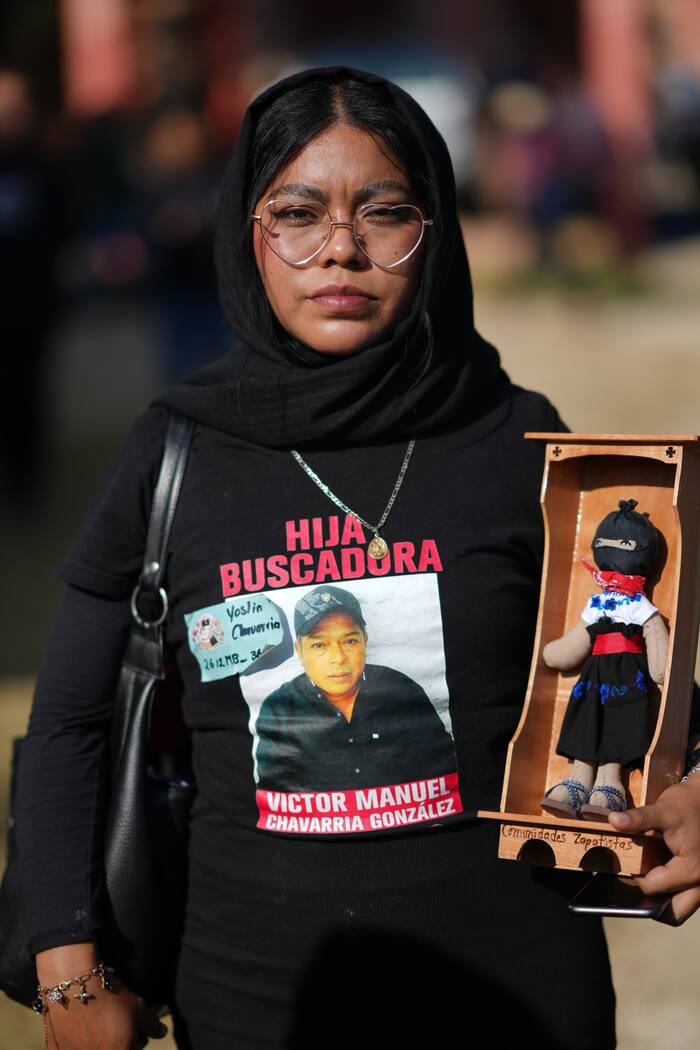
“It was a warm embrace for our souls to be heard, because the government so often tries to silence our voices,” said Yoslín Chavarría, who has searched for her father since 2023 and held a handcrafted Zapatista doll. “This is an opportunity for our missing people to be heard in different parts of the country.”
Zapatista movement remains active after more than three decades
For 32 years, the Zapatistas have continued to advocate for Indigenous communities and human rights while reminding the world that their movement remains active.
In 2001, they crossed Mexico in a large-scale caravan. Five years later, they launched another tour promoting an alternative approach to politics. In 2018, the movement put forward its own independent candidate for president. More recently, it organized a symbolic voyage to “invade” Europe, commemorating the route Spanish conquistadors took in the opposite direction 500 years earlier.
The Zapatistas have backed the families of Mexico’s disappeared before. This latest initiative, however, carries a wider appeal and has drawn support from hundreds of people across 27 of the country’s 32 states.
The movement plans to remain in Mexico City until January. On Dec. 19, its members will join a demonstration marking the U.N.’s newly declared International Day of Recognition for Women Searching for Missing Persons.
Zapatistas and families of the disappeared join forces
Fernando Vargas, whose son is an engineering student who disappeared two years ago in the mountains south of Mexico City, traveled to Chiapas so he could accompany the Zapatista caravan along its full route.
“We hope to bring our struggles together — those of Indigenous communities and those of families searching for their loved ones,” he said.
The Zapatista uprising in 1994 drew international attention to the racism, marginalization and neglect experienced by millions of Mexicans. Agreements reached with the government in 1996 paved the way for a major constitutional reform five years later. The changes recognized fundamental Indigenous rights, including the authority to determine forms of organization and the protection of cultural traditions, though many of those guarantees have yet to become reality across parts of the country.
“We would like to begin a similar process, because our problem is defined by total impunity and the authorities’ complete lack of effectiveness,” Vargas said.
___
Verza reported from Mexico City.


