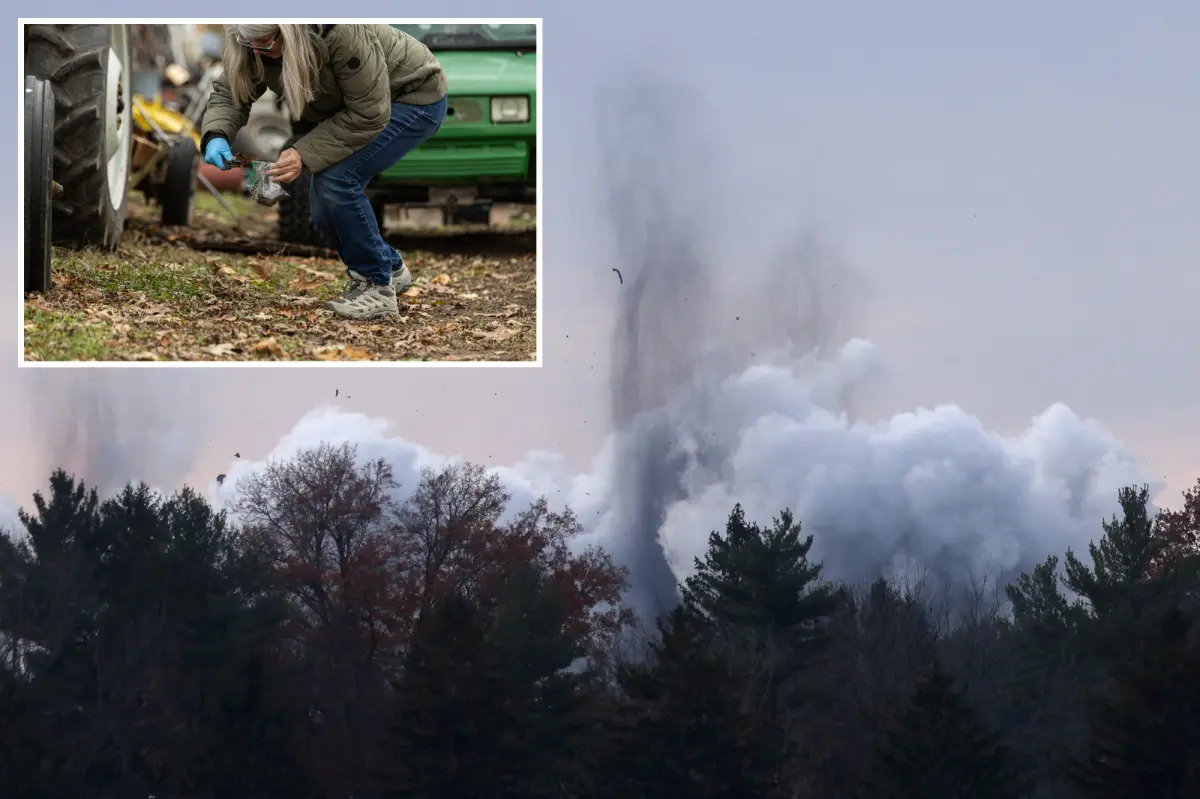

The US Army says it successfully detonated the nation’s aging stockpile of lead azide, an operation that had raised widespread fears of environmental contamination. Still, questions persist about how quickly and broadly the federal government disclosed its plans.
The US Environmental Protection Agency said roughly 300 people spent Thursday collecting samples from schools, playgrounds, churches and homes throughout the region.
The EPA could begin releasing preliminary findings as soon as Friday evening.
Before the detonation, crews collected more than 1,500 air, water, soil and dust samples. Afterward, they gathered hundreds more from locations including homes, parks and drinking-water sources, according to the EPA.
The agency said no airborne lead has been detected in the region since Wednesday’s controlled blast.
Although the initial results are reassuring, residents and several elected officials have criticized the Army for failing to provide greater transparency and more advance notice after determining that the stockpile had become unstable.
A notice stating that plant managers planned to neutralize the stockpile appeared on a government website last fall.
Concerns intensified after the plant closed in March, a development that was made public. An October meeting then warned residents that the chemicals would soon have to be detonated.
People in Middletown, the small town where the Army stockpile was stored, were aware of the plans. But few others knew about them, and the warnings did not draw significant attention from elected officials or the wider public until only days before the scheduled detonation.
Democratic Gov.-elect Rob Sand is among those seeking an investigation into why the lead azide was allowed to reach such a precarious condition.
“The lead-up to the detonation should never have been so chaotic and unclear,” he said afterward.
Plant shutdown gives Middletown residents an early warning
Middletown Mayor Rodney Johnson and other residents said they were not caught off guard. They learned about the problem in March.
Johnson said the plant commander briefed him at the time and showed him photographs of the bunkers where 68 barrels had been stored since arriving nearly two decades earlier.
An Army-appointed working group formed in January spent months developing a plan. In October, about 200 residents attended a public meeting where experts explained that the hazardous material needed to be detonated urgently, before it could trigger a chain reaction of unintended explosions.
Army officials said they were targeting a November date and that weather conditions would determine the exact timing.
In late October, the Army submitted an application to the EPA, which approved it roughly two weeks later. The extensive document described the alternatives considered, the environmental monitoring planned after the blast and the community outreach required.
“Because this action may raise public concerns related to noise, blast effects, and potential environmental contamination, this Community Engagement Plan establishes the framework for proactive, transparent communication with the EPA, local elected officials, the Middletown community, the media, and other interested stakeholders,” the application said.
Critics accuse the Army of limiting public disclosure
Johnson has said he believes the Army fulfilled its responsibilities.
“Unfortunately negative social media and unconfirmed theories have made this task more complicated for all parties involved,” he wrote in a social media post after a legal challenge postponed the original Nov. 20 detonation date.
He said Middletown residents were frightened at the time because they did not know when the lead azide would be dealt with and when their lives could return to normal.
Environmental advocates and other critics argued that the Army should have notified a broader area, particularly communities located downwind, and done so earlier.
They warned that toxic lead dust can cause lasting health and environmental damage, leaving residents too little time to prepare.
“The failure of communication and transparency throughout the planning process is inexcusable and left many Iowans feeling confused, helpless, and scared,” said Josh Turek, a Democratic state lawmaker recently elected to Iowa’s open US Senate seat.
Many missed public notices tied to the permits
The EPA began issuing public notices about the series of permits required for the operation as early as May.
In a letter to Iowa Gov. Kim Reynolds, the agency said those notices were sent to the state’s congressional delegation, lawmakers and local officials.
Reynolds’ office did not respond to emails asking whether the governor knew about the March plant closure or the permit notices.
Several Democratic state lawmakers said they were blindsided. Iowa House Majority Leader Bobby Kaufmann, a Republican, also said he had concerns about the way the notification process was handled.
US Sen. Joni Ernst, a Republican and former lieutenant colonel in the Iowa Army National Guard, said the Army had discussed disposal with some communities months earlier. However, she said those discussions did not include critical information about the potential plume or how far it might travel.
“At a time when trust in our institutions is already low, the military owes the people it serves more transparency, not less,” Ernst said in a statement issued the day before the detonation.
US Sen. Chuck Grassley said the situation had devolved into political finger-pointing.
The Iowa Republican said his office had been communicating with federal officials since March and that the Oct. 15 town hall drew a large crowd.
“But it’s clear it wasn’t enough,” he said earlier this week, promising to keep seeking answers so the public can better understand how the Army reached its decision.
Extra time allowed the Army to add safeguards
Following public backlash and the legal postponement, environmental advocates said the Army had additional time to strengthen protections beyond the dirt berms, water walls and specialized foam already planned.
The EPA also added personnel to assist with air, water and soil testing.
Court documents and federal briefings indicate that much of the lead azide was moved to the Iowa plant in 2009. Records at the time showed that much of the material was old and already considered a military concern.
For years, contractors inspected the barrels and replenished the water-ethanol mixture used to keep the lead azide stable.
According to court documents, crystals began forming inside the barrels and around their lids, making the containers too dangerous to handle or open.
Army officials said the barrels were last replenished in September 2025.
That was when American Ordnance, the plant operator, first notified officials that the lead azide needed to be neutralized.
The contract that followed was eventually withdrawn after the working group concluded that detonation was the safest option.