VATICAN CITY – Pope Francis wrote that he saw the “gates of hell” after confronting the full scale of the clergy sexual abuse crisis and described mystical encounters with the devil during his years in ministry, according to excerpts from his personal diary released by the Vatican on Tuesday.
“The Private Diary of Pope Francis” also details a deep spiritual crisis the Argentine pontiff endured from 2021 to 2022. The crisis was tied to his struggle with the temptation to wield power without limits. He ultimately said he overcame it by placing himself completely in God’s mercy.
Published worldwide in multiple languages, the book offers an unusually intimate look at Francis’ inner life. It reveals his fears, doubts, dreams and temptations, along with a harsh self-judgment marked by feelings of shame and unworthiness. At the same time, the diary shows his steadfast belief that God could guide him even through profound despair.
The volume was assembled by one of Francis’ closest advisers, Cardinal Víctor Manuel Fernández, the Argentine theologian who leads the Vatican’s doctrine office. Fernández is credited as the author because he provides context and commentary around the diary passages.
Francis wrote the entries in a leather-bound calendar that served as his notebook. The diary begins in 1992, when Jorge Mario Bergoglio was auxiliary bishop of Buenos Aires, follows his years as cardinal archbishop of the Argentine capital and continues into his papacy. The final entry is dated Aug. 18, 2024.
Spiritual torment and encounters with the devil
Among the book’s most striking passages are Francis’ accounts of spiritual anguish and what he portrayed as encounters with the devil — experiences he described as physical, vivid and frightening. Two took place during his time in Buenos Aires, while a third came after his troubled 2018 visit to Chile.
“A few days after returning to Rome, I was in a meeting. I saw him and heard his voice, triumphant, possessing everything. ‘Now I’ve gotten everything I wanted,’” Francis wrote in a Jan. 24, 2021, entry. “Just as I can’t forget his eyes from the previous two, in this case, I can’t forget the powerful raspiness of his voice.”
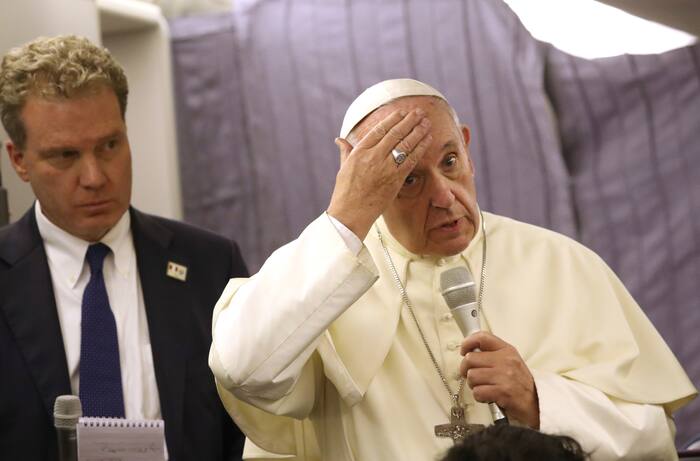
Francis faced intense criticism during his January 2018 trip to Chile after appearing to dismiss allegations against the country’s most notorious abuser. Journalists, including Associated Press reporters, pressed him about the issue during the flight home. Francis then ordered an investigation and concluded that the victims had been telling the truth, while he had been wrong and misled by Chile’s church leadership.
“Devastated because of the situation in Chile and the dialogue with the journalists on the airplane,” Francis later wrote. “I became aware of how serious the problem was. … It was hard for me to admit what happened in Chile; I didn’t think it was so serious.”
On June 7, 2018, several months after returning from Chile, Francis wrote that he had “seen the entrance to hell. Pagan seduction in full force” through the scandal.
As he confronted the aftermath in July and August, he added: “What shame and evil this has brought on the church!” and “Once more the gates of hell. … May holiness and conversion abound in the midst of so many scandals.”
Francis’ own spiritual crisis, however, would emerge three years later.
A spiritual crisis from 2021 to 2022
The diary places the beginning of the crisis on Jan. 24, 2021. The previous day, Francis had canceled several public appearances because of what the Vatican described as a recurrence of sciatica.
Fernández writes, however, that Francis was enduring “insupportable” pain caused by an intestinal condition. In July 2021, the illness required a 10-day hospital stay and surgery to remove 33 centimeters (13 inches) of his colon.
At the same time, the world was still struggling with the COVID-19 pandemic, while the Vatican was engulfed in turmoil over a sweeping financial investigation authorized by Francis.
In September 2020, Francis had dismissed Cardinal Angelo Becciu, once a close ally, after becoming convinced that Becciu had misappropriated Holy See funds. The scandal, combined with Francis’ belief that corruption had spread through the Vatican secretariat of state, triggered an unprecedented investigation and years of legal proceedings. Francis sought to demonstrate that he was prepared to confront financial wrongdoing.
The trial produced several convictions, including Becciu’s, but prosecutors’ broader theory of a far-reaching corruption conspiracy was largely rejected. Appeals remain underway, and Francis’ role in the investigation has become a central issue for the defense.
Fernández does not discuss the trial directly. He does suggest its relevance by explaining that Francis later viewed his 2021-2022 spiritual struggle as intertwined with “governance issues, pressure regarding decisions to make, and aridity and desolation.”
Fernández ultimately concludes that the crisis centered mainly on Francis’ use of authority — and on his temptation to believe he was omnipotent and somehow above the rest of the world. Francis had acknowledged this weakness publicly in 2013, during his first interview as pope, when he admitted that he could exercise power in an “authoritarian” manner.
The revelation is notable because Francis was wrestling with a flaw frequently cited by his critics: a forceful, solitary governing style as the absolute monarch and supreme leader of the world’s 1.4 billion Catholics.
Francis understood this temptation as the devil’s effort to draw him into “reductive curiosity” — the belief that he alone could resolve every problem, effectively placing himself in God’s position.
By Dec. 30, 2022, Francis appeared to have emerged from the crisis after surrendering himself to God. Fernández writes that Francis came to see the experience that began on Jan. 24, 2021, “as a powerful invitation from the Lord to become aware of an accumulation of interior darkness that he had to overcome so he could be free.”
Fernández says the final two major teaching documents of Francis’ life — a 2023 text on confidence in God’s merciful love and a 2024 encyclical about Christ’s human and divine love — grew directly from this spiritual struggle. Their tone and subject matter differ from many of the writings most closely associated with Francis’ papacy.
The most private thoughts remain coded
Although the book exposes some of Francis’ deepest thoughts, Fernández says the pope recorded his most confidential reflections in an indecipherable code. Those passages are not included.
That leaves unanswered questions about which diary entries Fernández selected and what additional context he may have withheld as one of Francis’ most trusted advisers.
Fernández says the diary contains little about the day-to-day affairs of the church and functions primarily as a spiritual record. He omitted material involving third parties, though he retained some personal observations, including Francis’ assessment of then-Cardinal Robert Prevost, now Pope Leo XIV: “A great pastor, a generous missionary and an irreproachable man.”
Pope Leo gives his approval
Fernández said Francis once showed him the diary and told him, “From this, you will all see,” effectively entrusting the writings to him after his death on April 21, 2025.
A few weeks after Leo was elected, Fernández said, he informed the new pope about the diary.
“I added that I wished to study these materials — to make them known and interpret the exact meaning of their contents,” Fernández wrote. “The Holy Father showed intense interest.”
The publication of a pope’s most intimate spiritual reflections after his death has historical precedent.
Pope John XXIII’s autobiography, “Journal of a Soul,” was published by his secretary in 1960. St. John Paul II asked that his personal notes be destroyed after his death, but his secretary disregarded that request and arranged for their publication in 2014.
___
Associated Press religion coverage receives support through the AP’s collaboration with The Conversation US, with funding from Lilly Endowment Inc. The AP is solely responsible for this content.


