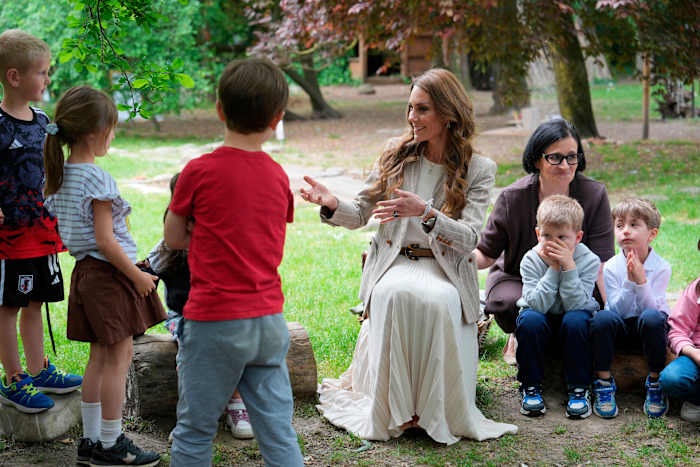


REGGIO EMILIA – The recent visit of the Princess of Wales to Italy has shone a spotlight on an innovative educational model that has transformed how young children learn. This model, known as the Reggio Approach, is particularly prevalent in the northern Italian city of Reggio Emilia and is receiving renewed attention thanks to the Princess’s interest.
The Reggio Approach is distinct in its emphasis on harnessing a child’s natural curiosity and potential. Within this framework, teachers serve more as guides rather than traditional instructors, while parents and the broader community actively participate in the educational process. Princess Catherine, who has long championed early childhood development, is taking a two-day tour to observe this approach in action.
Upon her arrival at a local preschool on Wednesday, Princess Catherine expressed her admiration, stating, “I love that you put children and childhood at the heart of the community, and I’m really fascinated to learn more about it.” Her words underscore the importance of integrating community and education in nurturing young minds.
The Reggio Approach shares roots with the Montessori philosophy, and both have gained international recognition. They offer an alternative to the more standardized educational practices common in countries like the U.S. and Britain, where early education often focuses on testing and uniformity, even before children can read.
This approach has appealed to some Italian parents who experienced more traditional, rote-learning education. However, Kathryn Ramsay, an experienced early childhood educator who manages a Reggio-inspired project near Rome, notes a shift in parental attitudes as children grow older. “When the children are 3 or 4, they’re totally fine with it,” Ramsay observes. “But when they hit 5, parents start getting a little twitchy because they’re thinking about Grade 1,” where children are expected to sit still for longer periods and begin formal reading and writing.
“When the children are 3 or 4, they’re totally fine with it,” Ramsay said. “And then when they hit 5, they (the parents) start getting a little twitchy because they’re thinking about Grade 1,” when children have to sit still for longer periods and learn to read and write.
A postwar approach to childcare
The Reggio Approach was born as Italy began to rebuild after World War II and a group of mothers in hard-hit Reggio Emilia, a center of anti-Fascist resistance, banded together.
“They sold the metal from a German tank for funds and they hand-carried stones from the river to reconstruct a place for the children to be cared for while the rest of the village went about the business of putting life back together,” said Margie Cooper of the North America Reggio Emilia Alliance.
An innovative pedagogical expert, Loris Malaguzzi, built on Montessori and other educational reform movements to help articulate Reggio’s child-centered approach, which covers children aged 0-6.
His poem exploring how young children communicate and make sense of their world through drawing, painting, dancing and singing served as something of a manifesto. Valuing the capacities and experiences of children was unheard of at the time.
“The child was only an adult in formation and didn’t have things to say or competencies already realized,” said Roberta Cardarello, senior professor of didactical and special pedagogy at the University of Modena and Reggio Emilia.
The Reggio Approach spread to other towns, especially in the north’s left-leaning municipalities. But Italy’s central government in Rome — headed by conservative Christian Democrats until the 1990s — resisted promoting it widely, perhaps because of its association with Reggio Emilia’s communist history.
Today, that red scare is gone, but the model’s adoption often depends on whether cash-strapped local administrations invest in training or teachers have trained independently, according to Elisabetta Nigris, professor of didactic programs and evaluation at the University of Studies Milan-Bicocca.
How Reggio works and what are its outcomes
Reggio employs features common in high-quality programs, including a focus on adults and children in relationship that promotes social and emotional well-being, according to Sylvi Kuperman, senior researcher at the Center for the Economics of Human Development at the University of Chicago. Her 2017 study on Reggio in Italy found greater high school graduation and employment outcomes compared to kids who didn’t receive formal childcare.
Children typically spend multiple years with the same teacher, she said. They participate in meal preparation. Classrooms feature windows and natural materials, like wood. Gardens and artwork are a staple.
On Thursday, Catherine visited the “Salvatore Allende” daycare and preschool in Reggio Emilia, playing with children in the garden, using a magnifying glass to look in the grass and at one point letting a slimy newt crawl in her hand.
“In London, we have newts like this too,” she said.
Catherine’s visit is significant for Britain, since the Reggio Approach isn’t recognized in its national educational policy, and most early childhood programs are run by private organizations for profit, said Peter Moss, emeritus professor at the University College London’s Institute of Education.
But he stressed that Reggio developed in a very particular time and context that is hard to replicate.
“Reggio Emilia is a reaction to 20 years of authoritarian rule under Mussolini and, after that fell, of course a lot of places in Italy were asking the question ’How do we make sure that never happens again?’”
A Reggio-inspired center called Wild Joy
At Ramsay’s Reggio-inspired, bilingual project north of Rome, there is a large grassy garden but no typical playground equipment or bright decorative posters lining the schoolhouse walls. Rather, the tiny log cabin with a covered porch is spare and neutral-toned. Most learning takes place outside: the “mud kitchen,” where kids play at a table with dishes, a digging pitch, a big rock to climb up and slide down in the dirt. Called “Wild Gioia” (Wild Joy), it currently has five children enrolled, aged 3-6.
Ramsay points to evidence suggesting that the best preparation for reading and writing is play, because it teaches children to concentrate.
“They don’t learn to concentrate by being told what to concentrate on,” she said. “They’re learning to concentrate by having the freedom to be able to follow their own interests.”
___
Winfield reported from Rome. Hollingsworth reported from Kansas City, MO.