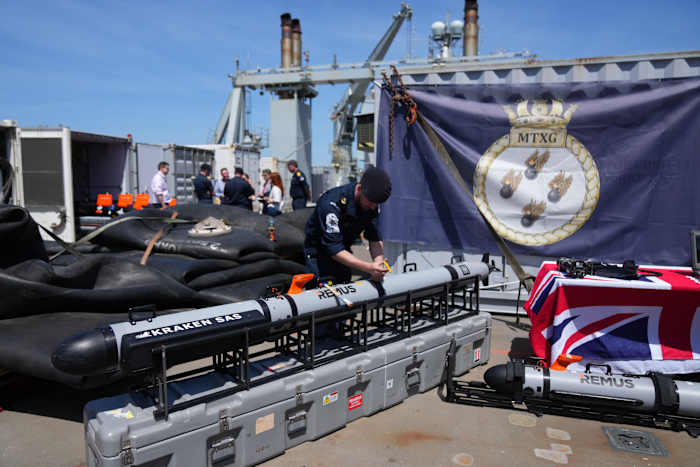


Onboard the RFA Lyme Bay, currently stationed off Gibraltar’s coast, a contingent of British sailors are poised for a potential mine-clearing mission in the Strait of Hormuz—a deployment still mired in uncertainty.
President Donald Trump has criticized allied nations for their perceived lack of contribution to the U.S.-led efforts in Iran. Iran’s control over the Strait has significantly disrupted global shipping and spiked energy prices. In March, Trump urged NATO allies to secure their own oil supplies and take the initiative to ensure the strait’s safety.
While the Royal Navy prepares for potential action, any deployment hinges on a peace agreement. Located at Gibraltar, the southern tip of the Iberian Peninsula, the U.K.’s naval forces stand ready, pending negotiations. Trump announced on Saturday that talks with Iran are “largely negotiated,” following discussions with Israel and regional allies, but final details remain unresolved.
Armed Forces Minister Al Carns hosted a small group of journalists aboard the RFA Lyme Bay to outline the preparations for a possible U.K.- and France-led international mission to secure the waterway. During the visit, the amphibious vessel, strategically docked at the Mediterranean entrance, was being outfitted with ammunition and sonar-equipped mine-hunting sea drones.
The RFA Lyme Bay, manned by several hundred sailors, is set to join the U.K. destroyer HMS Dragon and allied air support vessels. Their journey will take them through the Suez Canal towards the Persian Gulf.
“Which other country can unite 40 nations to tackle a complex issue we couldn’t foresee, given our initial non-involvement?” Carns posed in response to a question from The Associated Press regarding Trump’s expectations from the U.K.
After the U.S. and Israel launched the war on Feb. 28, Tehran retaliated by effectively closing the strait, a key waterway for the region’s oil, natural gas and fertilizer, causing global economic pain. The U.K. in particular has drawn the ire of Trump, who has described Britain’s navy as “toys” and Prime Minister Keir Starmer as “not Winston Churchill.”
At least 6,000 ships have been blocked from passing through the strait since the conflict began, Carns said.
There could be a range of threats from Iran’s mines
Iran could have a “huge” variety of mines throughout strait, said Cmdr. Gemma Britton, who is in charge of the Royal Navy’s Mine and Threat Exploitation Group. Mines could be rocket-propelled, cabled or sit on the seabed and be triggered by sound, movement or light.
AP was shown autonomous systems that can scan the seabed and the water with sonar in about half the time it takes for a crewed vessel to enter and map potential dangers. The sea drones equipped with sonar produce a picture of objects under the water, from fishing traps to pipelines. The picture is used to identify mines that can be explored with advanced acoustic systems and cameras, Britton said.
Some of the systems on the RFA Lyme Bay can be loaded onto a smaller vessel that can be launched and piloted autonomously from the ship, which acts as a mother ship, waiting outside any potential minefield, Britton said. That reduces the number of people needed to enter, she said.
Once a mine has been located, a diver with explosives normally places a charge on the mine before swimming away to detonate it. But RFA Lyme Bay is trialing a remotely operated vehicle that dives and drops a charge by a mine before setting it off, Britton said.
The priority, she said, will be to clear a transit lane in the strait to allow around 700 ships to leave. A lane flowing in the opposite direction will then be cleared, allowing ships to enter, she said, but added that clearing the entire strait could take months or years.
It’s still not clear if the UK and its allies will be deployed
It’s still not clear if any mines are in the strait — or if the U.K. and its allies will be deploying to remove them.
When asked by AP if the British effort was partly for show, to curry favor with the U.S., Carns said he was sure some mines had been blown up or floated away but that assurance is not good enough for commercial insurance companies. He said those companies need “absolute certainty” to get vessels traveling through the strait again.
“That’s what this capability will provide,” he said.
The international effort to secure the strait would happen only once hostilities are over.
“Final aspects and details of the Deal are currently being discussed, and will be announced shortly,” Trump said Saturday on social media, with no details on timing.
This is not the first time in recent weeks that a deal has been described as close.
“We don’t know when the Americans, Iranians and Israelis are going to come up with a suitable solution,” Carns said.
In the meantime, the RFA Lyme Bay and its crew will be waiting and will be “really, really ready,” Carns said.
——
Associated Press writer Konstantin Toropin in Washington contributed to this report.