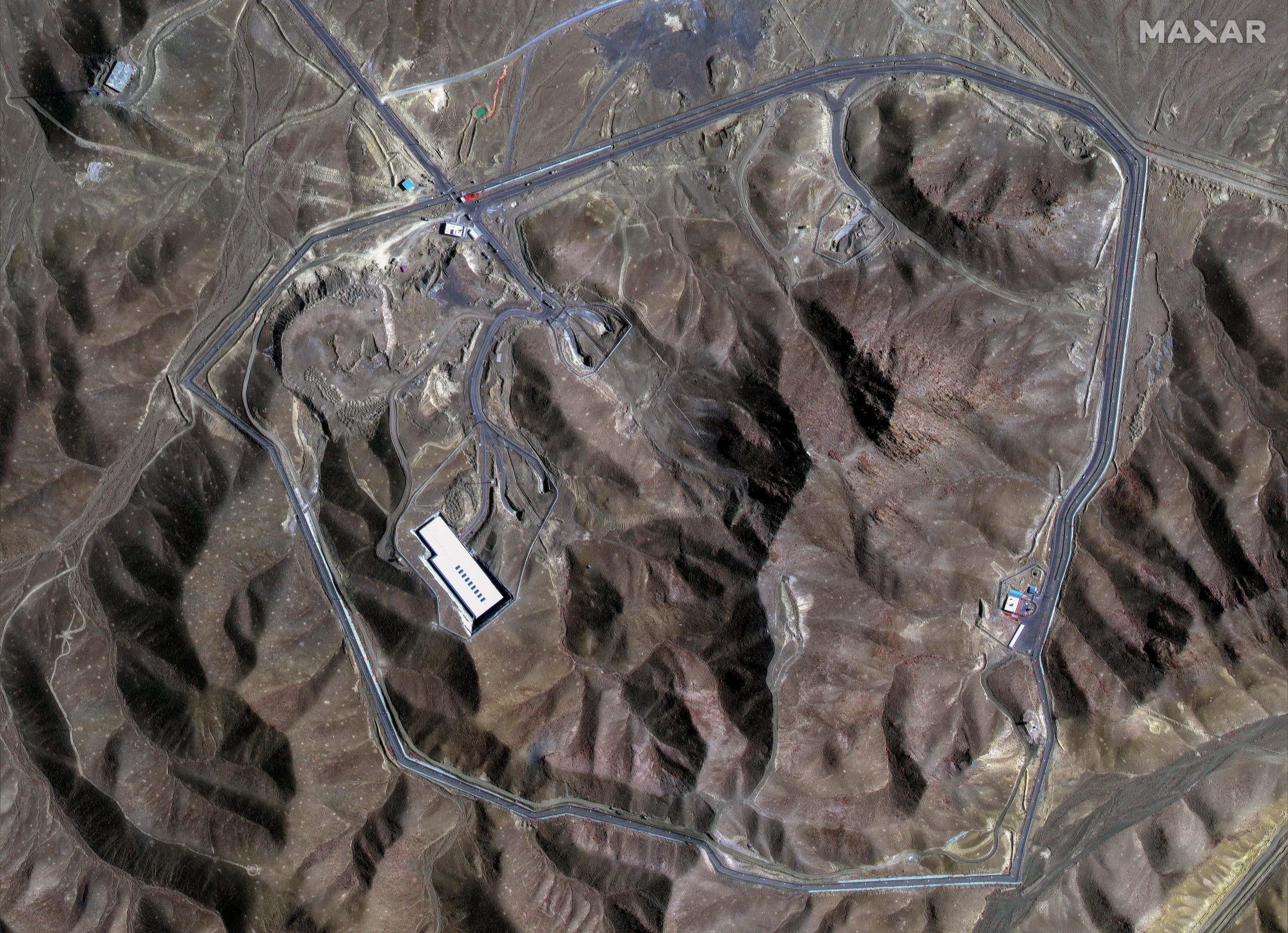

(NewsNation) — Newly released satellite imagery shows damage to three nuclear sites in Iran before and after Saturday night’s U.S. airstrikes.
The U.S. military deployed specialized bunker bombs to target underground sites at Fordow, Natanz, and Isfahan. This marked President Donald Trump’s decision to align with Israel’s military efforts against Iran’s nuclear ambitions.
Maxar Technologies’ high-resolution images revealed significant craters on a ridge above Fordow, one of Iran’s most fortified nuclear sites. Similar imagery was obtained from Natanz and Isfahan.
Interact with the images below by dragging the slider to the left and right to see the before and after differences after the U.S. strikes:
Fordow enrichment facility
The strikes appear to have blocked several tunnel entrances leading into the underground facility with debris and dirt, per Maxar.


Analysis of the satellite imagery pointed out a wide area blanketed in gray-blue ash, indicative of the intense explosions from the bunker-busting bombs utilized in the strikes.
The Fordow facility, built deep inside a mountain near the city of Qom, considered a holy site in Shi’a Islam, has been a particular concern for Western intelligence agencies due to its heavily fortified construction designed to withstand military attacks.


The image below, also from Maxar Technologies, shows several holes, which appear to have been left by bombs, with what appears to be ash around them.

Natanz enrichment facility


At the Natanz enrichment facility, satellite images show a 5.5-meter diameter crater positioned directly above part of the underground military complex.


Natanz houses centrifuges, which are critical to Iran’s uranium enrichment program.

The crater’s precise placement over the underground centrifuge operations indicates penetration of the facility’s protective earth covering. Historical Maxar imagery from 2003 shows the site during construction, when centrifuge buildings were visible before being covered with earth for protection.
Isfahan Technology Center
The Isfahan nuclear technology center sustained extensive building damage across the entire complex, according to the latest satellite imagery analysis.


The facility serves as Iran’s primary nuclear technology research center.


Hegseth: US ‘does not seek war’ with Iran after attack
Defense Secretary Pete Hegseth said Sunday that America “does not seek war” with Iran in the aftermath of Saturday’s surprise attack while Vice President JD Vance said the strikes have given Tehran a renewed chance of negotiating with Washington.
The mission, called “Operation Midnight Hammer,” involved decoys and deception, and met with no Iranian resistance, Hegseth and Air Force Gen. Dan Caine, chairman of the Joint Chiefs of Staff, said at a Pentagon news conference.
“This mission was not and has not been about regime change,” Hegseth added.
Caine said the goal of the operation — destroying nuclear sites in Fordow (sometimes spelled Fordo), Natanz, and Isfahan — had been achieved.
“Final battle damage will take some time, but initial battle damage assessments indicate that all three sites sustained extremely severe damage and destruction,” Caine said.
Vance said in a television interview that while he would not discuss “sensitive intelligence about what we’ve seen on the ground,” he felt “very confident that we’ve substantially delayed their development of a nuclear weapon.”
Pressed further, he told NBC’s “Meet the Press” that “I think that we have really pushed their program back by a very long time. I think that it’s going to be many many years before the Iranians are able to develop a nuclear weapon.”
The vice president said the U.S. had “negotiated aggressively’ with Iran to try to find a peaceful settlement and that Trump made his decision after assessing the Iranians were not acting “in good faith.”
The Associated Press contributed to this report.


