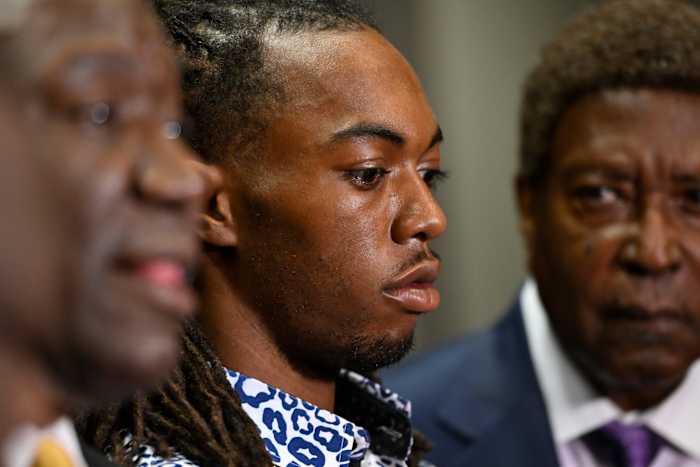


A video showing the violent arrest of a Black college student, who was removed from his car and beaten by police in Florida, has prompted an investigation and discussions on the importance of drivers installing cameras in their vehicles for protection.
William McNeil Jr. recorded his February traffic stop using his cellphone camera mounted above his dashboard. This perspective provided the only clear evidence of the officers’ brutality, including punches to his head not visible in the body camera footage released by the Jacksonville Sheriff’s Office.
McNeil’s decision to document the incident from inside his car allowed an unfiltered view and context of what it means to experience racial profiling, explained civil rights attorney Ben Crump, one of many legal advisors for McNeil.
“It’s crucial for young people to record their interactions with police,” Crump stressed. He noted that, similar to the impact of the George Floyd video, without such recordings, the narrative would rely solely on the possibly biased police report prior to the video being made public.
McNeil was stopped for not having his headlights on in poor weather, according to his legal team. His footage shows him questioning the officers’ reasoning. Moments later, an officer shatters his window, hits him while seated, and forcibly removes him from the car, punching him in the head. Once on the ground, McNeil was punched in the thigh six more times, as detailed in the police report.
The reports fail to mention the officer punching McNeil in the head. The officer’s account described the use of force as follows: “Physical force was applied to the suspect and he was taken to the ground.”
But after McNeil posted his video online last month and it went viral, the sheriff’s office launched an internal investigation, which is ongoing. A sheriff’s office spokesperson declined to comment about the case this week, citing pending litigation, though no lawsuit has been filed over the arrest.
McNeil said the ordeal left him traumatized, with a brain injury, a broken tooth and several stiches in his lip. His attorneys accused the sheriff’s office of trying to cover up what really happened.
“On Feb. 19, 2025, Americans saw what America is,” said another of McNeil’s lawyers, Harry Daniels. “We saw injustice. You saw abuse of police power. But most importantly we saw a young man that had a temperament to control himself in the face of brutality.”
The traffic stop, he said, was not only racially motivated but “it was unlawful, and everything that stemmed from that stop was unlawful.”
McNeil is hardly the first Black motorist to record video during a traffic stop that turned violent — Philando Castile’s girlfriend livestreamed the bloody aftermath of his death during a 2016 traffic stop near Minneapolis. But McNeil’s arrest serves as a reminder of how cellphone video can show a different version of events than what is described in police reports, his lawyers said.
Christopher Mercado, who retired as a lieutenant from the New York Police Department, agreed with McNeil’s legal team’s suggestion that drivers should record their police interactions and that a camera mounted inside a driver’s car could offer a unique point of view.
“Use technology to your advantage,” said Mercado, an adjunct assistant professor at John Jay College of Criminal Justice in New York. “There’s nothing nefarious about it. It’s actually a smart thing in my opinion.”
Rod Brunson, chairman of the Department of Criminology and Criminal Justice at the University of Maryland, said he thinks it’s a good idea for citizens to film encounters with police — as long as doing so doesn’t make the situation worse.
“I think that’s a form of protection — it’s safeguarding them against false claims of criminal behavior or interfering with officers, etc.,” Brunson said.
Although the sheriff’s office declined to speak to The Associated Press this week, Sheriff T.K. Waters has spoken publicly about McNeil’s arrest since video of the encounter went viral. He pushed back against some of the allegations made by McNeil’s lawyers, noting that McNeil was told more than a half-dozen times to exit the vehicle.
At a news conference last month, Waters also highlighted images of a knife in McNeil’s car. The officer who punched him claimed in his police report that McNeil reached toward the floor of the car, where deputies later found the knife.
Crump, though, said McNeil’s video shows that he “never reaches for anything,” and a second officer wrote in his report that McNeil kept his hands up as the other officer smashed the car window.
A camera inside a motorist’s vehicle could make up for some shortcomings of police bodycams, which can have a narrow field of view that becomes more limited the closer an officer gets to the person being filmed, Mercado said.
However, after the police murder of Floyd, some states and cities debated how and when citizens should be able to capture video of police. The Constitution guarantees the right to record police in public, but a point of contention in some states has been whether a civilian’s recording might interfere with the ability of officers to do their job. In Louisiana, for example, a new law makes it a crime to approach within 25 feet (7.6 meters) of a police officer in certain situations.
Waters acknowledged those limitations at a news conference last year, as he narrated video of a wild brawl between officers and a fan in the stands at EverBank Stadium during a football game last year between the universities of Georgia and Florida.
The sheriff showed the officers’ bodycam videos during the start of the confrontation near the top of the stadium. But when the officers subdued the suspect and were pressing against him, the bodycam footage didn’t capture much, so the sheriff switched to stadium security video shot from a longer distance away.
In McNeil’s case, the bodycam video didn’t clearly capture the punches thrown. If it had, the case would have been investigated right away, the sheriff said.
For the past 20 years, Brunson has been interviewing young Black men in several U.S. cities about their encounters with law enforcement. When he first began submitting research papers for academic review, many readers didn’t believe the men’s stories of being brutalized by officers.
“People who live in a civil society don’t expect to be treated this way by the police. For them, their police interactions are mostly pleasant, mostly cordial,” Brunson said.
“So it’s hard for people who don’t have a tenuous relationship with the police to fathom that something like this happens,” he said. “And that’s where video does play a big part because people can’t deny what they see.”
Copyright 2025 The Associated Press. All rights reserved. This material may not be published, broadcast, rewritten or redistributed without permission.


