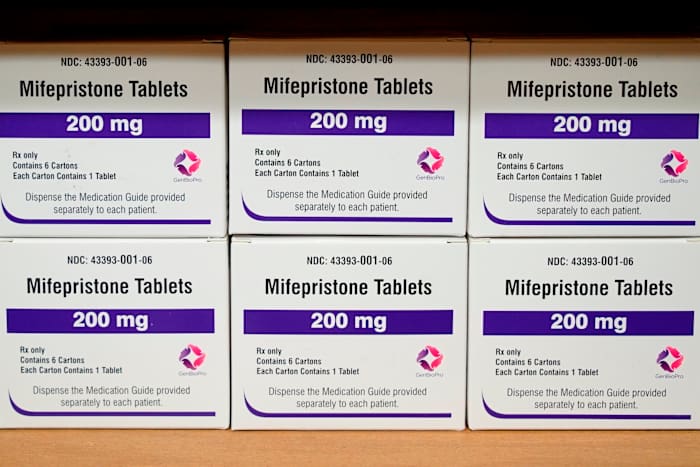


WASHINGTON – In a significant decision on Thursday, the Supreme Court safeguarded the availability of a key abortion medication, maintaining access for women while ongoing legal battles unfold.
The ruling ensures that mifepristone, a drug commonly used in abortion procedures, remains accessible to women via pharmacies or mail without needing a face-to-face consultation with a healthcare provider. This accessibility is expected to persist well into the next year as the legal process, possibly reaching the Supreme Court, continues.
The justices responded to urgent appeals from mifepristone manufacturers who are contesting a federal appellate court’s decision mandating in-person doctor visits and prohibiting mail delivery of the drug. The FDA, which approved mifepristone for abortion use two decades ago, eliminated the in-person requirement five years prior.
Advocates against abortion, discontent with the pace of the Trump administration, are urging the FDA to expedite its review process, hoping for tighter controls on mifepristone, including restricting its use through telemedicine. The administration, however, insists that these procedures require time.
Earlier in the week, Marty Makary, the FDA Commissioner, stepped down following sustained criticism from political allies of Trump, which included those opposed to abortion.
Groups such as Susan B. Anthony Pro-Life America had pressed Trump to dismiss Makary over what they viewed as sluggish progress in reviewing mifepristone.
The court is dealing with its latest abortion controversy four years after its conservative majority overturned Roe v. Wade and allowed more than a dozen states to effectively ban abortion outright.
The case before the court stems from a lawsuit Louisiana filed to roll back the Food and Drug Administration’s rules on how mifepristone can be prescribed. The state claims that the policy undermines the ban there, and it questions the safety of the drug, which has repeatedly been deemed safe and effective by FDA scientists.
Lower courts concluded that Louisiana is likely to prevail, and a three-judge panel of the 5th U.S. Circuit Court of Appeals ruled that mail access and telehealth visits should be suspended while the case plays out.
The drug is most often used for abortion in combination with another drug, misoprostol. Medication abortions accounted for nearly two-thirds of all abortions in the U.S. in 2023, the last year for which statistics are available.
The current dispute is similar to one that reached the court three years ago.
Lower courts then also sought to restrict access to mifepristone, in a case brought by physicians who oppose abortion. They filed suit in the months after the court overturned Roe.
The Supreme Court blocked the 5th Circuit ruling from taking effect over the dissenting votes of Justices Samuel Alito and Clarence Thomas. Then, in 2024, the high court unanimously dismissed the doctors’ suit, reasoning they did not have the legal right, or standing, to sue.
In the current dispute, mainstream medical groups, the pharmaceutical industry and Democratic members of Congress have weighed in cautioning the court against limiting access to the drug. Pharmaceutical companies said a ruling for abortion opponents would upend the drug approval process.
Debate over the safety of mifepristone has churned for more than 25 years. The FDA has eased a number of restrictions initially placed on the drug, including who can prescribe it, how it is dispensed and what kinds of safety complications must be reported.
Despite those determinations, anti-abortion groups have filed a series of petitions and lawsuits against the agency, generally alleging that it violated federal law by overlooking safety issues with the pill.
Trump’s administration has been unusually quiet at the Supreme Court. It declined to file a written brief recommending what the court should do, even though federal regulations are at issue.
The case puts the administration in a difficult place. Trump has relied on the political support of anti-abortion groups but has also seen ballot question and poll results that show Americans generally support abortion rights.
Both sides took the administration’s silence as an implicit endorsement of the appellate ruling.
___
Mulvihill reported from Haddonfield, N.J.
___
Follow the AP’s coverage of the U.S. Supreme Court at