RHONE GLACIER – Climate change appears to be making some of Switzerland’s vaunted glaciers look like Swiss cheese: Full of holes.
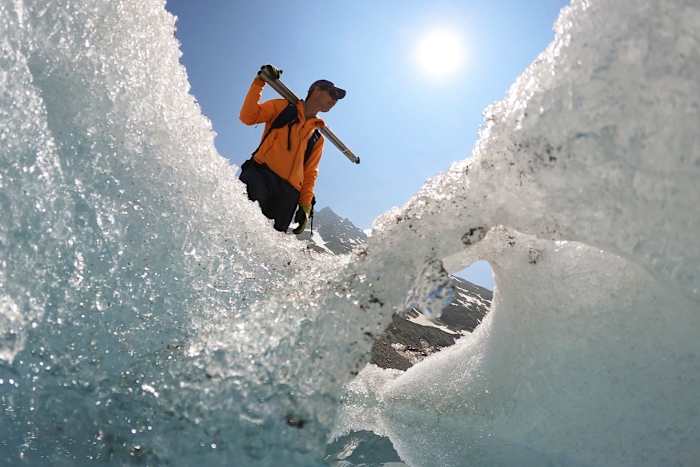
Matthias Huss from the glacier monitoring team called GLAMOS provided insights into the Rhone Glacier, which is crucial as it supplies the river sharing its name. This river travels through Switzerland and France, eventually reaching the Mediterranean. He relayed these observations to The Associated Press while on a summer expedition aimed at assessing the glacier’s condition.
Switzerland’s glaciers attracted global attention last month after a mudslide from the Alps covered the southwestern village of Blatten. This incident occurred when the Birch Glacier, which had been holding back rocks near the summit, collapsed and triggered an avalanche that descended into the valley. Thankfully, the village was evacuated in advance.
Experts say geological shifts and, to a lesser extent global warming, played a role.
Switzerland, renowned for having more glaciers than any other European nation, has experienced a glacier retreat since about 170 years ago, which showed fluctuating patterns until the 1980s, Matthias noted. However, since then, the retreat has been consistent, with 2022 and 2023 witnessing the most severe declines. Although last year saw some slight improvements, he added.
“Now, this year also doesn’t look good, so we see we have a clear acceleration trend in the melting of glaciers,” said Huss, who also is a lecturer at the Federal Institute of Technology in Zurich, ETHZ, said in beaming sunshine and with slushy ice dripping underfoot.
Less snow and more heat create punishing conditions
The European Union’s Copernicus climate center said last month was the second-warmest May on record worldwide, although temperatures in Europe were below the running average for that month compared to the average from 1991 to 2020.
Europe is not alone. In a report on Asia’s climate released Monday, the U.N.’s World Meteorological Organization said reduced winter snowfall and extreme summer heat last year “were punishing for glaciers” — with 23 out of 24 glaciers in the central Himalayas and the Tian Shan range suffering “mass loss” in 2024.
A healthy glacier is considered “dynamic,” by generating new ice as snow falls on it at higher elevations while melting at lower altitudes: The losses in mass at lower levels are compensated by gains above.
As a warming climate pushes up the melting to higher altitudes, such flows will slow down or even stop altogether and the glacier will essentially become “an ice patch that is just lying there,” Huss said.
“This is a situation we are seeing more and more often on our glaciers: That the ice is just not dynamic anymore,” he said. “It’s just resting there and melting down in place.”
This lack of dynamic regeneration is the most likely process behind the emergence and persistence of holes, seemingly caused by water turbulence at the bottom of the glacier or air flows through the gaps that appear inside the blocks of ice, Huss said.
“First the holes appear in the middle, and then they grow and grow, and suddenly the roof of these holes is starting to collapse,” he said. “Then these holes get visible from the surface. These holes weren’t known so well a few years ago, but now we are seeing them more often.”
Such an affected glacier, he said, “is a Swiss cheese that is getting more holes everywhere, and these holes are collapsing — and it’s not good for the glacier.”
Effects felt from fisheries to borders
Richard Alley, a geosciences professor and glaciologist at Penn State University, noted that glacier shrinkage has wide impacts on agriculture, fisheries, drinking water levels, and border tensions when it comes to cross-boundary rivers.
“Biggest worries with mountain glaciers may be water issues — now, the shrinking glaciers are supporting summertime (often the dry season) flows that are anomalously higher than normal, but this will be replaced as glaciers disappear with anomalously low flows,” he said in an email.
For Switzerland, another possible casualty is electricity: The Alpine country gets the vast majority of its power through hydroelectric plants driven from its lakes and rivers, and wide-scale glacier melt could jeopardize that.
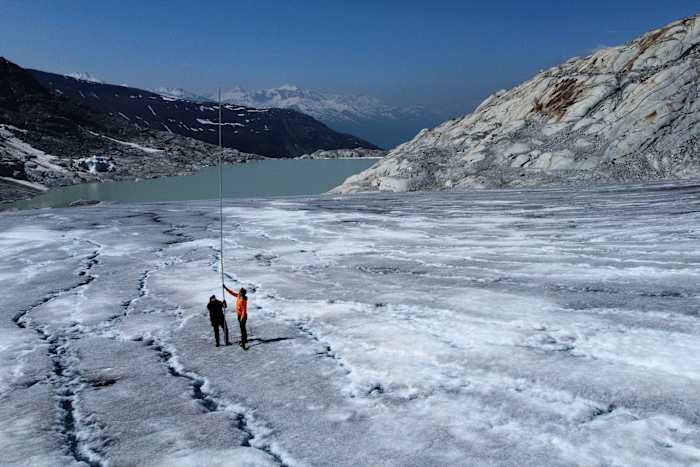
With a whirr of a spiral drill, Huss sends ice chips flying as he bores a hole into the glacier. Then with an assistant, he unfurls a jointed metal pole — similar to the basic glacier-monitoring technology that has existed for decades — and clicks it together to drive it deep down. This serves as a measuring stick for glacier depth.
“We have a network of stakes that are drilled into the ice where we determine the melting of the mass loss of the glacier from year to year,” he said. “When the glacier will be melting, which is at the moment a speed of about 5 to 10 centimeters (2-4 inches) a day, this pole will re-emerge.”
Reaching up over his head — about 2.5 meters (8 feet) — he points out the height of a stake that had been drilled in in September, suggesting that an ice mass had shrunk by that much. In the super-hot year of 2022, nearly 10 meters of vertical ice were lost in a single year, he said.
Some glaciers have gone for good
The planet is already running up against the target cap increase of 1.5 degrees Celsius in global temperatures set in the Paris Climate Accord of 2015. The concerns about global warming that led to that deal have lately been overshadowed by trade wars, conflicts in Ukraine and the Middle East and other geopolitical issues.
“If we manage to reduce or limit global warming to 1.5 degrees, we couldn’t save this glacier,” Huss said, acknowledging many Swiss glaciers are set to disappear in the future. As a person, Huss feels emotion. As a glaciologist, he is awestruck by the speed of change.
“It’s always hard for me to see these glaciers melting, to even see them disappearing completely. Some of my monitoring sites I’ve been going to for 20 years have completely vanished in the last years,” he said. “It was very sad — if you just exchange this beautiful, shiny white with these brittle rocks that are lying around.”
“But on the other hand,” he added, “it’s also a very interesting time as a scientist to be witness to these very fast changes.”
___
Keaten reported from Geneva.
___
The Associated Press’ climate and environmental coverage receives financial support from multiple private foundations. AP is solely responsible for all content. Find AP’s standards for working with philanthropies, a list of supporters and funded coverage areas at AP.org.
Copyright 2025 The Associated Press. All rights reserved. This material may not be published, broadcast, rewritten or redistributed without permission.