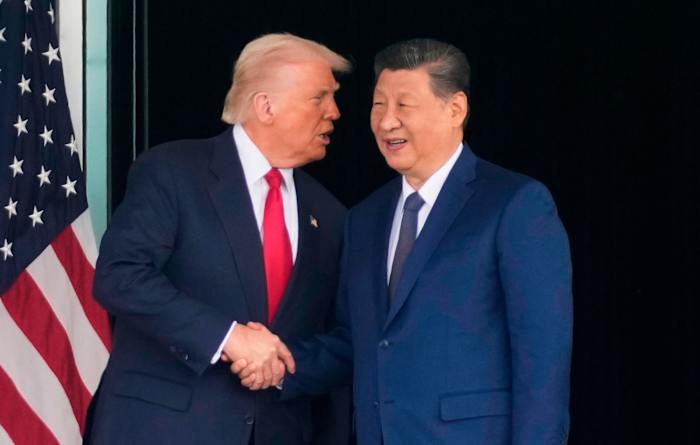


WASHINGTON – President Donald Trump asserts that the United States has been reaping substantial benefits from its trade relationship with China. He downplays the significant tensions surrounding rare earth materials, tariffs, and new technologies like artificial intelligence, which have the potential to disrupt ties between the globe’s two largest economies.
On Tuesday, Trump is set to travel to Beijing for a summit with Chinese President Xi Jinping. This meeting might be the first of four planned encounters between the two leaders this year.
“We’re engaged in significant business activities with China and generating considerable profits,” Trump remarked last week. “Our financial gains are substantial compared to previous times.”
The main focus of the summit is to maintain the economic partnership, with only minor policy updates anticipated. It is expected that the trade ceasefire agreed upon last October will be prolonged. Additionally, China might unveil initiatives to purchase American products such as soybeans, beef, and Boeing aircraft. U.S. representatives have hinted at establishing a Board of Trade to ensure ongoing dialogue on economic matters.
According to Brett Fetterly, a managing principal at The Asia Group, some within the Trump administration believe that ensuring stability and fostering ongoing dialogue are more critical than specific deliverables. This approach aims to enhance domestic resilience and pave the way for future agreements.
While continued dialogue is a crucial first step in addressing U.S.-China competition, challenges such as reciprocal tariffs, advancements in AI and electric vehicles, and the conflict in Iran could potentially destabilize relations.
China and the US are buying less from each other
Despite Trump’s claims about making money, China bought nearly $50 billion less in American products last year than it did in 2022, according to U.S. Census Bureau data.
Some of that decrease reflects Beijing stopping soybean purchases during last year’s trade war. The Trump administration has made clear that it wants to support American farmers and factories by having China import more from the U.S., with the goal of further narrowing a trade imbalance that totaled $202 billion last year.
The United States also now imports more goods from Taiwan than China, a change provoked in part by the AI race that has U.S. firms buying computer chips and servers from the self-governing island.
But going back to Trump’s first term, China also began to route its U.S.-bound products through other Asian countries, while American companies shifted supply chains for computers and other electronics to Vietnam and India.
China’s share of goods imported to the U.S. has fallen from 22% at the start of Trump’s first term in 2017 to just 7.5% in the first three months of this year, according to government data analyzed by Chad Bown, a senior fellow at the Peterson Institute for International Economics and co-author of the book “How to Win a Trade War.”
The US wants a board to guide trade with China
U.S. Trade Representative Jamieson Greer has said he “highlighted” in an April 30 call with Chinese Vice Premier He Lifeng the value of a “new government-to-government Board of Trade.”
Greer indicated the board could improve trade in goods without national security concerns. That could mean agricultural products, for instance, but not computer chips or other sensitive technology.
The initiative could make it easier to resolve trade disputes and help American efforts to sell more to China. It might help prevent a repeat of last year when Trump hiked tariff rates on Chinese goods by 145%, before finalizing a truce in an October meeting with Xi in South Korea.
The board also would give the Trump administration an alternative to severe tariff hikes, which have become a logistical and legal problem. The Supreme Court ruled that Trump lacked the authority to unilaterally impose many of last year’s tariffs, while his temporary replacement tariffs that followed were deemed illegal by a federal court last week.
The Trump administration says the U.S. and China would need to get sign-off at home to create the board that could manage tens of billions of dollars in trade. Administration officials also would like to create an investment forum to discuss financing of operations in each country.
Traveling to China as part of the U.S. delegation are some 17 CEOs, including Tesla’s Elon Musk, Apple’s Tim Cook and Boeing’s Kelly Ortberg, the White House says.
Washington and Beijing have different goals
In some ways, Trump’s and Xi’s governments have been talking past each other. Trump assumes America can keep its edge on AI, so he judges the trade imbalance as the big issue to solve. But Xi sees a world disrupted by climate change and the Iran war, shifts that could give a boost to Chinese technologies such as solar panels and EVs.
“Washington and Beijing are competing at different levels and different domains, with different theories of victory,” said Michael Sobolik, a senior fellow specializing in U.S.-China relations at the Hudson Institute, a conservative think tank. “President Trump leveraged tariffs not as a weapon against China but as leverage to secure a trade deal. Xi Jinping is angling to win a cold war with the United States.”
The U.S.-Israel war against Iran also is leading to an inflection point on energy, said Ali Wyne, a senior research and advocacy adviser on U.S.-China relations at the International Crisis Group.
The Trump administration is banking on the world continuing to rely on oil and natural gas, whereas China sees the price spikes following the disruption to energy shipments in the Strait of Hormuz as supporting a green energy transition that favors its industrial strategy.
“The structural frictions between the United States and China, they are growing in number and severity,” Wyne said.
The tensions beneath the sunny talk
Several potential strains could easily upset the cheery talk of friendship — raising questions about whether any meaningful progress can be made at the summit on issues like:
— China’s control of the majority of rare earth mining and almost all of the processing for those minerals widely needed for electronics. The Trump administration is trying to develop its own rare earths production with new partnerships and investments in companies, a strategy that would unfold over several years.
— The U.S. push to limit China’s access to the most advanced computer chips. These chips, designed by companies such as Nvidia and AMD, have the processing power to further develop AI.
— China’s dominance as an automaker. Its worldwide exports of vehicles increased 21% last year, according to the China Association of Automobile Manufacturers. China can sell EVs at a much cheaper price than automakers in the U.S., Germany, Italy, Japan and South Korea.
— Tariffs. After the Supreme Court struck down Trump’s tariffs, the administration launched national security investigations under a provision of the Trade Act of 1974 to impose new tariffs based on excess industrial capacity and efforts to prevent slave labor that could potentially withstand legal scrutiny.
— U.S. sanctions on a Chinese oil refinery and dozens of tankers and shippers for involvement in transporting Iranian oil. Beijing responded to the action earlier this month by demanding that no one abide by the U.S. penalties against Chinese businesses. The countries also are jousting over management of the Panama Canal.


