

Recent developments have seen Ukrainian drone strikes targeting refineries, depots, and pipelines, with tanker trucks set ablaze along the critical land corridor from Russia to Crimea. This has led to long lines at gas stations as motorists wait to refuel, highlighting a growing fuel crisis.
Kyiv’s strategic moves have dealt a significant blow to the Kremlin’s narrative of victory in the ongoing conflict in Ukraine. By disrupting the supply lines to Crimea, Ukrainian forces have triggered the most severe fuel crisis on the Black Sea peninsula since Russia’s controversial annexation in 2014.
The relentless nature of these attacks underscores the increasing effectiveness and precision of Ukraine’s drone operations, leaving Russian forces scrambling for an adequate response.
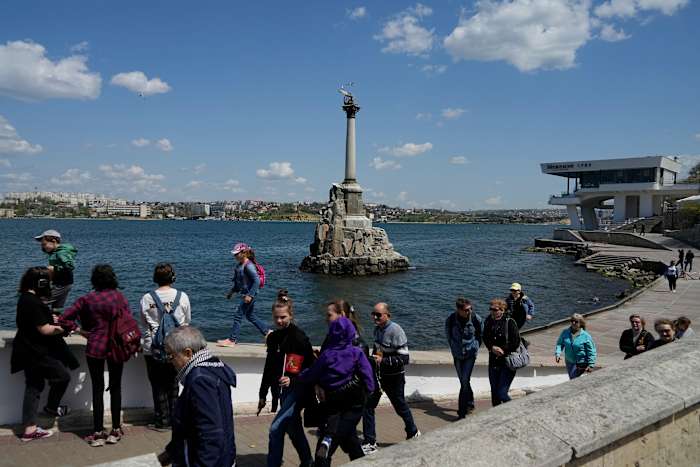
This crisis comes at a particularly sensitive time, coinciding with Russia Day on Friday, which marks the beginning of the summer vacation season. The fuel shortages threaten to disrupt a region heavily reliant on tourism, with its popular beaches and resorts now facing the prospect of reduced visitor numbers.
In a notable admission, the Kremlin has publicly acknowledged the scale of the crisis and has pledged swift action to resolve the fuel shortages.
Ukraine’s recent successes not only demonstrate its capability to deliver significant blows to Russia but also suggest a potential shift in the dynamics of the conflict. As of Thursday, the conflict has entered its 1,569th day, surpassing the duration of World War I, while Russia’s military progress appears to have stalled.
Crimea’s importance to Russia
Crimea has been a jewel in Russia’s imperial crown since it was seized from Turkic-speaking Tatars in the 18th century after Moscow defeated the Ottoman Empire.
Soviet leader Nikita Khrushchev transferred Crimea from Russia to Ukraine in 1954 when both republics were part of the USSR. When the Soviet Union collapsed in 1991, the diamond-shaped peninsula became part of newly independent Ukraine.
Russia kept a naval base in Sevastopol, and when a Moscow-friendly Ukrainian president was ousted by a popular uprising in February 2014, Russian President Vladimir Putin sent in troops to overtake Crimea. Weeks later, Moscow annexed the peninsula following a referendum that most of the world refuses to recognize.
Soon afterward, a Moscow-backed separatist insurgency erupted in eastern Ukraine, and fighting there raged with varying intensity until the February 2022 invasion. Russian troops concentrated in Crimea quickly seized large parts of southern Ukraine early in the war and secured the land route to the peninsula.
Since early in the war, Ukraine has fired missiles and drones to try to dislodge Moscow’s hold on the territory. The Ukrainian military sank several Russian warships in the Black Sea and at their Crimean bases, crippling Moscow’s naval capability and forcing it to redeploy its fleet to Novorossiysk.
Ukraine also methodically targeted munitions depots, airfields and Putin’s prized asset, the Kerch Bridge linking Crimea to Russia. The span was struck by a truck bomb in October 2022 that killed five people, blew up two sections of the bridge and required months of repairs. More attacks on the bridge followed in 2023 and 2025.
Ukraine’s attacks on the land corridor to Crimea
Sine the Kerch Bridge attacks, Russia has channeled most fuel and other supplies along the highway and railroad via the occupied territories along the Sea of Azov coast. Those shipments were interrupted last month, when Ukrainian drones hit fuel trucks on the highway that Moscow once deemed to be safe, leaving behind dozens of burning vehicles.
Other relentless Ukrainian strikes hit refineries, oil depots and pipelines deep inside Russia, hurting its oil exports and causing domestic fuel shortages.
The Washington-based Institute for the Study of War noted the synergy between the longer-range attacks and those disrupting supplies to Crimea and other occupied regions.
“The long-range strike campaign is therefore reducing Russia’s production capacity, while the midrange strike campaign is hurting Russia’s ability to transport the gasoline Russia is still able to produce,” it said in an analysis.
Making maters worse, Ukrainian drones this week repeatedly hit the Chonhar Bridge, which links mainland Ukraine and Crimea over a shallow strait. Authorities deployed pontoon bridges.
The Ukrainian military said it struck the bridge to disrupt movement of troops, ammunition and fuel from Crimea.
Queues and gas rationing
It’s not immediately clear how the fuel disruptions will affect Russian military operations, but residents of Crimea and other occupied territories are keenly feeling the blow.
The peninsula has had periodic fuel shortages from Ukrainian strikes before, but this crisis is the worst since its 2014 annexation.
At the end of May, authorities restricted the sale of gasoline to 20 liters (5 1/3 gallons) per vehicle owner per week using prepaid coupons. Those were snapped up immediately following their release on an official messaging app channel, and motorists lined up for hours, waiting to refuel.
Social networks have been abuzz with requests and advice on where to find fuel, and authorities launched a hotline for tourists who have found themselves trapped.
While fuel shipments over the Kerch Bridge long has been suspended for security reasons since the Ukrainian attacks, fuel also has been carried by ferries. Those shipments are expected to increase.
Some motorists bring their own gas over the bridge from the mainland, but they are restricted to carrying 100 liters (about 26 1/2 gallons) per vehicle. Some speculators are selling gas at double the market price.
Crimea attracted nearly 7 million tourists last year, and it had hoped to top that number this year. The business daily Kommersant reported that nearly 80% of hotel bookings were canceled in late May and early June.
Some hotels offered gasoline as a bonus for new bookings, offers that were quickly snapped up.
Some travelers were unsettled by a Ukrainian drone attack earlier this week on a passenger train traveling from Moscow to Crimea, injuring its driver and killing his assistant. That led to a brief suspension of service, with passengers taken by buses.
An earlier attack on a commuter train in Crimea killed one person and injured three others, forcing authorities to shift schedules to limit service during daytime hours.
Kremlin pledges action
Kremlin spokesman Dmitry Peskov acknowledged the Crimean fuel shortages earlier this week and promised that “measures were being taken” to deal with them.
The Russian Defense Ministry has been silent about the Ukrainian attacks on the land corridor, while some war bloggers have harshly criticized the military for failing to anticipate the strikes and its slow response.
Some suggested military escorts for fuel trucks while others urged stepping up strikes on Ukrainian bridges, fuel storage sites and other infrastructure.
Amid the fuel crisis and the finger-pointing, Ukraine dealt another symbolic blow to Russia, striking a historic Sevastopol building that houses a huge panoramic painting that depicts the defense of the city during the 19th century Crimean War. The painting was effectively destroyed by fire during the attack, according to Mikhail Razvozhayev,, the Kremlin-appointed head of Crimea’s largest city.
Given Putin’s focus on Crimea, military blogger Valery Shiryayev said, the attack would certainly anger the Russian leader.
“It’s hard to find another work of art, another part of national heritage, whose destruction would be as painful for Putin,” he said.


