
MONTPELIER, Vt. – Vermont has made history as the first state in the nation to ban paraquat, a widely used herbicide that lawmakers and health advocates have scrutinized over concerns about a possible connection to Parkinson’s disease.
Supporters of the measure are hailing the decision as a major public health milestone. They hope Vermont’s action will encourage other states to reconsider use of the chemical as part of broader efforts to reduce risks tied to Parkinson’s, a neurological disorder that affects movement and impacts roughly 1 million people in the United States.
“Vermont took the step to be the leader in this, and that’s significant because it shifts the conversation,” said Dan Feehan of The Michael J. Fox Foundation, the world’s largest nonprofit funder of Parkinson’s research. “Now, ‘will your state be the last to ban it?’ becomes the question.”
The move is not without controversy. Some farmers warn that losing access to paraquat could put additional pressure on already narrow profit margins, particularly in places where the herbicide plays a larger role in crop management. Similar efforts to restrict or ban the chemical in other states have struggled to gain traction.
At the federal level, the U.S. Environmental Protection Agency is continuing to review paraquat’s safety. The agency has previously said there is no clear link between the herbicide and Parkinson’s disease.
Syngenta, the Swiss chemical company that has long manufactured paraquat, announced earlier this year that it would stop producing or selling the herbicide worldwide. Even so, the company has continued to defend the product’s safety. Other manufacturers still sell paraquat.
“Despite decades of investigation and more than 1,200 epidemiological and laboratory studies of paraquat, no scientist or doctor has ever concluded in a peer-reviewed scientific analysis that paraquat causes Parkinson’s disease,” the company said.
Paraquat remains widely used in the U.S., though it has been banned in China and Europe.
First introduced in the U.S. in 1964, paraquat became a popular weed killer for farmers.
It’s known as an extremely toxic chemical that is fatal if ingested and can cause chronic health problems on contact. Farmworkers are at particular risk, which has led the EPA to require special training for certified applicators of paraquat. The roughly hourlong training requires applicators to pass a 15-question quiz, and must be completed every three years.
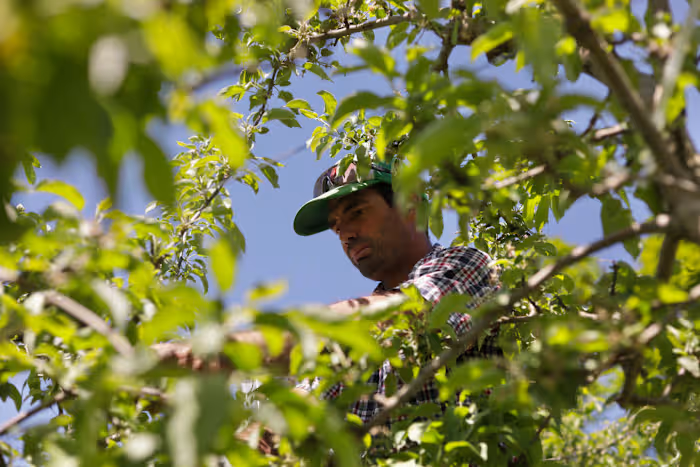
It’s commonly used for protecting soybean, cotton and corn crops, but also for apples and grapes, according to the United States Geological Survey. As of 2018, the USGS reported more than 10 million pounds (4.5 million kilograms) of paraquat was used in the U.S., largely concentrated in the South, Midwest and California.
Despite its popularity, dozens of countries have banned the substance. The European Union and the UK banned paraquat in 2007. China banned domestic use of paraquat in 2017, along with Vietnam and Malaysia. Thailand issued a similar ban in 2019.
Health risks and links to Parkinson’s
Defenders of using paraquat say the chemical is quickly absorbed by weeds, meaning that if rain falls — even after 30 minutes of application — it won’t wash off into the soil. Companies like Syngenta say paraquat becomes immobilized once it touches soil. Yet there’s disagreement over its harmful effects, with the Parkinson’s community warning that people living near where paraquat is applied have increased risk of getting the disease.
Whether it causes Parkinson’s disease has been heavily debated and studied for years.
Dr. Philip Landrigan, an epidemiologist who directs a global health program at Boston College and has campaigned against human exposure to toxic chemicals, said multiple studies have shown that environmental factors, including exposure to pesticides like paraquat, can increase the risk for Parkinson’s disease.
The Parkinson’s community considers the Vermont ban a significant victory.
“No matter how you slice and dice it, there’s no safe way to use paraquat,” said Ron McConnell, a Vermonter who was diagnosed with Parkinson’s after getting exposed to a different toxic substance at his work in 2017. “This law that Vermont just passed really is protecting the farmers that use it and the farmworkers that use it.”
The ban goes into effect Nov. 1, but the statute gives farmers using paraquat on fruit-producing orchards, berries and small fruit crops until 2030 to transition away from using the herbicide.
Vermont farmers are bracing for changes
Greg Burtt, owner of a family apple orchard and Republican Vermont lawmaker, considers paraquat a “critical tool” in his operation.
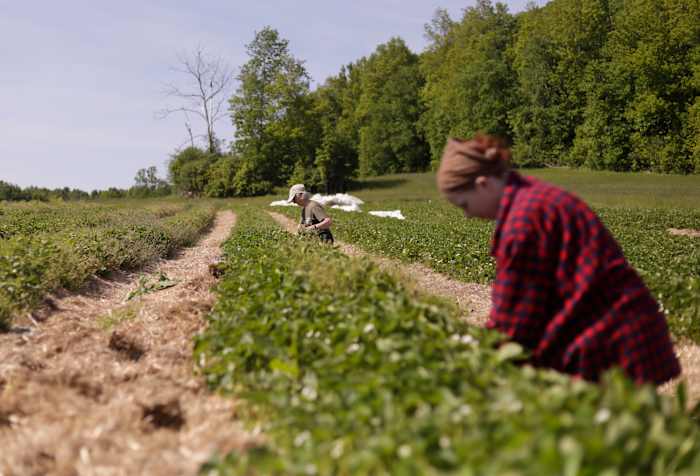
He says he believes the ban will place farmers like him at a competitive disadvantage to growers in other states who can continue using the more budget-friendly paraquat. There are alternative herbicides, but some farmers warn that those could involve chemicals that risk killing the plant if not applied carefully. Mechanical tilling, crop rotation and hand weeding are also options, but come with separate downsides, notably increased labor costs.
“There’s a reason why it’s an industry standard,” said Burtt, who’s used paraquat for 20 years.
He’s not worried about getting Parkinson’s because he interpreted the research on the herbicide to be inconclusive.
“I wanna be the first person to make sure that it’s safe because I don’t wanna die young over farming,” Burtt said. “And so if anybody’s had to wrestle with these questions, it’s me.”
___
Kruesi reported from Providence, Rhode Island.