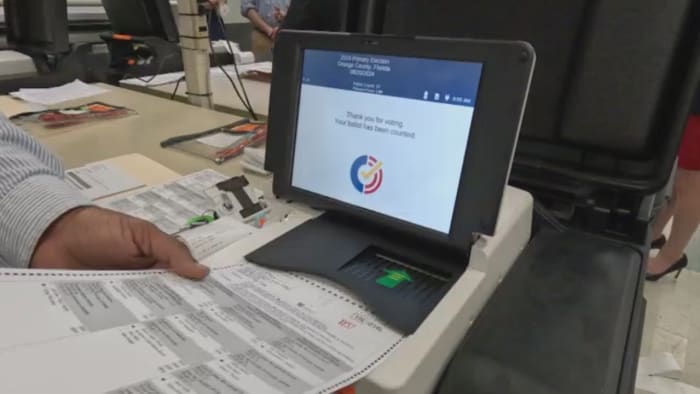


ORLANDO, Fla. — Before Floridians cast their ballots in November’s midterm election, they will first take part in another major contest: the statewide primary on Aug. 18.
The primary ballot will feature party races for several high-profile offices, including U.S. Senate, U.S. House, governor, cabinet positions and seats in the Florida Legislature.
Voters will also weigh in on nonpartisan contests, such as school board races. In some counties, county commission elections are also nonpartisan. Those races are open to all registered voters, no matter their party affiliation.
Party primaries work differently. In Florida, voters must be registered with a political party to take part in that party’s primary because the state uses a closed primary system.
Primaries are held when more than one candidate from the same party is seeking the same office. In the governor’s race, for example, 11 Republicans are competing for their party’s nomination.
Unlike some states that allow broader participation in primary elections, Florida limits voters to their own party’s ballot. That means Democrats can vote only in Democratic primaries, Republicans only in Republican primaries, and members of other parties follow the same rule.
Still, if you want to vote in a specific party primary, you just change your party affiliation.
You can do this up to 29 days before any election. For the statewide primary on Aug. 18, the deadline to change your party affiliation would be July 20.
To change your party affiliation, go to RegistertoVoteFlorida.gov and update your voter registration information.
You will need a Florida driver’s license or state ID to do so.
You can also contact your county supervisor of elections office.
Why it matters
Say you live in a district where the majority of voters lean toward one political party over another. An incumbent is facing a party primary, and whoever wins that primary will face candidates who are not likely to win given the district’s demographics.
Being able to vote in the primary gives you more of a say over who will take that political office.
A good example is the 2020 election for Orange-Osceola State Attorney. The race had a crowded field of Democrats and one lesser-known No Party Affiliate candidate. The odds were pretty good that a Democrat was going to win in the general election, given the demographics in the two counties.
Monique Worrell won the Democratic primary for Orange-Osceola state attorney and went on to win the general election.
Only Democratic voters got to pick which candidate would face the NPA candidate in November and likely win the general election.
If an election is important to you, you may want to choose a political party before the primary in order to have more of a say.
The loophole
There is a way to open a party primary to all voters.
If you have an election where only people from one political party have decided to run for an office, the election becomes open to every voter. This is called a universal primary.
The winner of this universal primary wins the office they were campaigning for.
This happens occasionally with state legislature or county seats.
But there is a loophole that closes a primary: get a write-in candidate to run for that election.
It costs a write-in candidate nothing to run; their name doesn’t even go on the ballot. But since there is a candidate with a different political affiliation in the race, there will be no universal primary, only primaries open to political party members.
This tactic has been used by some factions to close voters out of elections. As election officials have pointed out before, statistically, write-in candidates don’t win in county, state or federal elections, and many even drop out of the race before election day.
There have been several reports in recent years where write-in candidates with ties to a party candidate will run, thus insulating that candidate from the wider community of voters with a closed primary race.
Despite calls over the last few years to close the write-in loophole, Florida lawmakers have not done anything about it.
Again, if you wish to vote in a party primary this August, you have until July 20 to change your party affiliation. Head to Register to Vote Florida.gov to update your registration.


