

BUNDIBUGYO — When Ebola strikes, some patients head straight to the nearest hospital. Others turn first to traditional healers, a choice that can have tragic consequences.
For many, the early signs of the hemorrhagic fever are seen not as a medical emergency but as a spiritual attack, prompting them to seek herbs, prayers and ritual treatment instead of professional care. That pattern is playing out again in Congo, now facing its 17th Ebola outbreak since the virus was first identified in 1976 in the Congo Basin.
Nearly 50 years on, Ebola still leaves many communities confused and fearful, while pastors and other religious figures are often thrust into the front lines of the response. Humanitarian workers and others who spoke to The Associated Press said the latest outbreak has infected not only unprotected health workers, but also clergy and worshippers who continued gathering as the virus spread.
Ebola is transmitted through close contact with the bodily fluids of infected people, including those who have died from the disease. The current outbreak is especially alarming in an area where deep mistrust of the health system has led many residents to avoid clinics and hospitals.
In Bunia, the epicenter of the outbreak in Ituri province, false information has complicated efforts to contain a disease that has already killed at least 181 people. Among the rumors circulating is a claim that Ebola is spread by ill-intentioned individuals who leave magical charms attached to dollar bills in pit latrines.
“Some people still describe Ebola as something mysterious, spiritual, or brought by outsiders, rather than a disease that needs medical care,” said Onesphore Bangenza of the aid group Mercy Corps, speaking from Bunia. “When people do not trust the health system, they often go first to traditional healers, faith leaders, or people they already know. The danger is that many only reach the hospital when they are already very sick.”
Uncommon type of Ebola causing the outbreak
The current outbreak is caused by the Bundibugyo virus, a rare type of Ebola that has no approved medicines or vaccines to combat it. It is occurring in a remote area of Congo that also faces armed violence by rebel groups as well as displacement. Ebola intensifies the suffering, with its terrifying symptoms that evoke a modern-day plague.
The outbreak was confirmed on May 15. Some experts believe infections may have been occurring in February, but health officials initially tested for a different kind of virus that causes Ebola disease.
The World Health Organization quickly declared the event a public health emergency of international concern. The U.S. government has imposed a temporary ban on the entry of people without U.S. passports who have recently visited Congo, Uganda or South Sudan.
With so many people in afflicted communities seeking spiritual answers to the outbreak, humanitarian workers are urging religious leaders to get involved in combating Ebola.
In a video widely shared among people in Ituri, a catechist leader recently cured of the disease in the Ebola hot spot of Mongbwalu spoke candidly of the mistake that could have cost him his life.
“I don’t usually rush to the hospital, so I decided to go to the fields,” Deogratias Kasereka said, before explaining how his children compelled him to seek medical treatment.
His symptoms had included muscle weakness and headaches, and he “felt very hot.” Ebola in later stages also can bring about internal and external bleeding.
The symptoms are so disturbing — and sometimes shameful — that some victims prefer the privacy of a traditional healer’s shrine, said Vincent Isimbwa, an elder among Seventh-day Adventists in a remote community of Ugandans that faced the first-ever outbreak of Bundibugyo in 2007.
“They faced it so rough,” said Isimbwa. “The challenge with Ebola is that it is so bad that some people can believe that there are supernatural powers behind it.”
That outbreak of Ebola killed at least 36 people and left the community terribly scarred. Many here also regret that the Bundibugyo virus is named for their district, the mountainous homeland of roughly 200,000 people mostly living as farmers.
Mistrust and medical limitations drive sick people to healers
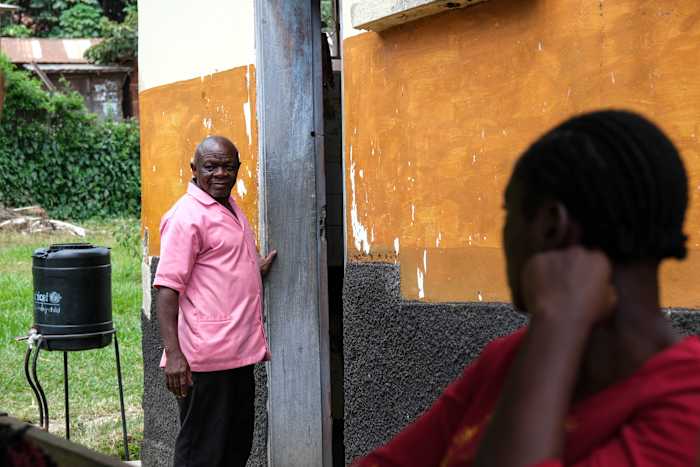
In Bundibugyo two decades later, the Ugandan nurse whose sample of blood confirmed the 2007 outbreak said his symptoms confused those who examined him in the early days of the outbreak. Some thought Samuel Kuule had a case of food poisoning. While others afflicted may have gone to see healers, described pejoratively as witch doctors, he was nursed in a narrow hospital room by caregivers including his pregnant wife, who was never infected.
Kuule recalled that his symptoms — peeling skin, bloodshot eyes and severe headache — terrified him without shaking his Seventh-day Adventist faith, unlike some others who may have felt they were being bewitched.
“For those who are weak in faith, they may (think) that they are being bewitched,” he said. “Maybe they can believe it.”
Some locals recalled that an early victim of the 2007 outbreak was a woman stretchered down the mountains and into the shrine of a traditional healer, an older man who survived but lost three sons to Ebola. Speaking through his presumptive heir, Amon Balinda, the healer said he switched his service from benediction and prayer to the prescription of herbs after he was told Ebola was spreading.
“For us in African traditional societies, in most cases when you fall sick and you go to the hospitals and they give you some injections and there is no improvement, there and then you switch to your neighbor, or anybody, and say maybe he is the one bewitching you,” he said. “Then you decide to go to the witch doctor.”
In fact, Ebola outbreaks are believed to start with the virus spilling over into humans from an infected animal such as a fruit bat. These cross-species infections often happen when people handle and eat wild meat, experts say.
The WHO is urging early testing for Ebola, in addition to isolating contacts in the current outbreak.
That’s challenging in communities with deep religious faith, Christian but especially traditional. People insist on burying the dead according to established custom, because to do otherwise may deprive the dead of an afterlife. Pastors who stake their authority on the ability to heal the sick are expected to perform. Traditional healers face similar hopes.
This is why Ugandan President Yoweri Museveni rebuked religious leaders in a recent televised speech, saying there was no need to touch the sick in the time of Ebola. He said that Tedros Adhanom Ghebreyesus, the WHO chief, told him while visiting Uganda that many victims in Congo are religious people.
“The pastors, the pastors, the pastors,” Museveni said, squinting in apparent disappointment. “The people of God — they are the ones who touch patients. … God is not deaf. You can pray without touching.”
___
Associated Press religion coverage receives support through the AP’s collaboration with The Conversation US, with funding from Lilly Endowment Inc. The AP is solely responsible for this content.