
CAIRO – Iran-backed Houthi rebels in Yemen claimed overnight that they had launched fresh attacks against neighboring Saudi Arabia, as Yemen’s Saudi-backed government called the group’s rapid advance along the Red Sea coast a “painful” setback on a new front in the Iran war.
The Houthis’ seizure in recent days of a key port city and an island near the Bab el-Mandeb Strait has raised alarm among markets and Yemeni civilians. The strategic waterway offers an important alternative shipping route to the Strait of Hormuz, while residents fear the developments could reignite Yemen’s devastating civil war.
The rebels said they carried out additional missile and drone strikes overnight against Saudi Arabia, which backs Yemen’s internationally recognized government in its fight against the Houthis.
Houthi military spokesperson Brig. Gen. Yahya Saree said in a statement that the group had targeted a military base in Sharurah province, in Saudi Arabia’s Najran region. He offered no evidence and did not specify when the alleged attack took place.
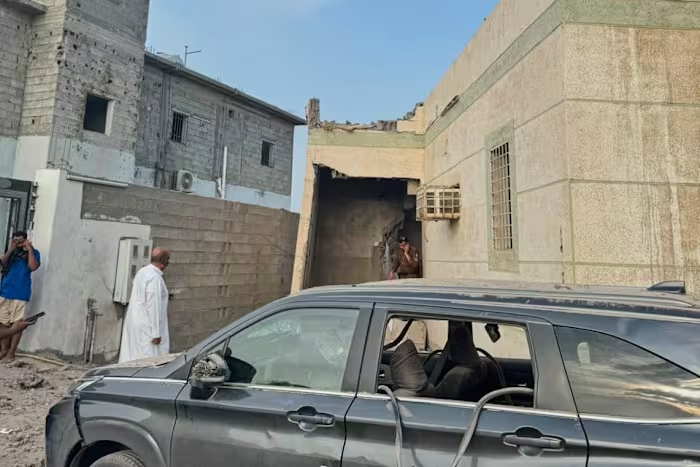
Saudi civil defense officials said overnight that a projectile landed in al-Tawwal governorate near the Yemen border along the Red Sea, injuring two people and damaging a mosque and several other buildings. The statement blamed the Houthis. It also reported that air-raid sirens sounded in Sharurah province, but gave no details of casualties or property damage there.
Saudi Arabia issued no statement Sunday about any new strikes against the Houthis, who have targeted Saudi oil facilities and shipping as part of a blockade declared recently.
Although the rebels insist that other commercial vessels are not at risk, uncertainty continues to weigh on markets, and oil prices have climbed again.
Yemen’s government vows to fight back
A senior Yemeni government official said the country’s forces would return to the Red Sea coast and counterattack. The pledge followed accounts from residents fleeing the Houthi advance, who told The Associated Press that government forces had withdrawn and urged civilians to escape.
Sultan al-Arada, a member of Yemen’s ruling presidential council, described the collapse of government forces in the port city of Mokha and other areas along the country’s western coast as “painful and regrettable.”
Al-Arada, who also serves as governor of central Marib province, said in a televised interview broadcast late Saturday that the forces were “currently regrouping and will return to the battle in one form or another.”
On Friday, a senior military official from Yemen’s internationally recognized government attributed the setbacks to a “lack of coordination” between the army and several allied militias, saying the failure had handed the Houthis “a priceless opportunity.”
The official, who spoke on condition of anonymity because he wasn’t allowed to speak to the media, also said they were stunned that the Saudi air force didn’t act to prevent the capture of Mokha, about 50 miles (80 kilometers) from the strait.
The rebels’ rapid advance has been a major setback both to Yemen’s internationally recognized government and Saudi Arabia, which have been battling the Houthis for 12 years. The latest escalation threatens a 2022 ceasefire.
The advance also puts the Iran-backed rebels just 20 miles (32 kilometers) from the U.S. military base in Djibouti, on the other side of the Bab el-Mandeb. It’s the main U.S. base in Africa and one of several foreign military bases in Djibouti, including those of China, France and Japan.
The small Horn of Africa nation is already seeing the arrival of Yemenis making the perilous crossing of the strait. More than 2,000 people have reached Djibouti, the International Organization for Migration said Sunday.
Djibouti’s Economy and Finance Minister Ilyas M. Dawaleh, said on X that the country’s navy, coast guard and other specialized agencies were conducting rescue operations and providing emergency assistance.
___
Associated Press writer Omar Farouk in Mogadishu, Somalia, contributed to his report.