
A controversial $25.1 billion plan would place more than 200 Coles and Woolworths supermarkets under public ownership, transforming them into government-operated grocery stores offering discounts of up to 30 per cent on essential items.
The proposal has been put forward by former Greens MP Max Chandler-Mather, once a prominent critic of Prime Minister Anthony Albanese. Chandler-Mather now leads the Green Institute, a public policy organisation aligned with the Greens.
He is calling on the Federal Government to introduce forced divestiture powers and establish a national supermarket chain, to be known as Fair Go Grocers. The scheme, he claims, could reduce the average family’s annual grocery bill by more than $3,000.
The proposed laws would give competition regulators or the courts the ability to require dominant companies to sell parts of their operations.
Under the Green Institute’s plan, the government would spend $25.1 billion over five years buying 200 Coles and Woolworths outlets, along with three distribution centres.
The investment would also fund the construction of 424 additional supermarkets and 10 more distribution centres in locations across Australia.
The proposal arrives as Labor faces growing voter anger over the cost of groceries. It also echoes New York Mayor Zohran Mamdani’s campaign for a network of publicly backed grocery stores designed to make food more affordable.
Chandler-Mather said Fair Go Grocers would provide a publicly owned alternative to Coles and Woolworths, with savings of up to 30 per cent on staples such as fresh produce, bread, milk and meat.

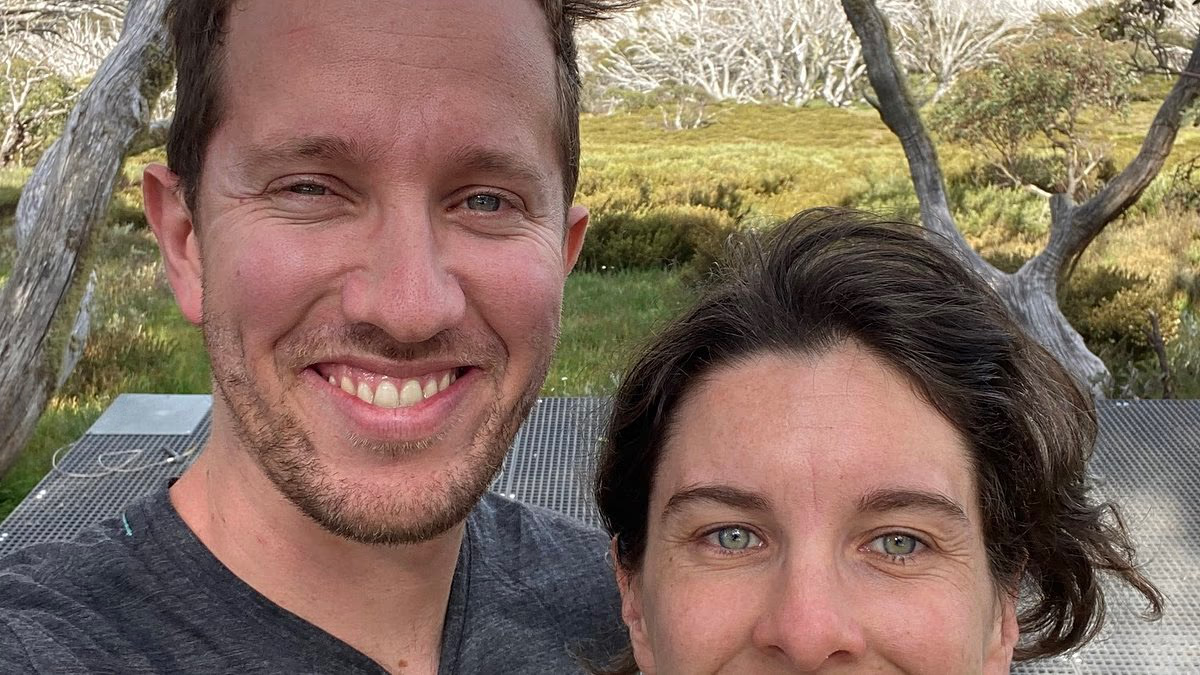
Former Greens MP Max Chandler-Mather (pictured) is proposing new forced divestiture powers to create a national supermarket chain called Fair Go Grocers

A recent poll found almost 80 per cent of Australians believed groceries had become less affordable over the past year, while 38 per cent said they had skipped meals or reduced how much they ate
Green Institute modelling estimates that shoppers would pay an average of 22 per cent less during each grocery trip.
Chandler-Mather said the cost-of-living crisis was forcing children to attend school hungry and families to miss meals, blaming Labor for allowing Coles and Woolworths to increase prices in pursuit of higher profits.
He argued that a nationwide network of publicly owned supermarkets could be created for roughly half the cost of one AUKUS submarine, while helping break the supermarket duopoly and providing long-term relief for millions of Australians.
“Australians are tired of being overcharged by profit-driven Coles and Woolworths while politicians in Canberra stand by as households struggle to put enough food on the table,” he said.
The plan was unveiled three months after Labor’s anti-price-gouging laws took effect. Chandler-Mather said those measures had not produced meaningful savings for shoppers at the checkout.
He accused the two major supermarket chains of price gouging and claimed public ownership could reduce costs by removing the need to generate profits from essential food sales.
“Small changes around the edges have not worked,” Chandler-Mather said.
CONTINUE READING: Prince Philip’s Alleged Love-Child Reaches Breaking Point After Uneasy Meeting with the Royals, Christopher Wilson Reports
“If governments want essentials to become more affordable, they need to remove the profit incentive through public ownership.”
He compared food with healthcare and education, arguing that Australians should have a publicly backed grocery option alongside services such as Medicare and state schools.

New York Mayor Zohran Mamdani (pictured) is advocating a network of city-backed grocery stores to help lower food prices for residents

Modelling shows a nationwide supermarket chain would save the average family more than $3,000 a year on groceries

Chandler-Mather, who earned a reputation as one of Anthony Albanese’s fiercest political opponents due to his regular jabs at the Prime Minister in Parliament
Join the discussion
Should the government step in and run supermarkets to make food more affordable for everyone?
A national YouGov poll cited by the Green Institute found 84 per cent of Australians would support publicly owned supermarkets if they reduced grocery prices by cutting out profit margins.
The same survey found 62 per cent of voters, including 53 per cent of One Nation supporters, said they would be more likely to vote for a party that backed the proposal.
It also found 79 per cent of Australians said it had become harder to afford groceries over the past year, while 38 per cent reported skipping meals or eating less because of rising food costs.
Fair Go Grocers would aim to capture 20 per cent of the supermarket market and become cost-neutral within five years, with store revenue funding operating costs including wages and inventory.
According to the proposal, eliminating shareholder dividends, executive salaries, profit margins and marketing costs would allow the chain to sell groceries at substantially lower prices than Coles and Woolworths.
The plan comes as new Green Institute research found Coles’ profits had risen 58 per cent since 2019, while Woolworths’ profits had increased 41 per cent, even as real wages fell six per cent.
The New Zealand Greens have also proposed nationalising 120 supermarkets and establishing a new publicly owned grocery chain.
The proposal has reignited debate over so-called divestiture powers, which would allow regulators to seek court orders forcing dominant companies to sell parts of their businesses if they were found to have misused their market power.
In 2024, Prime Minister Anthony Albanese rejected a similar proposal from the Greens, saying Australia was ‘not the old Soviet Union’ after the party sought to give the ACCC the power to apply to courts for break-up orders.


