
Share this @internewscast.com
Millions across the United States are currently facing air quality warnings as powerful winds stir up hazardous dust and particulate pollution, leading to critical health advisories.
The National Weather Service (NWS) and the South Coast Air Quality Management District (AQMD) have signaled that elevated levels of airborne dust will persist until 11 PM local time on Wednesday. This situation is impacting vast areas, including California’s Inland Empire, Orange County, coastal zones of Los Angeles County, and parts of Arizona.
Authorities caution that particle pollution, specifically PM-10, can infiltrate deep into the respiratory system, potentially provoking asthma attacks, exacerbating symptoms of heart and lung diseases, and elevating the risk of lung infections.
The warnings extend to numerous high-density urban areas such as Riverside, San Bernardino, Ontario, Moreno Valley, Fontana, Corona, Huntington Beach, Santa Ana, Anaheim, Irvine, Long Beach, Santa Monica, and Torrance, among others.
Health experts emphasize that while deteriorating air quality might affect everyone, the most vulnerable are children, seniors, expectant mothers, and individuals with pre-existing heart or lung conditions.
In Arizona, the Department of Environmental Quality (ADEQ) has released a high pollution alert for the Tucson metropolitan area, forecasting that strong, gusty winds will lead to extensive blowing dust throughout the region.
Residents are being advised to limit outdoor activity, keep windows and doors closed, and use air conditioners or air purifiers, while avoiding fans or coolers that pull in outside air.
Authorities also warned that conditions may change rapidly depending on wind speeds and local weather patterns.

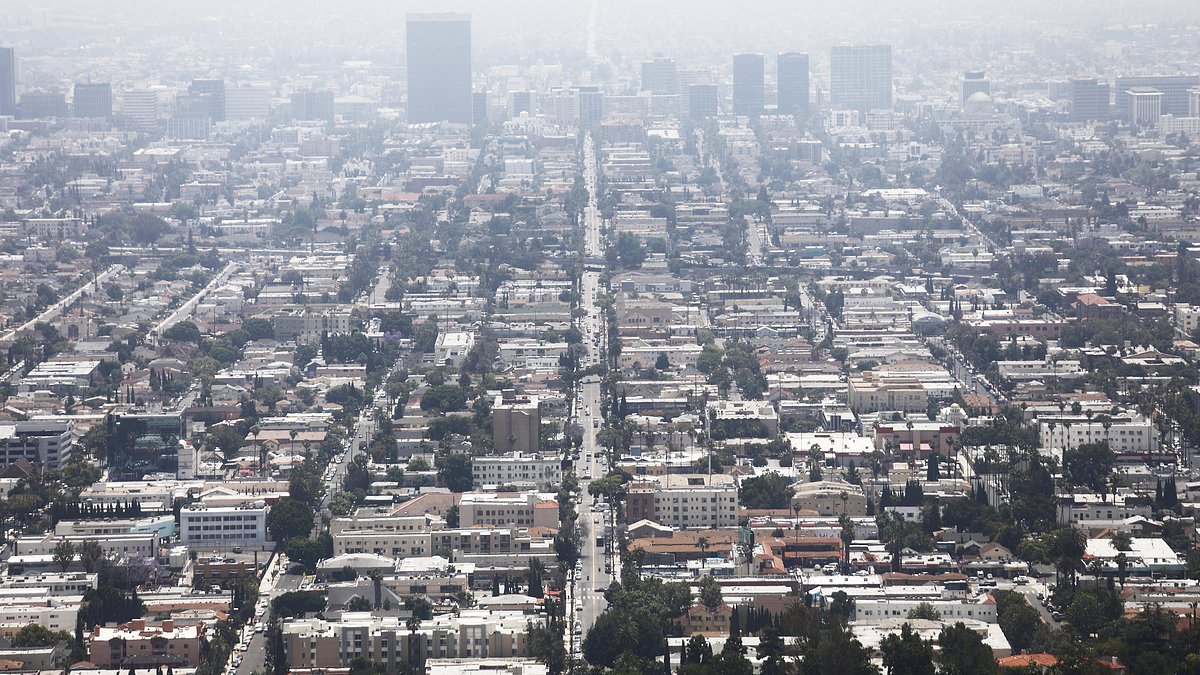
Millions of residents across Southern California (pictured/stock) and southern Arizona are under air quality alerts as strong winds whip up dangerous levels of dust and particle pollution, prompting health warnings.
According to the South Coast AQMD, the current alerts were triggered by strong winds lifting loose dust and soil into the air, significantly raising concentrations of fine and coarse particles.
These microscopic particles, commonly referred to as PM-10, are small enough to be inhaled and can irritate the lungs and cardiovascular system, especially during prolonged exposure.
Air quality levels may fluctuate throughout the day and night, officials said, meaning conditions could improve briefly before deteriorating again.
Residents are encouraged to check real-time air quality updates and forecasts through official monitoring systems to determine when it is safe to spend time outdoors.
Health agencies outlined specific precautions based on the Air Quality Index (AQI).
When conditions reach ‘Unhealthy for Sensitive Groups,’ vulnerable individuals should limit extended or strenuous outdoor activity.
When air quality deteriorates further into the ‘Unhealthy’ range, sensitive groups should avoid outdoor activity altogether, while others may begin experiencing symptoms.
At ‘Very Unhealthy’ or ‘Hazardous’ levels, officials recommend that everyone avoid outdoor physical activity.
Join the debate
Are air quality alerts affecting where YOU live?

Harmful levels of windblown dust are expected to linger through 11pm local time on Wednesday, affecting large swaths of the Inland Empire, Orange County and Los AngelesCounty coastal areas

Officials emphasized that while the dust event is weather-driven, its health impacts can be serious and cumulative, especially during prolonged exposure
Officials also recommended avoiding additional sources of indoor pollution, such as fireplaces, candles, incense, grilling, and gasoline-powered lawn equipment.
Drivers are being urged to slow down or avoid travel on dirt roads, which can kick up additional dust, while communities are encouraged to stabilize loose soil where possible.
Officials also suggested carpooling, telecommuting, or reducing unnecessary trips to help limit further particle pollution.
In Arizona’s Tucson area, ADEQ warned that worsening dust conditions could pose a significant health risk, particularly for people with asthma or pre-existing heart and lung conditions.
Residents there were advised to reduce physical activity, consolidate travel, and eliminate activities that generate additional dust or emissions.
Officials emphasized that while the dust event is weather-driven, its health impacts can be serious and cumulative, especially during prolonged exposure.
Residents across affected regions are urged to remain vigilant, follow public health guidance, and seek medical attention if they experience difficulty breathing, chest pain, or other concerning symptoms as the alerts remain in effect.