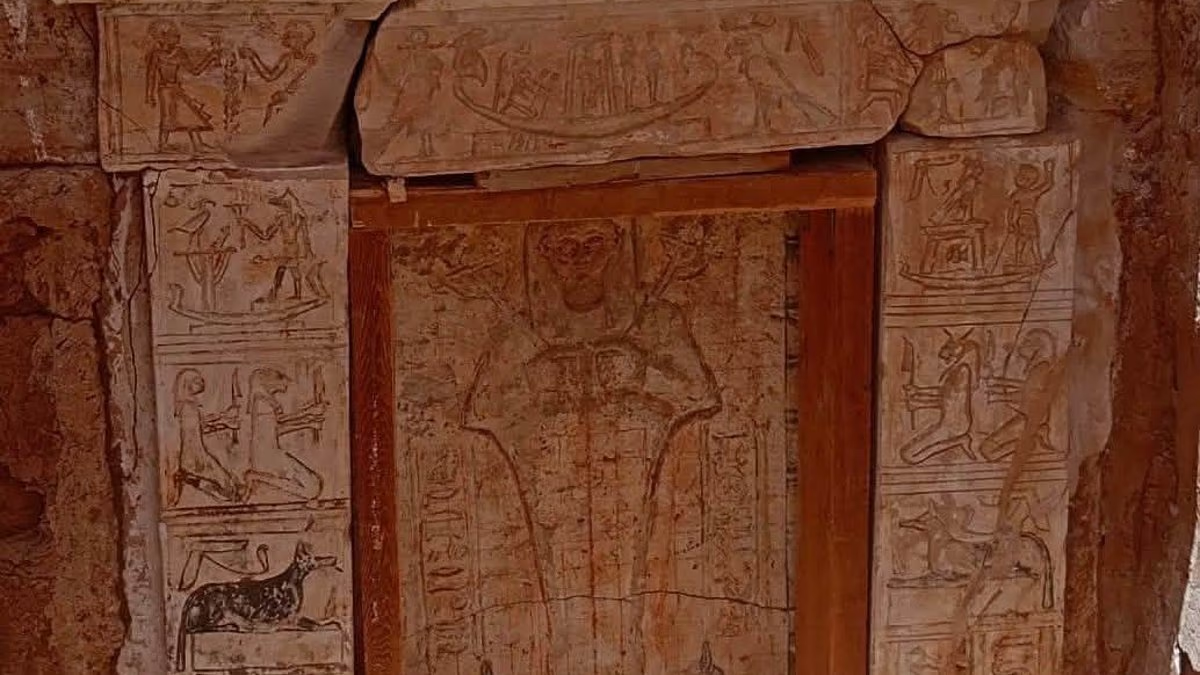

Archaeologists have uncovered a remarkable Roman-era pyramid tomb in a remote Egyptian oasis, complete with imagery portraying the ancient Egyptian passage into the underworld.
The limestone burial monument was discovered at the Bir al-Shughala necropolis in Egypt’s New Valley. It was constructed around 1,700 years ago for a man and his wife.
Fourteen steps descend toward the tomb’s entrance, where a stone doorway bears hieroglyphs, protective incantations and scenes drawn from religious tradition.
Among the most significant discoveries is a rare illustration of the “Hour of Death,” a section of the Amduat that describes the soul’s journey through the afterlife.
The ancient text follows the sun god Ra as he confronts the dangers of the underworld during a 12-hour journey, ultimately emerging reborn at dawn.
For ancient Egyptians, the cycle represented more than a divine myth. They believed the dead would undertake a similar passage, making the imagery a potent emblem of resurrection and everlasting life.
“An Egyptian archaeological mission has uncovered a pyramid-shaped tomb made of limestone, dating back to the Roman era, dedicated to the burial of a man and his wife,” Egypt’s Ministry of Tourism and Antiquities said.
The ministry described the monument as notable for its “unique architectural design” and the “rare inscriptions and funeral texts” preserved within it.

Archaeologists discovered an uncommon depiction of the “Hour of Death” from the Amduat, an ancient Egyptian text describing the passage through the afterlife

The limestone pyramid tomb was found in the Bir al-Shughala necropolis in Egypt’s New Valley
Officials from Egypt’s Ministry of Tourism and Antiquities said the entrance had been sealed by a stone block covered in magical symbols and an image of a figure believed to be an official.
A carefully carved stone panel adds further detail, displaying hieroglyphic text alongside protective spells and religious passages.
DON’T MISS: New Report Scrutinizes California’s Response to Devastating Los Angeles Fires
The decoration also features a traditional Egyptian cornice, a winged solar disc and ornamental designs shaped like bundled reeds.
Within the tomb, researchers found a pyramid-shaped funerary monument inscribed with a 19-line elegy written in ancient Greek.
The poem honours a man identified as Bisichthes, who may have held the position of judge during the Roman period.
The excavation also yielded pottery, a basin used for purification, a funerary offering table and a bronze coin bearing the name of the Roman emperor Constantine.
Together, the finds reveal how Egyptian, Greek and Roman customs came together in the oasis, where multiple cultural traditions flourished side by side.
Researchers believe the tomb was built for members of the local elite. Its inscriptions and artefacts offer a rare window into how they understood death, burial and the world beyond.


Fourteen steps (left) descend to a stone entrance decorated with hieroglyphs, protective spells and religious imagery. Additional finds (right) include pottery, a purification basin and a funerary offering table
The discovery demonstrates the remarkable endurance of ancient Egyptian religious beliefs, which continued to shape funerary practices for centuries under Greek and Roman rule.
Instead of disappearing, traditional funerary practices became intertwined with foreign cultural influences, producing a unique mix of Egyptian, Greek and Roman customs that can be seen throughout the tomb.
Bir al-Shughala forms part of the ancient cemetery of Mothis, the principal settlement of Egypt’s Dakhla Oasis during the Roman and Byzantine periods.
Now known as Mut, the town was a thriving regional centre and an important hub for communities living deep within the Western Desert.
Excavations led by the Egyptian authorities began there in 2002 and have since uncovered an impressive collection of tombs, revealing a rich variety of burial styles, architectural designs and decorative traditions spanning several centuries.
MORE ON THIS: Scots College Student Accused of Animal Cruelty and Child Sexual Abuse Offences


