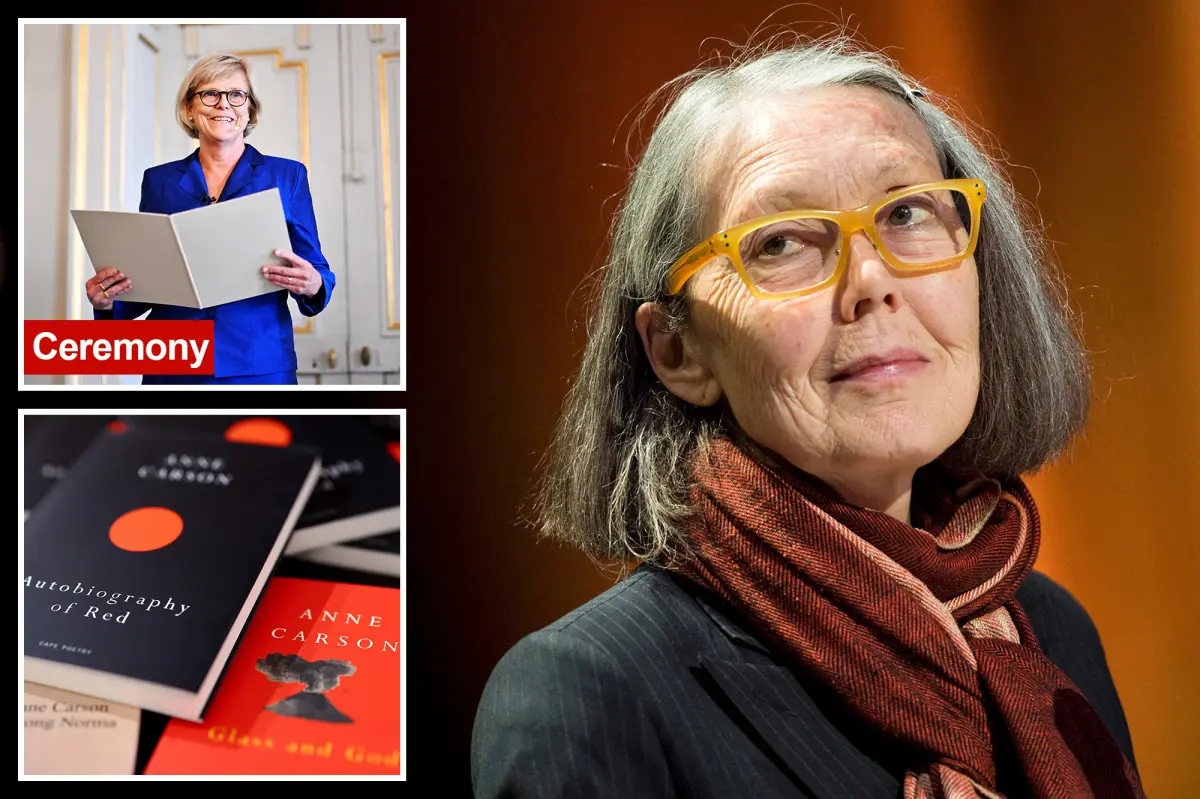

STOCKHOLM, Oct 8 (Reuters) – Canadian poet and author Anne Carson, whose genre-defying work moves between poetry, prose, dialogue and translation, won the 2026 Nobel Prize in Literature on Thursday. The Swedish Academy praised her “bold and inventive oeuvre.”
“Crazy, I think they’re all crazy,” Carson told Icelandic broadcaster RUV when asked how she felt after learning of the award while on the Arctic island. “I’ll get a sticker on the front of my book.”
Carson, 76, was born in Toronto and has a home in Iceland. She was caught off guard by the news when the Academy called her, said Ingrid Carlberg, its permanent secretary. The Nobel Prize in Literature carries an award of 12 million Swedish crowns ($1.2 million).
“All she had time to tell me was that she is for the moment in Iceland, where she’s listening to the wind,” Carlberg said at a press conference in Stockholm following the announcement.
Carson is widely recognized for her translations of classical Greek literature, which has deeply shaped her writing. Her work spans opera libretti, literary criticism and verse novels, including the 1998 book “Autobiography of Red.”
“Genre is something for booksellers. It’s something you do in order to appeal to an audience and make them buy books. And on what shelf do you put Anne Carson’s books? It’s on a shelf of her own,” said Swedish novelist Steve Sem-Sandberg, a member of the award committee. “That’s what I like about her.”
‘New forms of contemporary literature’
In its citation, the Swedish Academy said Carson was being honored “for her bold and inventive oeuvre that, in playful dialogue with the classical tradition, has created new forms for contemporary literature.”
“Almost all her literary production has centred upon the intersection between the philologist’s obsession with words and the poet’s desire for new meaning,” the Academy said.
Carson has described the etymology of words as the starting point for all her work, the Academy noted. It added that her translations from Classical Greek can be viewed as independent literary works in their own right.
Her distinctive approach is evident in “Norma Jeane Baker of Troy,” a 2019 performance piece that brings together the story of Helen of Troy in Euripides’ play “Helen” and the life of Marilyn Monroe.
Life without Proust
Often regarded as Carson’s greatest achievement, “Autobiography of Red” shows how she can bring the classical literary tradition into the present, the Academy said. The book revisits enduring questions, including: “What happens when you love someone who will ultimately destroy you?”
Carson also drew on modern literary influences. In “The Albertine Workout,” she examined Albertine, one of the narrator Marcel’s love interests in Marcel Proust’s “In Search of Lost Time.”
Carson spent seven years reading Proust’s masterpiece. In a 2016 interview with Canada’s CBC Radio One, she said finishing the novel left her with withdrawal symptoms, prompting her to write “The Albertine Workout” to extend the experience.
“You think life goes on after Proust, but it seems so gray,” she said.
MORE STORY: Venezuela’s Maduro, Wife Cilia Flores Face US Torture Charges
Boxing lessons to fight Parkinson’s
Carson began taking boxing lessons in her 70s after being diagnosed with Parkinson’s disease. Boxing is sometimes recommended as therapy because it can help develop attention, hand-eye coordination and the sequencing of movements.
In a 2024 interview at the Louisiana Literary Festival in Denmark, she discussed the disease’s effect on her handwriting. “I scrub out whole paragraphs in shame … the shame of bad handwriting,” she said.
Carson has taught classics at universities in Canada and the United States. She has also said that she views herself as a visual artist as much as a literary artist.
“I think of making a poem as making an object. I have always thought of them more as drawings than as texts, but drawings that are also physically enterable through the fact of language,” she said in the CBC interview.
Carson has argued that poetry may be particularly suited to the pace of modern life, perhaps more so than long-form writing.
“I think it’s probably more useful than prose right now because it’s faster and everybody is in a hurry so basically it’s good because it is brief,” she told the Icelandic broadcaster on Thursday.
When asked by the Nobel Committee about her own sources of inspiration, however, she listed ancient Greek poet Homer, author of “The Odyssey” epic.
As to how the classical stories she has reinterpreted in her work might be relevant to modern audiences, she said: “I don’t think I’m interested in relevance.”
‘At home’ in Iceland and NYC
Carson and her husband, artist Robert Currie, first came to Iceland after the 2008 banking collapse and gradually spent more time there. “We got to know people and we liked the people,” Carson told Iceland Review in 2023.
She has held citizenship of Iceland since 2022.
Currie told the magazine Iceland was one of only two places that immediately felt like home to him, the other being New York City in the 1970s.
Literature was the fourth of this year’s Nobel prizes to be announced this week, following medicine, physics and chemistry. The peace prize winner will be announced in Oslo on Friday.
Established in the will of Swedish dynamite inventor and businessman Alfred Nobel, the prizes have been awarded since 1901.
Carson, who had been among the favorites this year, takes a place beside luminaries such as Alexander Solzhenitsyn, Alice Munro and Ernest Hemingway as a recipient of the award. Last year’s prize was won by Hungarian writer Laszlo Krasznahorkai.
($1 = 10.0190 Swedish crowns)