
Iran and the United States have abandoned a fragile peace deal struck just a month ago, with both sides now trading missile fire.
The renewed confrontation has once again disrupted the movement of oil and gas through the Strait of Hormuz, leaving major energy importers, including Australia, on edge. This latest crisis, however, may prove more damaging than the last.
At the same time, Ukraine’s drone strikes on Russian refineries have pushed Moscow to suspend diesel exports, sending global diesel prices sharply higher.
Together, the two shocks threaten to squeeze diesel supplies even further. Australia, the world’s largest diesel importer, relies heavily on the fuel to keep long-distance freight, mining operations and agricultural production moving.
The return to hostilities appears to centre on control of shipping routes through the Strait of Hormuz, one of the world’s most important energy corridors.
Tehran has launched missiles at vessels using the strategic passage near Oman’s coastline, rather than Iran’s preferred route closer to its own shores, where it is able to charge a shipping fee.
Washington has responded by proposing a 20 per cent levy on the value of cargo carried by every ship passing through the strait.
For a tanker such as a Very Large Crude Carrier, or VLCC, transporting two million barrels of oil at US$80 (A$115) a barrel — a cargo worth about US$160 million (A$230 million) — the proposed charge would amount to US$32 million (A$46 million) payable to the US. That added cost would almost certainly flow through to consumers.

Major oil importers such as Australia are on tenterhooks after Iran and the United States ended their fragile peace agreement

A tighter global diesel market has concerning implications for Australia, the world’s largest importer of the fuel
The outbreak of the Iran and US-Israel conflict in February heavily affected diesel supplies.
In early April, benchmark diesel prices in Asia hit a record level of more than US$232(A$334) a barrel, more than double the global oil price of around US$110($A158) a barrel at the time.
The combination of a closed strait and a dearth of Russian diesel will trigger further volatility.
Singapore Gasoil, the primary price benchmark across the Asia-Pacific, was up almost 6 per cent at US$131 (A$188) per barrel on Tuesday.
Although we are not the world’s largest consumer of diesel, the closure of around three-quarters of our refining capacity in the 20 years to 2021, has left Australia dependent on imports for 80 per cent of its oil product consumption.
The absence of Russian diesel does not affect Australia directly as it has sanctions on Russian energy, like many countries in the Organisation for Economic Co-Operation and Development (OECD).
But countries such as Turkey, China, Brazil and Singapore are buyers of Russian oil products. These countries will now be competing with Australia for diesel in a tighter market.
In addition, US strategic oil reserves are at their lowest levels since 1983 after it contributed to the International Energy Agency (IEA)’s stock release of 400 million barrel to global markets. A repeat of a release on this scale is no longer an option.

Renewed tensions between Iran and the US have again halted the flow of oil and gas through the Strait of Hormuz (pictured)

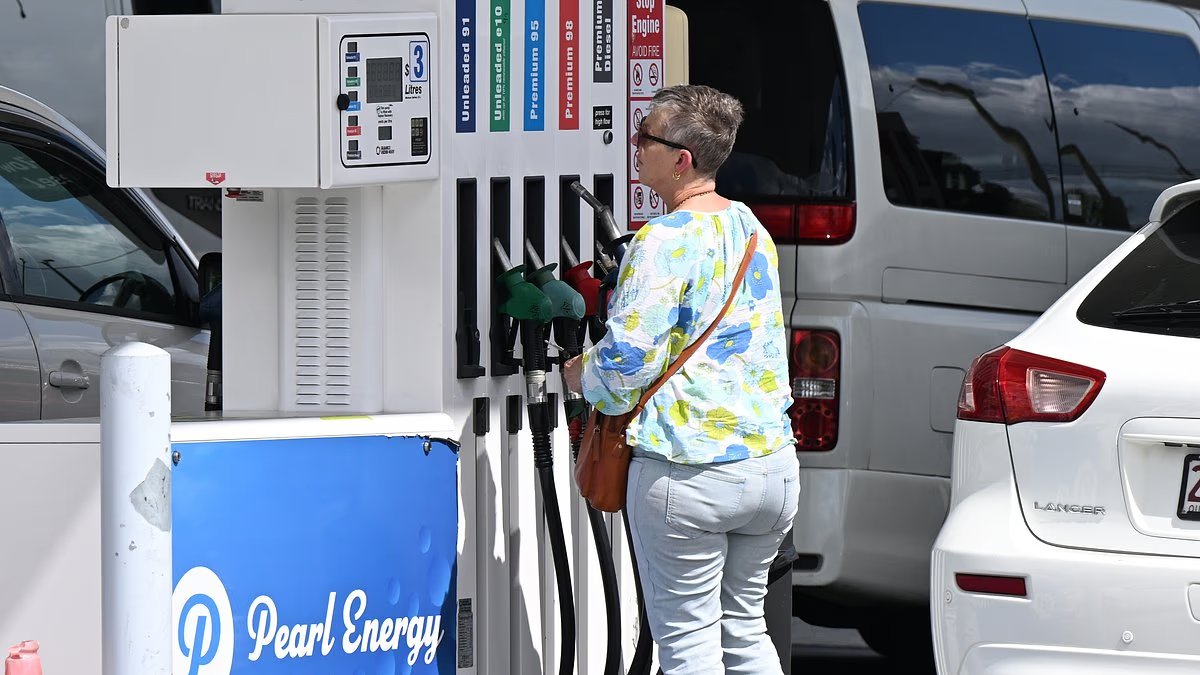
The longer the Strait of Hormuz is closed, the more likely Australian motorists will again feel increasing pain at the fuel pump
So far, Australia has been relatively successful in sourcing diesel, petrol and jet fuel from other partners. There have only been sporadic shortages, with queuing at petrol stations limited to the early days of the conflict.
However, Australia still has relatively thin oil stockpiles. We are at 50 days of net imports, the same as it was at the end of December. This is well below the 90-day level required for members of the IEA.
Even on the federal government’s preferred metric of the Minimum Stockholding Obligation (MSO), which tracks storage levels of diesel, petrol and jet fuel, actual volumes have declined.
But the government prefers to focus on another metric called ‘consumption cover days’: the number of days domestic fuel supplies would last at normal daily consumption rates. This has actually risen, which suggests Australians are using less fuel.
The latest official data from the Australian Petroleum Statistics (APS) on consumption show petrol, jet fuel and diesel consumption have each dropped (8.2 per cent, 6.6 and 2.1 per cent respectively) in the month of April, compared with last year.
The longer the Strait of Hormuz is closed and Russian diesel exports are offline, the more likely it is Australian motorists will again feel increasing pain at the fuel pump.
The promise of a long-term solution to this conflict remains only a distant goal, with both sides showing a willingness to battle over the Hormuz Strait.
The present uncertainty is exacerbated by the US failing to have any long-term strategy plan when it embarked on its missile attacks on Iran with Israel. However, Iran’s economy is weakening given its reliance on oil exports, which have declined to a trickle. They are not in a strong position to maintain a long conflict.
Both the US and Israel face important elections before the end of the year that could lead to both countries changing their approach.
Kevin Morrison is an Industry Fellow, Institute for Sustainable Futures at University of Technology Sydney.
This article originally appeared on The Conversation and was republished with permission


