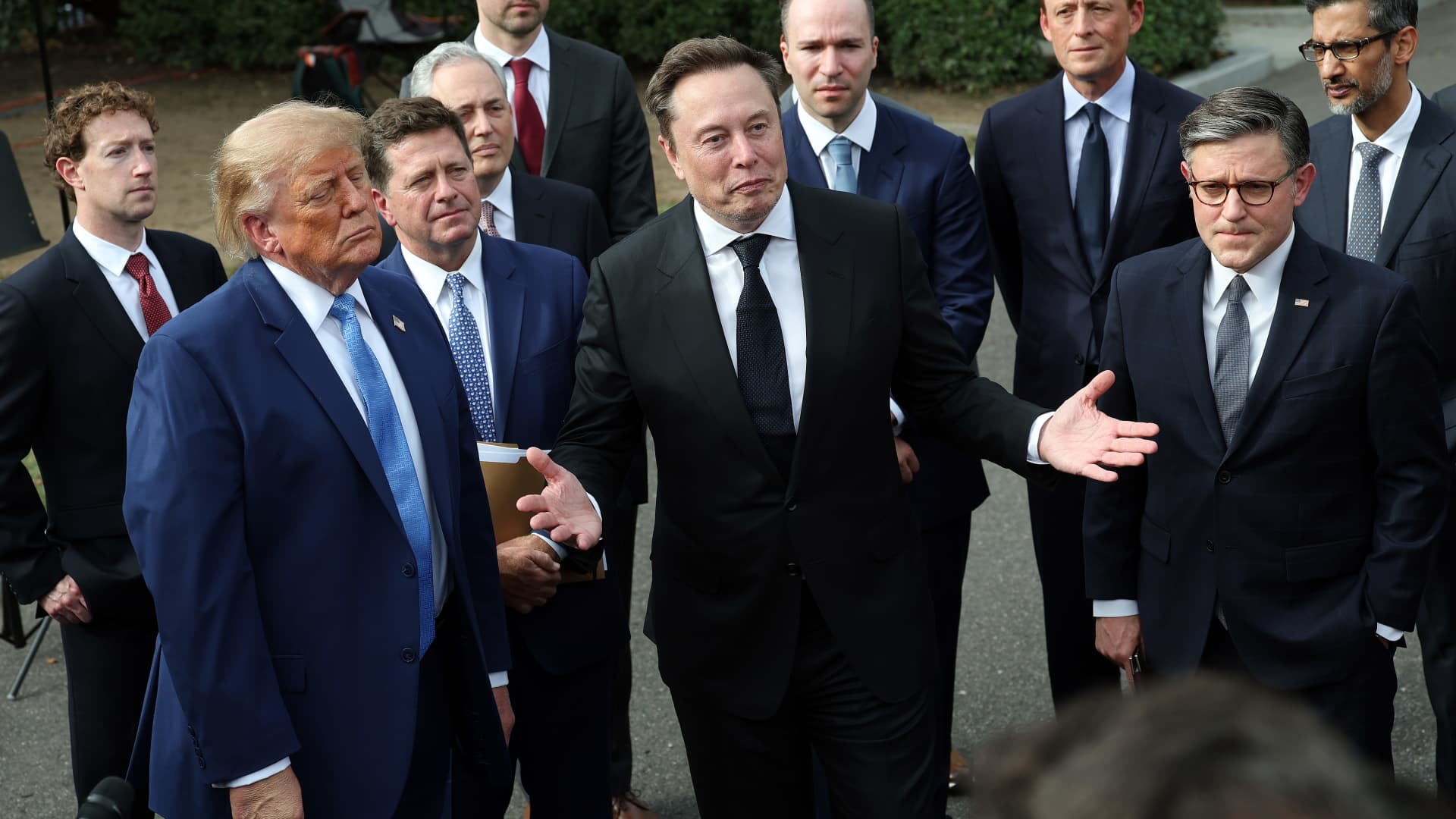

Tesla and SpaceX CEO Elon Musk appears alongside U.S. President Donald Trump, Meta Platforms CEO Mark Zuckerberg, House Speaker Mike Johnson, R-La., and other leaders during a press briefing with AI executives after a White House meeting on artificial intelligence outside the West Wing on Sept. 29, 2026, in Washington, D.C.
Kevin Dietsch | Getty Images
Hello, Anniek Bao here, writing from Singapore.
Markets open and close each day. Today marks the final edition of the Daily Open.
Thank you for making us part of your morning routine. Whether covering interest rates, market volatility or the rapid expansion of artificial intelligence, we hope we helped explain the business stories shaping the world—and gave you an enjoyable read along the way.
Beginning Monday, you will receive Morning Squawk, a daily briefing on the news driving markets and business. If you would prefer to unsubscribe, you can click here.
It has been a genuine pleasure writing for you. Thank you for reading.
— Lim Hui Jie, Leonie Kidd, Anniek Bao and Justina Lee
What you need to know today
Global markets are absorbing a sharp technology sell-off on Wall Street. The Nasdaq Composite dropped 2.6%, marking its steepest decline since early July as investors renewed their scrutiny of corporate spending on artificial intelligence.
In Seoul, SK Hynix shares recovered 2.6% after the chipmaker abandoned plans to list its Solidigm unit in the United States. The stock had earlier fallen below 1.2 million won ($905). Regulators determined that the proposed dual listing conflicted with existing rules, while SK Hynix blamed market conditions and said it would continue exploring financing options for a new U.S. manufacturing facility.
Elon Musk’s business interests also came under the spotlight. President Donald Trump called Musk and asked him to remove restrictions that had limited Ukraine’s use of Starlink and disrupted its drone operations, according to The Wall Street Journal. Trump said service had been restored, although Ukrainian President Volodymyr Zelenskyy said connection speeds have not yet fully recovered.
SpaceX recorded a $561 million unrealized gain on its investment in Musk’s Boring Co. during the third quarter, pushing net income to roughly $4.4 billion. The noncash valuation increase followed a September fundraising round for Boring. Despite the gain, SpaceX reported a net loss of $413 million for the first nine months of the year.
Musk is also directing substantial funds toward politics. He has contributed approximately $366 million during the current election cycle, including $276 million since July, with much of the money aimed at helping Republicans retain control of Congress, The New York Times reported. The spending could make him the largest individual donor in this year’s races. House Democrats have already urged investigations into SpaceX’s government contracts.
In the technology sector, Nvidia CEO Jensen Huang said demand from so-called neocloud companies is “off the charts.” Speaking to CNBC at the company’s GTC conference in Berlin, Huang said “the demand of the capital is much greater than the availability of the capital,” while adding that he expects the imbalance to be resolved.
China’s wealthy are moving money in the opposite direction, transferring offshore assets into U.S. banks as Beijing expands its tax enforcement efforts. Private bankers and attorneys said inquiries have increased since July. The government set Oct. 22 as the deadline for reporting offshore trust income, which is subject to a 20% tax.
Japan’s core inflation accelerated to 2.1% in September from 1.7% in August, reaching its highest level of the year and exceeding the Bank of Japan’s 2% target. The result matched economists’ expectations. The central bank is widely expected to leave rates unchanged at next week’s meeting, although a December increase remains possible.
— Anniek Bao
And finally…
AI debt and French bonds face a stress test — why the pressure may not be over
Credit markets are beginning to signal growing unease, from AI companies borrowing to build data centers to France’s heavily indebted government. Investors are becoming increasingly cautious about the risks associated with rising leverage.
Five-year credit default swap spreads have expanded for CoreWeave, Oracle and SoftBank Group, as well as for France and Italy, according to CNBC’s analysis of FactSet data.
AI-related bonds have been selling off as markets raise the cost of capital amid concerns of a financing crunch. Neocloud demand is “off the charts,” Nvidia CEO Jensen Huang told CNBC on Thursday, but he warned of a “scarcity of capital.” “The demand of the capital is much greater than the availability of the capital,” he said, adding, “that’s going to get solved.”
— Deena Zaidi, Christopher Hayes


