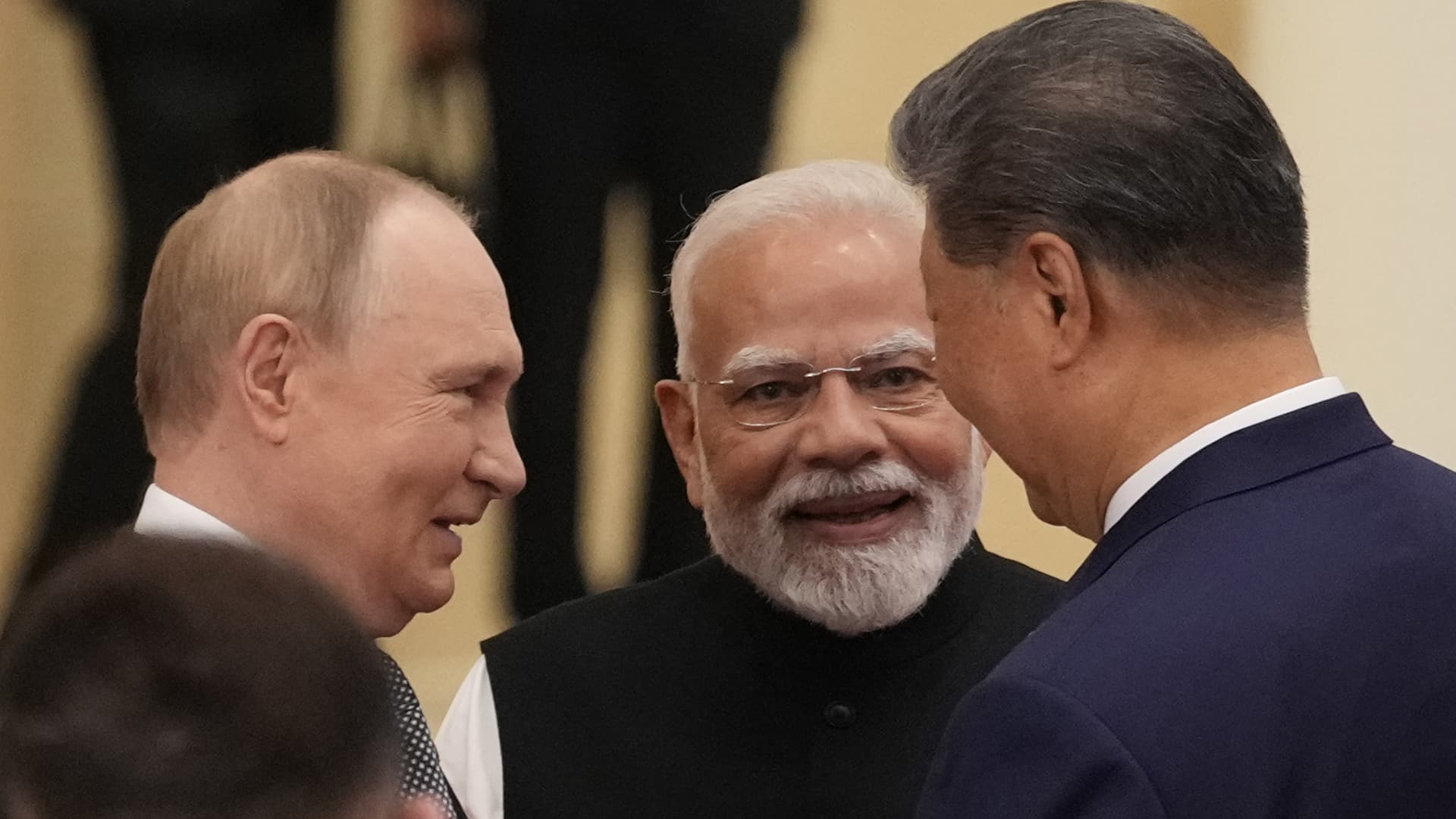

TIANJIN, CHINA – SEPTEMBER 01: In a momentous gathering ahead of the 2025 Shanghai Cooperation Organization (SCO) Summit, Indian Prime Minister Narendra Modi engaged in discussions with Russian President Vladimir Putin and Chinese President Xi Jinping at the Meijiang Convention and Exhibition Centre in Tianjin, China. The summit is a critical platform for dialogue among influential global leaders. (Photo by Suo Takekuma – Pool/Getty Images)
Pool | Getty Images News | Getty Images
Amidst mounting global tensions, India and China, both key players in the global oil market, find themselves in a heated race for diminishing crude oil resources. This competition has intensified due to disruptions in the Strait of Hormuz and stalled U.S.-Iran peace negotiations, which have added pressure to the already strained supply chain.
The rivalry primarily revolves around securing oil from Russia, with Saudi Arabia also playing a significant but secondary role in these procurement efforts. Both nations are vying for these crucial resources to sustain their economic growth and energy demands.
“The competition for Russian crude between India and China has been fierce and shows no signs of abating, especially for the June-loading shipments,” remarked Muyu Xu, a senior analyst at Kpler, in an interview with CNBC.
On April 18, the U.S. government extended a waiver that permits countries to engage in the purchase of sanctioned Russian oil at sea for approximately one month. This move provided some relief to global oil prices but did not extend to Iranian crude sanctions. Nearly 98% of Iranian oil exports are directed towards China, with only a small portion making its way to India.
Iranian attacks on energy infrastructure in the Middle East have also disrupted oil supplies from Gulf countries, increasing demand for Russian oil.
According to Kpler, Chinese imports through the critical waterway fell to about 222,000 barrels per day in April, a sharp dip from 4.45 million barrels per day (mbd) before the start of the Iran war. India’s supplies through this route plunged to 247,000 barrels per day so far this month from 2.8 million in February.
Both countries are now seeking alternative supplies to fill the gap.
“The de facto closure of the Strait of Hormuz is prompting Asian countries to seek cheap crude that is readily available, and Russian crude falls into this category,” said Xu of Kpler.
India appears more vulnerable to supply shocks. Its oil imports fell in March, and it has a limited buffer of around 30 days against prolonged supply shocks, oil industry experts said. Unlike other countries, the Indian government has not raised pump prices, so demand for petrol and diesel in the country has not dropped, they added.
Meanwhile, China is dependent on the critical waterway for 45-50% of its crude imports, according to Columbia University’s Center on Global Energy Policy. However, its oil stockpiles can meet demand for three to four months.
China is better positioned than most other Asian countries, said Mukesh Sahdev, chief oil analyst at energy intelligence firm XAnalysts.
Still, Beijing needs crude imports to support its massive export and petrochemical industries and to ramp up its strategic reserves in case the war is prolonged, Sahdev said.
Reliance on Russian crude
India imported a total of 4.57 mbd of crude in March, of which 2.14 mbd came from Russia, or 47%, said Benjamin Tang, director, head of liquid bulk research, S&P Global Commodities at Sea.
That’s nearly double from February, when t Russia’s share of India’s crude imports was around 20%, data from Kpler showed. At the same time, India’s total oil imports fell more than 14% from prewar levels.

China’s crude imports have also contracted, falling 2.8% on year in March in volume terms. With the Iranian supplies constrained, Beijing has turned to Russia to fill the gap.
Data from Kpler showed China imported 1.8 mbd of Russian oil in March, slightly down from 1.9 mbd in February. But so far this April, both India and China are going head-to-head, with each securing 1.6 mbd of Russian crude.
Before the war, Indian refiners had reduced Russian oil imports following U.S sanctions on two major oil companies in November. Washington further doubled down on India, demanding that New Delhi cut its reliance on Russian crude in lieu of a favorable trade deal with the U.S.
U.S. President Donald Trump and Indian Prime Minister Narendra Modi meet in the Oval Office at the White House on February 13, 2025 in Washington, DC.
Andrew Harnik | Getty Images
By February, the month when India and the U.S. finally agreed on a trade deal, Kpler’s data showed India’s Russian crude imports fell to around 1.04 mbd in February 2026, from 1.84 mbd in November last year.
But the conflict involving Iran reversed that trend.
In an interview with India’s NDTV, Denis Alipov, the Russian Ambassador to India, confirmed that “India is buying a lot of Russian oil recently” and that Moscow would like to sustain this level of energy cooperation going forward. He described U.S. tariffs and sanctions as “illegitimate pressure”.
While New Delhi needs to strike a favorable deal with the U.S., Russian crude has become critical for India’s energy security amid the ongoing Middle East conflict.
“India has been more exposed to the recent disruptions than China, given its heavier reliance on Middle Eastern crude and comparatively lower inventory levels,” Lin Ye, vice president of oil commodity markets at Rystad Energy, told CNBC.
She pointed out that while India is in stronger need for Russian crude, there is stiff competition from Chinese state-owned companies that have “returned to the market following the sanction waiver.”
Supplies from Saudi
Before the Iran war, India was replacing Russian crude oil imports with more from Saudi Arabia.

Kpler data showed that in February, New Delhi’s shipments from Saudi Arabia rose to 1.03 mbd in February from an average of 638,387 barrels per day in 2025. So far in April, Saudi Arabia has shipped 684,190 bpd of crude to India.
However, much of Saudi supply is directed toward China through the Red Sea, where it has significant refinery investments, giving Riyadh a vested interest in supplying more to Beijing than to India, according to Sahdev from XAnalysts.
Data from Kpler showed that Saudi Arabia has supplied 1.35 mbd of crude to China in April, up from 1.04 mbd in March but lower than 1.67 mbd in February.
“In case of an indefinite ceasefire, price becomes less relevant,” and availability of supplies becomes the major issue, Sahdev said.


