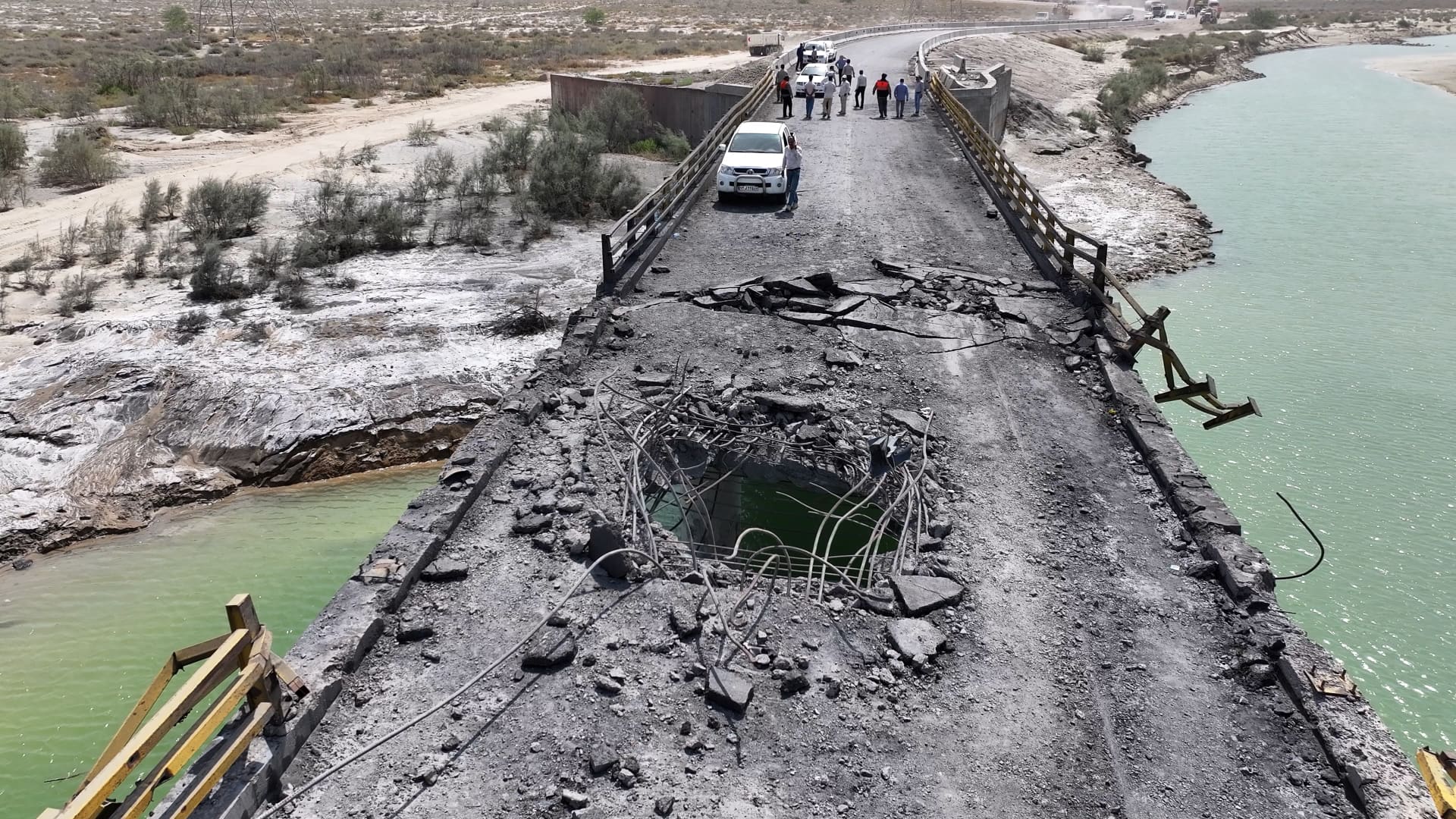

A damaged bridge is seen lying in a riverbed in southern Iran’s Hormozgan Province on July 17, 2026, after U.S. airstrikes the previous day, in this handout image provided by Morteza Akhoundi via Getty Images.
Contributor | Getty Images News | Getty Images
Iran said Friday that it had struck U.S. military forces in Syria and Bahrain, signaling a broader regional escalation as Washington carried out its sixth straight night of attacks against the Islamic Republic.
The renewed exchange has placed last month’s fragile U.S.-Iran truce under growing strain. That temporary deal was designed to halt hostilities and restore access through the Strait of Hormuz, one of the world’s most critical maritime corridors.
U.S. Central Command said overnight that it had finished another large-scale round of strikes on Iran, targeting dozens of military sites, including air defense systems, logistics facilities and maritime assets.
In a post on social media, Centcom said more than 50,000 U.S. service members were deployed across the Middle East and described the force as “vigilant, lethal, and ready.”
Iranian state media reported that the latest U.S. airstrikes killed eight people and injured 20, claiming American attacks had damaged civilian infrastructure such as bridges, a train station and an airport. CNBC was not able to independently confirm those claims.

Separately, Iran’s Revolutionary Guard said it had attacked a U.S. command center in Syria’s al-Tanf area, according to state media. The U.S. military and the Syrian government did not immediately issue a response.
The U.S. military said in February that it had completed the withdrawal of forces from the strategic al-Tanf military base, which sits near the Syrian border with Iraq and Jordan.
Syria has sought to avoid being drawn into regional hostilities, with President Ahmed al-Sharaa telling a Chatham House event in March that the country would “remain outside” the conflict unless it is subjected to direct attacks.
Kuwaiti authorities said Friday that one of the country’s power generation and water desalination stations was hit in an Iranian attack, causing widespread damage.
The ‘Al-Riqqa’ oil tanker (L) and ‘Al-Yarmouk’ oil tankers sail in the Arabian Gulf waters, off the coast of Kuwait City on June 27, 2026.
Yasser Al-zayyat | Afp | Getty Images
Kuwait’s Electricity Water and Renewable Energy Ministry said via social media that it had extinguished a blaze triggered by the attack and was working to assess the damage and get the station working again.
Kuwait is known to be overwhelmingly dependent on desalination for drinking water, with almost 90% of the arid nation’s water demand satisfied through seawater desalination plants.
Air raid sirens were activated in Bahrain overnight, with the country’s Defence Force saying it had intercepted multiple aerial attacks from Iran. The alert followed a claim by Iran that it had targeted U.S. aircraft at the Sakhir airbase in Bahrain.
Jordan and Qatar also both said they had intercepted Iranian missiles.
Trump: ‘We are likewise winning big in Iran’
U.S. President Donald Trump has insisted the war with Iran is going well, saying Thursday in a primetime address to the American public: “We are likewise winning big in Iran, and you will see the fruits of that labor very, very shortly.”
The U.S. president had threatened to strike Iran’s bridges and power plants next week if the country refused to return to the negotiating table.
US President Donald Trump addresses the nation from the East Room of the White House in Washington, DC on July 16, 2026.
Saul Loeb | Afp | Getty Images
Ian Lesser, distinguished fellow at GMF, a Washington-based think tank, said there appears to be a risk of the U.S. and Iran becoming mired in a so-called forever war.
“There’s a risk of this, but of course we were in essentially a cold and occasionally hot war with Iran for decades,” Lesser told CNBC by video call.
“I think in some sense this is misjudgment by the current administration. But it is also part of a pattern in the American approach to the use of force, that we have enormous capability and enormous operational prowess and we are hobbled by strategic mistakes,” he added.
Oil prices were higher on Friday, firmly on track to register bumper weekly gains.
International benchmark Brent crude futures with September delivery advanced 1.7% to trade at $85.72 per barrel, while U.S. West Texas Intermediate futures with August delivery gained 2.2% to trade at $80.63.
Both oil contracts are up more than 11% so far this week and on track for their best weekly performance since late April.


