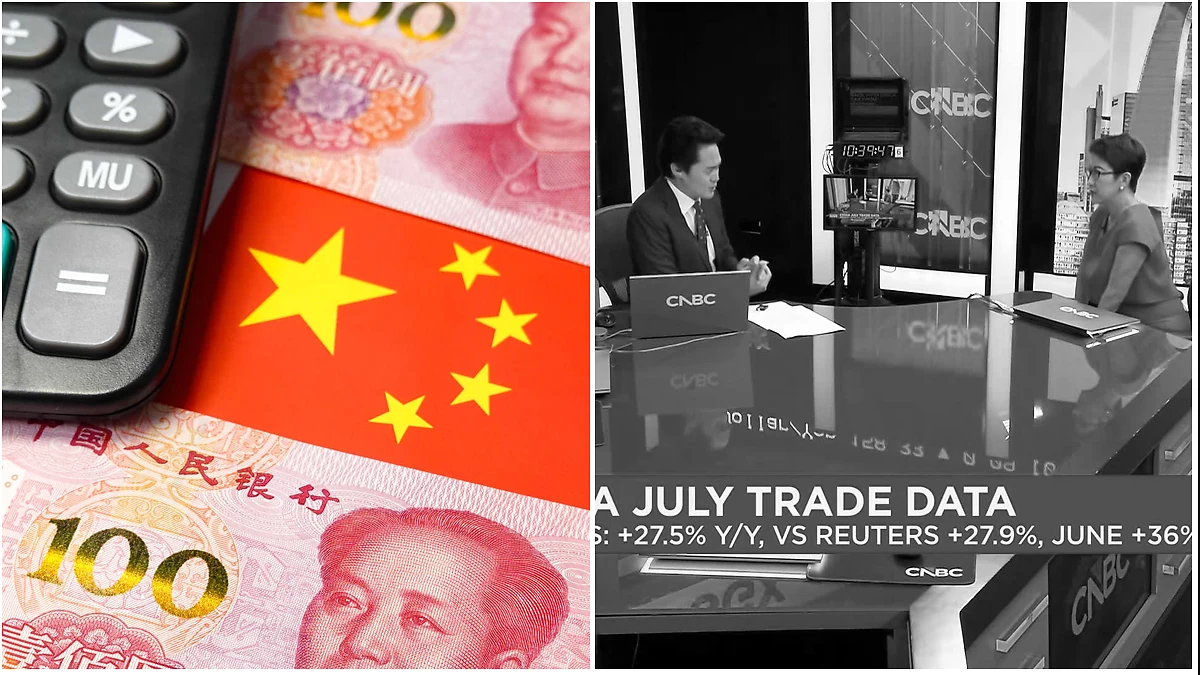

CHINA — 2025/09/05: In this photo illustration, 100-yuan RMB banknotes, a calculator and the Chinese national flag are arranged on a table.
Sopa Images | Lightrocket | Getty Images
Offshore trusts have for years been a go-to tool for China’s ultra-wealthy, allowing families to hold hundreds of billions of dollars beyond the country’s borders. Beijing’s latest push to tax those structures is now sending rich families racing to legal advisers — and in some cases, hunting for cash.
For decades, Chinese tycoons have used offshore trusts to park a wide range of assets, from pre-IPO shareholdings to multigenerational family wealth. Yet their tax status in China remained largely undefined. That changed on July 24, when China’s Ministry of Finance and tax authority released the most explicit guidance to date on how offshore trusts should be taxed.
Under the new rules, a 20% tax will apply at almost every point in a trust’s lifecycle, including when it is created, when profits are distributed and when the structure is wound down. Families must declare and pay any outstanding tax on assets transferred into such trusts since the beginning of 2023 by Oct. 22, giving them a 90-day window to comply. Those who file late or fail to pay could face additional charges.
The deadline has triggered a flurry of activity in Hong Kong and Singapore, two of the most popular hubs for China-linked wealthy families setting up trust arrangements.
“Many clients, trustees, and advisors are still in shock,” said Clifford Ng, a Hong Kong-based partner at Zhong Lun law firm.
Kia Meng Loh, chief operating officer and senior partner at Singapore law firm Dentons Rodyk, said inquiries have been pouring in from wealthy families, private banks, trust companies and insurers. Clients are trying to determine whether the new offshore trust tax rules apply to them, how large their liabilities could be and how to settle the bill before the grace period ends, he said. Some are already considering which assets they may need to sell.
“This is a watershed moment for China-linked private wealth planning,” Loh added.
For an industry built on decades of Chinese money, the sums potentially involved are massive. Assets held under trusts in Hong Kong alone reached HK$5.2 trillion ($667 billion) in 2023, with 55% of the underlying investments located in mainland China and Hong Kong, according to a report by KPMG and the Hong Kong Trustees’ Association, which called the mainland the industry’s most significant growth driver.
Singapore, along with the British Virgin Islands and the Cayman Islands, has been favored as another legal hub for Chinese high-net-worth families to hold offshore assets. KPMG found some clients see less political risk in the city-state than in Hong Kong, according to a report released in 2025.
“Wealth owners from a diverse range of countries choose Singapore for many reasons, including our high standards of regulation, strong rule of law, and a comprehensive ecosystem of wealth managers and professional service providers,” a Monetary Authority of Singapore spokesperson told CNBC.
Hong Kong’s Financial Services and the Treasury Bureau said the government would continue to strengthen the city’s position as an international asset and wealth management center through tax incentives and measures aimed at attracting more funds and family offices.
The tax revision comes as the Chinese government looks for new sources of fiscal revenue. Land sales – which used to be a major contributor to budgetary financing – collapsed amid a broader economic slump. Citizens’ mountains of overseas assets presented a compelling target.
Local tax bureaus in Shanghai, Shenzhen and Jiangsu had begun inspecting offshore trusts and applying 20% levies in select cases even before the national rules were released. Individual income-tax revenue jumped 13.1% in the first half of 2026, even as retail sales barely grew.
Chinese officials have also been taking tougher stances on capital flows out of the country, including banning three cross-border online brokerage firms from the country earlier this year.
Look for cash
The super-rich are calling lawyers to figure out the scope of their exposure and pin down a tax bill. There are multiple challenges.
Taxable amounts submitted to Chinese authorities will need to match figures already shared with Beijing by foreign governments under the Common Reporting Standard, the global tax-information exchange, said Richard Grasby, a partner at offshore law firm Appleby in Hong Kong. Since first participating in the CRS in 2018, offshore financial account information has been continuously exchanged with Chinese tax authorities.
Some assets may be hard to value. The wealth inside these trusts is often locked up in operating companies, pre-IPO stakes, properties, and other illiquid assets. Past banking and trading records may be difficult or impossible to locate.
What’s more, “dipping into the trust fund itself to cover the bill could trigger additional tax,” Grasby said.
The retrospective 90-day window could lead to ‘forced or pre-emptive stake reductions’ to fund compliance.
Xiangrong Yu
Citigroup economist
But it’s a distinct possibility for many trust holders that they’ll need to sell something in order to pay the new levies.
“Finding cash for taxes can be more complicated than calculating the tax,” Dentons Rodyk’s Loh said. His clients are weighing distributions, asset sales, financing, and installment plans.
“Most of them are saying that they will liquidate some of their portfolio to pay the tax,” said Ryan Lin, a director at Singapore’s Bayfront Law whose clients include wealthy Chinese families. He said listed Hong Kong and A-share holdings are likely to bear the brunt because they are the most liquid assets in many portfolios.
Risk to stocks
One obvious asset class that could be affected: Hong Kong equities, where founders of some mainland companies hold their stakes in trusts, according to Citigroup economist Xiangrong Yu.
“The retrospective 90-day window could lead to ‘forced or pre-emptive stake reductions’ to fund compliance,” Yu said.
But others see the pressure as relatively contained. Edith Qian, Hong Kong and China equity strategist at CGS International, noted most large red-chip names were listed well before the 2023 lookback period. Dominic Chiu, senior analyst at Eurasia Group, expects “one-off, episodic selling pressure rather than a sustained market crash.”
And in certain scenarios, people can apply for installment terms with local tax bureaus to pay the sum over five years, according to Beijing’s policy announcement last month.
So far there are few signs of a stampede for exits, as unwinding a trust crystallizes the very tax bill families were trying to manage, and China’s 20% flat rate remains well below the top U.S. federal rate of 37% that American taxpayers face on worldwide income.
Individuals with foreign citizenship or residency abroad will have limited shelter, lawyers say, as they can still be treated as Chinese tax residents if their primary economic interests remain in China – akin to Washington’s longstanding taxation of Americans wherever they live.
“A second passport is not a tax plan,” Loh said.
Offshore trusts can still play an important role in asset protection, wealth preservation and family succession planning, but they are no longer effective tax-planning tools, said Michael Olesnicky, senior consultant at Baker McKenzie.
One thing seems certain — any Chinese citizen with this type of account needs to be paying attention to their obligations, and the sooner the better, to avoid falling afoul of the new mandate.
“It may be difficult to come up with the correct numbers within 90 days if at all,” said Ng.


