
Iran has again threatened retaliation against Britain after accusing the UK of allowing Washington to use RAF Fairford for a B1 bomber raid on Iran.
Foreign Minister Abbas Araghchi said on Friday that Tehran would seek to hold responsible any nation found to have helped the United States carry out an attack.
‘Any participation, cooperation or assistance in committing aggression against Iran will create international responsibility for the relevant parties,’ Araghchi told a meeting in Kyrgyzstan, adding that Iran ‘reserves its right to take all necessary measures within the framework of self-defence’.
His remarks followed an earlier warning from the Islamic Revolutionary Guard Corps (IRGC), which denounced the ‘British monarchy regime’ for assisting America and declared that ‘any base used to invade Iranian territory is our legitimate target’.
Military analysts have previously questioned whether Tehran possesses the capability to strike targets in Western Europe.
However, Israel warned in March that Iran has missiles powerful enough to destroy buildings in major capitals.
‘The IDF revealed that the Iranian regime has intentions to develop missiles with a range of 4,000km (2,485 miles), which pose a danger to dozens of countries in Europe, Asia and Africa. The Iranian regime denied this,’ the IDF said in a statement.
‘We have been saying it: The Iranian terrorist regime poses a global threat. Now, with missiles that can reach London, Paris or Berlin.’

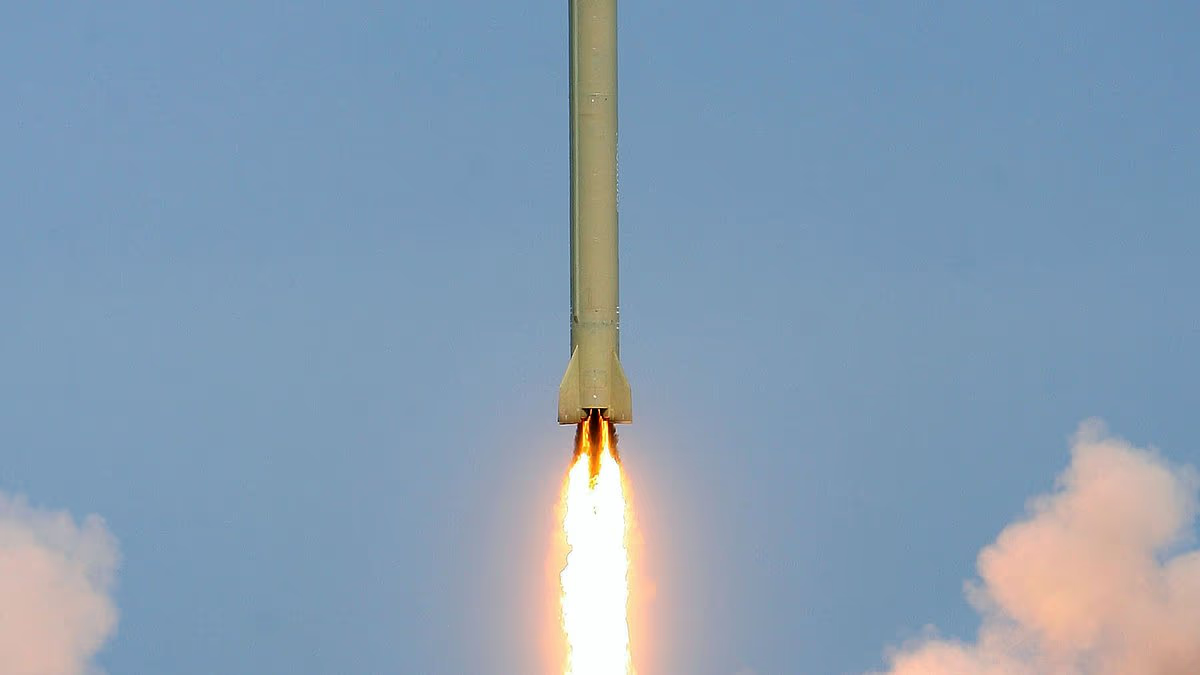
Iran has renewed its threat of retaliation against Britain over claims Washington used RAF Fairford to launch a B1 bomber raid on Iran. Pictured: A long-range Shahab-3 missile being launched

Pictured: A satellite carrier being launched from the Imam Khomeini spaceport in Semnan, December 2024
General Sir Richard Barrons, a former Commander in Chief of British forces, previously warned that Tehran’s power may have been ‘serially underestimated’.
On March 19, Iran launched two ballistic missiles targeting the joint UK-US military base on Diego Garcia in the Indian Ocean, 2,361 miles from Iran.
While the first missile was intercepted by a missile fired from a US warship, the second failed in flight after travelling 1,990 miles, some 400 miles from the outpost in the Chagos islands.
Foreign affairs analyst Nawaf Al-Thani reacted to the Diego Garcia strikes on social media, saying that a long-held assumption about Iran’s missile capability had ‘just collapsed’.
‘For years, the accepted ceiling was around 2,000 kilometres [1,243 miles]. A ballistic missile reaching Diego Garcia suggests something in the neighbourhood of 4,000 kilometres [2,500 miles], which pushes it out of the medium-range category and into the intermediate-range class (IRBM). That is a strategic leap.
‘The real story is not whether the missile was intercepted. It is that Iran may have demonstrated reach far beyond what much of the world believed it possessed.
‘Paris comes into range. London moves much closer to the edge of vulnerability depending on launch point and payload.
‘This would mean the missile threat is no longer confined to the Gulf, Israel, or parts of South Asia. It would mean the radius of deterrence, defence, and fear has expanded dramatically.
‘If confirmed, Diego Garcia was not just a target. It was a message.’
It is understood that rockets equipped for Iran’s space programme could be redesigned for military usage, putting European capitals at risk.
Tehran’s Simorgh space launch vehicle, for example, could offer greater range ‘at the likely cost of terminal accuracy’, said Justin Bronk, a senior research fellow at the Royal United Services Institute, a defence think-tank.
Steve Prest, a retired Royal Navy commodore, said: ‘Ballistic missiles are space rockets. They launch, they go really high up and they come down really fast. If you’ve got a space programme, you’ve got a ballistic missile programme.’

Iran has warned that Britain’s RAF Fairford is a ‘legitimate target’ after the US used the base to launch a B1 bomber raid

This screen grab from handout video footage released by the US Central Command (CENTCOM) on July 17 shows what the US military says are precision strikes on strategic Iranian military sites

Military personnel gather next to a US Air Force B-1 Lancer bomber parked on the tarmac at RAF Fairford in south-west England on March 10
In a statement published by the IRNA news agency, the IRGC issued a direct threat to Britain after discovering the US used RAF Fairford to launch its bombing raid.
‘The aggressive US military, which had been using cruise missiles from its ships in the Indian Ocean in its aggressions after the official resumption of the war, turned to using B1 aircraft flying from Fairford Air Base in England […] as the missile reserves of the aforementioned ships ran out,’ the statement said.
‘As Foreign Ministry officials have also clarified, any base used to invade Iranian territory is our legitimate target,’ it added.
The British government has responded by saying its military was ‘ready 24/7 to defend’ Britain from ‘any kind of attacks, whether it’s on our soil or from abroad.’
It added: ‘This includes through operating a layered approach to air and missile defence, provided by Royal Navy, British Army and Royal Air Force assets equipped with a range of advanced capabilities, working closely with our Nato allies.
‘The UK’s approach to the conflict remains the same – we are committed to defending our people, our interests and our allies, acting in accordance with international law and not getting drawn into the wider conflict.”
According to US news website Axios, the B1 – which can carry two-dozen 2,000lb bombs – took off from RAF Fairford in Gloucestershire on Tuesday.
It marks the first such mission launched from the UK since Andy Burnham became prime minister.
It was also the first time the US has carried out a B1 mission since fighting in Iran resumed nearly two weeks ago.
Bloomberg reported earlier this week that Burnham, who took power on Monday following Sir Keir Starmer’s formal resignation, had approved the use of UK military bases by the US.
It is not currently known what the B1’s target in Iran was, but Axios reports the long-range plane was used to hit IRGC assets.
During Operation Epic Fury, B1s were used to hit missile bases, command centres, weapons storage facilities and air defence systems.
Burnham had agreed to continue Starmer’s policy of allowing Washington to use the air base in Gloucestershire, as well as Diego Garcia airfield in the Chagos Islands for ‘defensive strikes’, according to Bloomberg.
‘We warn the British monarchy, which is the main cause of the misfortunes of the people of our region and has a dark record of dividing Islamic countries […] not to burden itself any further with this case,’ the IRGC’s statement said.
The military group accused the UK of causing ‘widespread massacres’ in Islamic countries, ‘imposing authoritarian governments’, and organising ‘the occupation of Palestine and the creation of the Israeli Nakba’.
The Nakba, which means ‘catastrophe’ in Arabic, refers to the mass displacement of Palestinians during the 1948 Arab-Israeli war.
The statement also condemned Britain for the ‘greatest participation in the recent aggressions of the United States and the Zionist regime’, referring to Israel.
Ed Miliband, the foreign secretary, has long been against the government’s policy of permitting the US to use British airbases during the war – prompting concern from the White House over his appointment.
In February, he led opposition on the National Security Council to the use of UK bases for US bombers, triggering tension across the Atlantic.


