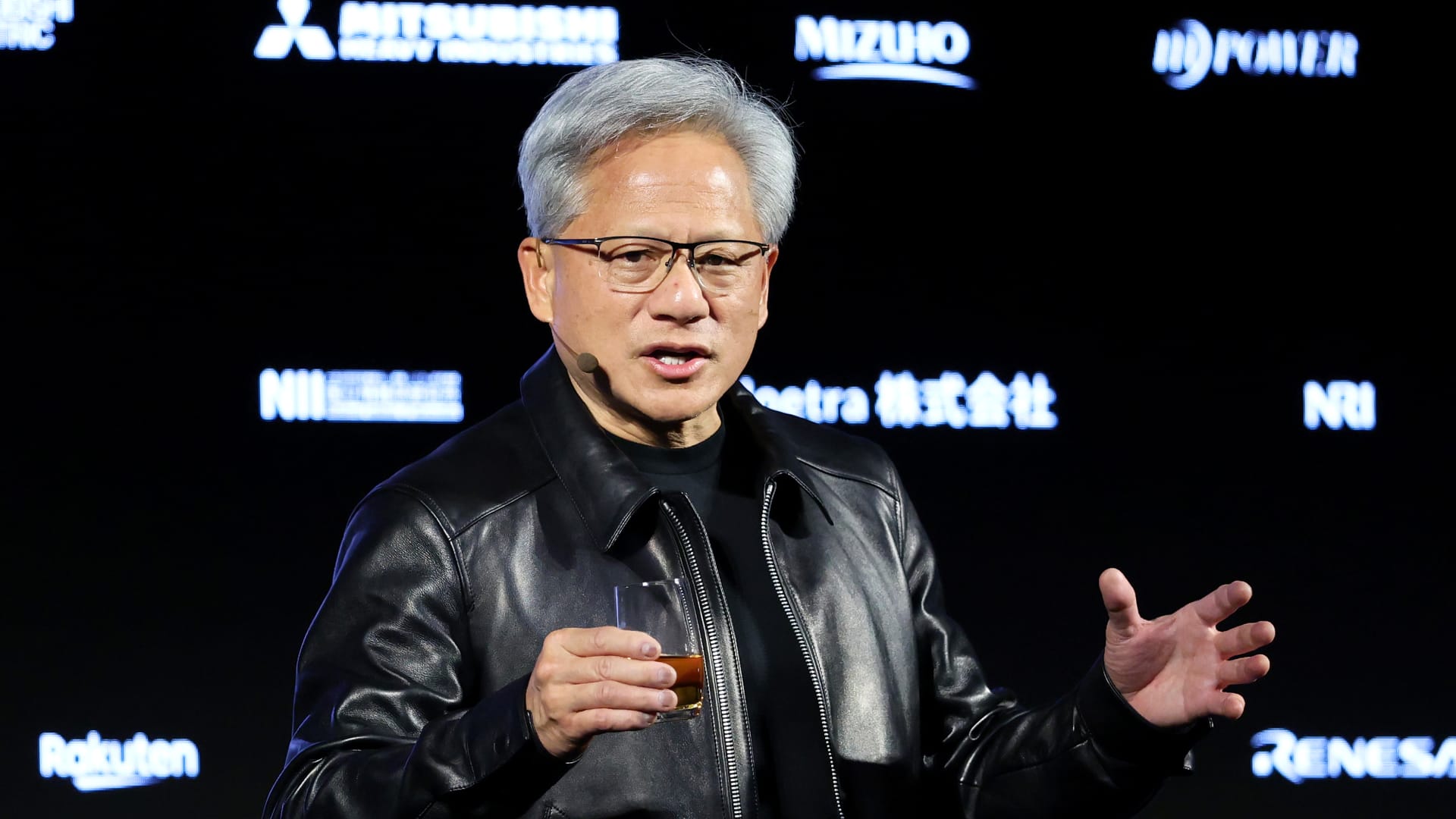

Nvidia Corp. CEO Jensen Huang speaks with reporters after the company’s “Japan AI Ecosystem” reception in Tokyo, Japan, on Thursday, July 16, 2026.
Kiyoshi Ota | Bloomberg | Getty Images
Nvidia introduced a new artificial intelligence model on Wednesday built for robotics and vision AI agents, marking another step in the chipmaker’s growing bet on Japan’s physical AI sector.
The model, called Cosmos 3 Edge, belongs to a category known as a world model, technology designed to help machines understand, respond to and move through real-world environments as events unfold. Unlike large language models, world models can absorb and learn from a broader mix of inputs. The release comes after Nvidia launched Cosmos 3 in May.
Nvidia’s Japan expansion is a key focus of Huang’s two-day trip to the country, where the Silicon Valley semiconductor leader is widening its physical AI ambitions. The company said it is building a coalition that major Japanese industrial names, including Fujitsu, Hitachi and Kawasaki Heavy Industries, plan to join.
“The next frontier of AI is in the physical world, and this is a once-in-a-generation opportunity for Japan,” Huang said in a statement Wednesday. “Japan invented modern manufacturing. Now, it has the opportunity to reinvent it for the age of intelligent industries.”
Nvidia’s deeper collaboration with Japanese companies follows a wave of major artificial intelligence investment in the country. Just months earlier, Microsoft committed $10 billion to strengthen Japan’s AI infrastructure and cybersecurity capabilities. SoftBank, one of Japan’s most prominent investment firms, has also made aggressive moves in artificial intelligence and is seeking to work with Microsoft and Sakura Internet on AI development in Japan.
Japan’s artificial intelligence market is projected to grow to $27.9 billion by 2029, according to the International Trade Administration, creating a sizable opportunity for U.S. technology companies. The expected growth is being fueled by the Japanese government’s push to accelerate AI adoption across sectors, as well as strong interest among domestic companies in forming global partnerships.
Ajay Rajadhyaksha, global chairman of research at Barclays, told CNBC last month that the country holds an advantage in Asia, driven by its diverse AI and clean structural growth stories.
Nvidia’s partnership push
Nvidia is also aggressively expanding its AI footprint into Japan’s healthcare and biotechnology sectors by extending its reach into agentic AI for advanced sciences through new drug discovery and medical robotics initiatives.
When it comes to agentic AI, Nvidia highlighted the ongoing expansion of Tokyo-1, the AI drug discovery consortium operated by Xeureka, a Mitsui subsidiary. The platform, which has steadily grown since its initial announcement in 2023, is powered by the Nvidia BioNeMo Agent Toolkit, a platform for accelerating autonomous AI drug discovery.
Japan’s pharmaceutical heavyweights are already scaling their involvement. Major drugmakers, including Astellas Pharma, Daiichi Sankyo and Ono Pharmaceutical are utilizing Nvidia’s specialized biology toolkit to streamline their workflows, the U.S. company said in a blog post.
Beyond biotech, Nvidia said it is making inroads into industrial automation through a partnership with Kawasaki Heavy Industries.


