

Donald Trump and Iranian President Masoud Pezeshkian have signed a peace agreement intended to halt the war and reopen the Strait of Hormuz, a move the US president said was needed to avert an “economic catastrophe.” The deal is described as taking “immediate effect” and includes provisions for Iran’s “reconstruction” as well as Washington ending “all types of sanctions” on Tehran. Still unresolved is the issue that triggered Trump’s military campaign in February: Iran’s nuclear programme. Negotiations on that front are set to continue for another 60 days, with Trump warning he would “bomb the hell” out of Iran if a final agreement is not reached.
Trump signs agreement amid uncertainty

The diplomacy surrounding the agreement has been marked by secrecy, mixed signals and confusion. US officials declined to release the full terms even after saying Trump and Vice President JD Vance had digitally signed the document over the weekend. A White House signing ceremony had been planned for Friday in Switzerland, but its status is now unclear amid conflicting accounts from the US, Iran and Pakistan. “It’s signed,” Trump told reporters as he left a dinner at Versailles with French President Emmanuel Macron following the Group of Seven summit in France.
Oil prices drop as US leaders split

Video posted online by a White House aide showed Trump seated beside Macron as he signed a paper copy of the agreement at Versailles, the historic palace associated with several landmark treaties. After signing, Trump handed the document and pen to Secretary of State Marco Rubio as attendees applauded. “This was not easy,” Trump said moments before putting pen to paper, according to a separate video shared on social media by Macron. Oil prices fell by more than 3 per cent after news of the signing emerged, reflecting hopes that the deal could ease pressure on global energy markets.
Israel voices doubt over Iran deal

Reaction in Washington was sharply divided. Republican senator Lindsey Graham, one of Trump’s closest allies, said he had softened his view of the memorandum after a “very lengthy and productive” conversation with US special envoy Steve Witkoff. “After this discussion, it is my opinion that signing the MOU will be beneficial to the United States, in as much as the Strait of Hormuz will begin to open, and the hostilities with Iran will stop,” Graham wrote on social media. Senator Ted Cruz, however, argued Trump was receiving “very poor advice” on the agreement, while Senator Bill Cassidy said “Reagan is rolling over in his grave.” Cassidy added that Iran’s nuclear ambitions had not been curbed and warned Tehran had learned that threatening the Strait of Hormuz “works” and would likely use that leverage again.
Mixed reactions as Iran deal signed

Susan Rice, a former official in the Obama and Biden administrations, was even more blunt, calling the agreement “the biggest national security blunder in decades.” In Israel, senior officials expressed deep concern over whether Iran would negotiate seriously on its nuclear programme now that the US had eased economic and military pressure. An Israeli government official told NBC News that Prime Minister Benjamin Netanyahu’s government had not been shown the memorandum of understanding drafted to end the war. Opposition leader Yair Lapid said: “Netanyahu promised us a historic victory – and we got a crisis with the Americans, Hormuz open to the Iranians, money for the Revolutionary Guards, ballistic missiles aimed at Israel, and Israel waiting in the corridor like a scolded child.”
Iran warns as fragile agreement emerges

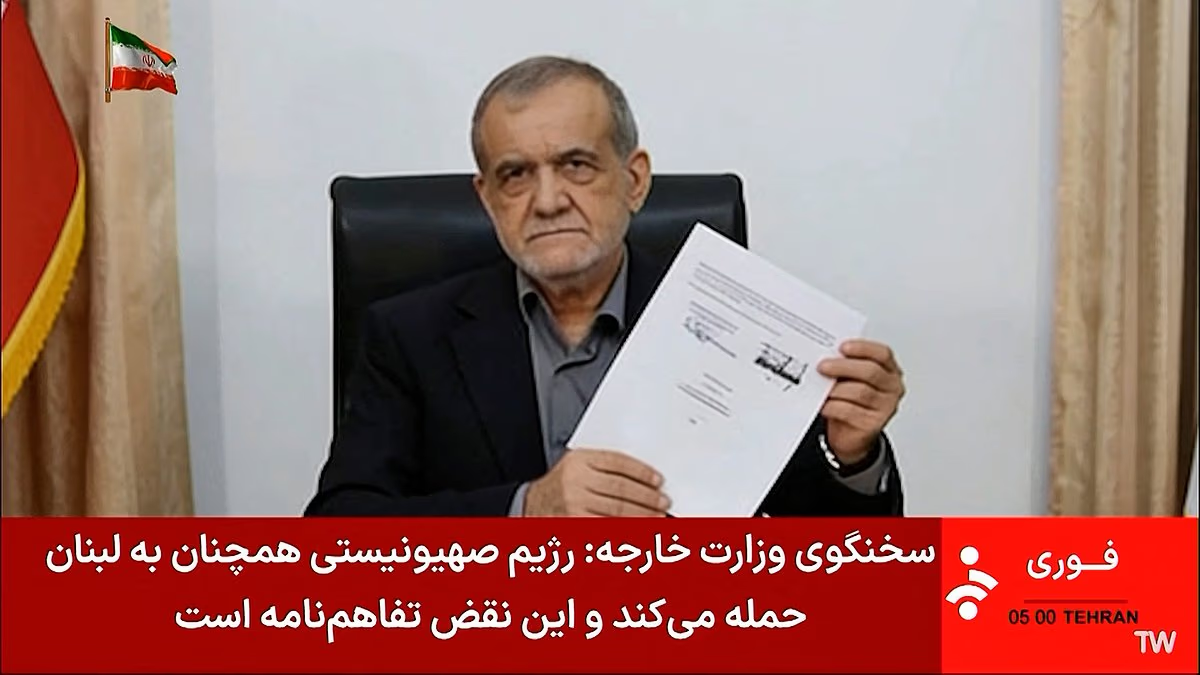
Not all Israeli voices were critical. Danny Citrinowicz, a former head of the Iran branch of Israeli military intelligence, said the agreement suggested reality had “finally returned to US policy on Iran.” “Before events spiraled completely out of control, the US administration stepped back from maximalist objectives and returned to a more measured and realistic approach,” Citrinowicz said Wednesday. In Tehran, state-run IRNA published images of a stone-faced Pezeshkian holding up the signed agreement bearing both his signature and Trump’s. But the tone from Iran remained combative, with parliamentary speaker and key negotiator Mohammad Bagher Ghalibaf warning that his country’s “finger is on the trigger.” He told state broadcaster Fars: “If the enemy does not understand the language of logic, we will enter again with the language of power.”
Strait reopens as tolls and sanctions shift

The full text of the agreement has still not been formally released. US officials, speaking anonymously, dictated draft language to reporters after days of silence, while Iranian state television later published text that largely matched the American version. The drafts indicate that much of the deal is designed to restore the prewar status quo: an end to hostilities, renewed US-Iran nuclear talks, and the reopening of the Strait of Hormuz, the vital passage for global oil and natural gas shipments whose closure helped trigger a historic energy crisis. The agreement says Iran will make arrangements to restart traffic through the strait “immediately” and allow passage without tolls for two months, though it does not rule out fees later.
Tensions rise over Lebanon and Israeli demands

In exchange, the US is expected to move toward waiving, rather than permanently eliminating, some broad sanctions on Iran. The agreement also calls for Washington to lift its blockade on Iranian ports and says traffic through the Strait of Hormuz should return to prewar levels within 30 days, while acknowledging that Iranian mines may need to be removed or destroyed. The strait’s closure had driven up energy and food prices worldwide, with Iran allowing some vessels through only after they paid tolls, an unprecedented step for a route long treated as an international waterway. The deal also includes language affirming Lebanon’s territorial integrity amid Israel’s invasion targeting Hezbollah, a highly sensitive clause given Israel’s insistence that it will continue to defend itself and maintain control over large areas of Lebanon. Iran says Israel must withdraw under the agreement, a condition Israel has already rejected. “Without me, there would be no Israel,” Trump told the G7 summit on Tuesday, while calling Netanyahu “crazy” and openly criticising Israeli attacks on Lebanon.
Trump defends war goals despite criticism

‘Too many people have been killed,’ Trump said, ’You don’t have to knock down an apartment house every time you’re looking for somebody, because there are a lot of people in those apartment houses, and they’re not all Hezbollah.’ The US and Israel went to war on February 28 in part to prevent Iran from ever getting a nuclear weapon. Trump has cited various goals for the war, including at times vowing it would end Iran’s nuclear and missile programs and its support for Hezbollah and other proxy groups in the region. He also suggested it could lead to toppling the Iranian government. The interim deal falls short of all those goals, but Trump hailed it Wednesday as ‘very strong.’
Major concessions reshape Iran deal

He also opened the door to abandoning it: ‘It’s a memorandum of understanding, and if I don’t like it, we’ll go back to shooting at them, dropping bombs.’ The US agreement to immediately allow Iran to sell its oil freely and the offer to eventually lift all sanctions represent major concessions that go beyond the terms of Iran’s 2015 nuclear deal with world powers. Trump withdrew America from that Obama-era pact in his first term, declaring it the ‘worst deal ever.’ Iran maintains its nuclear program is peaceful, though it is the only country to enrich uranium to 60 per cent purity without a weapons program, according to the International Atomic Energy Agency. The interim deal calls for the IAEA to monitor the ‘downblending’ of that uranium in Iran, without elaborating.
US waives sanctions as Iran deal advances

The accord likely will draw intense opposition in Washington, and it appears to be a major setback for Israeli Prime Minister Benjamin Netanyahu, who has come under criticism at home from the media, his opponents and even some allies as details emerge. Under the Obama-era nuclear agreement with Iran that Trump pulled out of, Iran also agreed to restrictions on its nuclear program and promised never to build an atomic weapon in exchange for the lifting of economic sanctions. Some concessions to Iran – including the full lifting of sanctions and the release of frozen assets – would happen gradually and be linked to progress in the nuclear talks, according to Pakistani officials. But in the meantime, the US will issue waivers to sanctions that allow Iran to sell oil freely.
Oil waivers weaken US negotiating power

The Islamic Republic’s oil export revenues in 2024 were more than $46 billion. Its main buyer of oil, China, is believed to have bought at below-market prices because of its willingness to ignore the sanctions. Granting oil waivers at the start of the 60-day talks strips the US of a major point of leverage. Only at the conclusion of the overall deal in 2015 were sanctions on Iran’s oil lifted. The interim deal also opens the door to ending all sanctions Iran faces from the US and at the UN – including those over Tehran’s weapons programs and human rights abuses – though it says the schedule for that will be worked out later.
Iran eyes $300 billion for rebuilding

Still, that far surpasses the 2015 deal, which only lifted some sanctions in exchange for Iran drastically reducing its enrichment and stockpile of uranium. The accord would also provide Iran with at least $300 billion to rebuild – an extraordinary figure and another major benefit for Iran. The money also appears dependent on the progress of further negotiations. Vance has said Gulf Arab nations would invest that amount. But Gulf countries would likely be reluctant to help Iran after Iranian attacks in the war destroyed oil facilities and other sites in their territory. Trump reiterated Wednesday that the US would not contribute and said it was up to other countries if they wanted to invest.


