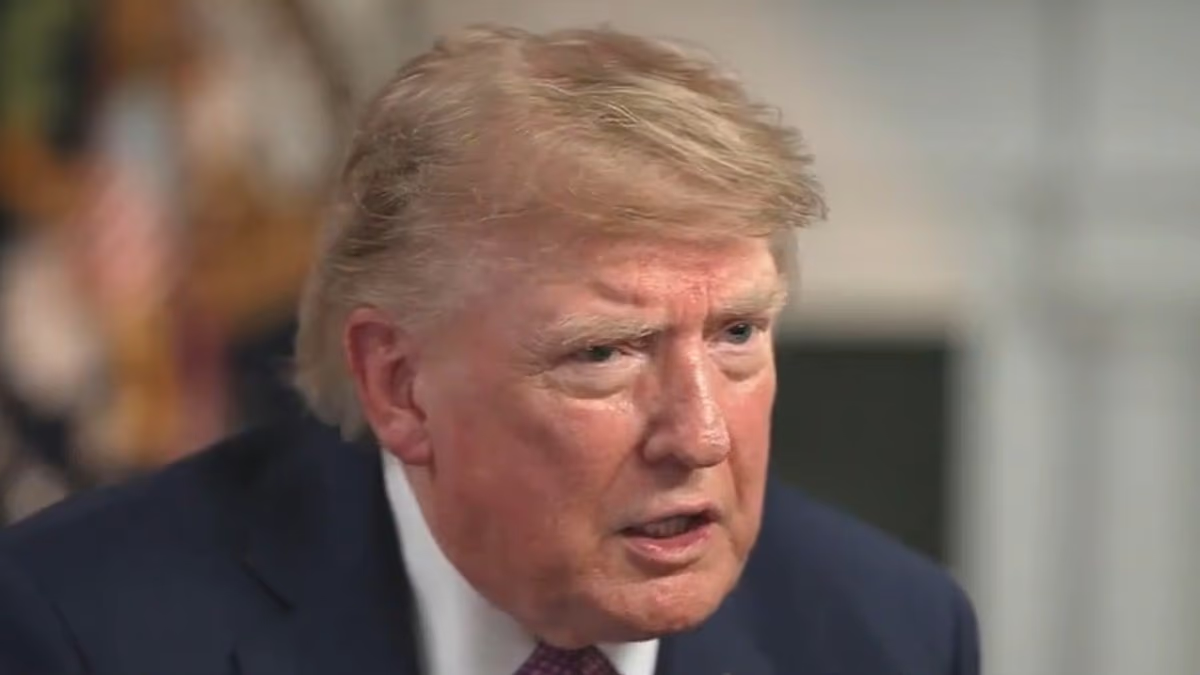


Donald Trump defended the war in Iran in stark terms, saying that without his presidency, Israel and “the entire Middle East” would no longer exist. The remarks aired on Fox News on the same night that US and Iranian attacks escalated again following a weeks-long pause in the six-month conflict. In the interview, Trump described Iran’s government as “violent, evil people” and again insisted Tehran must never be allowed to obtain a nuclear weapon, warning that Israel and the broader region could be erased. “If they had a nuclear weapon, Israel would be gone. If I weren’t President, Israel would be gone and there would probably be no Middle East,” he said. Trump argued that Iran had alienated its allies — as well as countries that had once been “sort of neutral” or maintained workable relations with Tehran — after the war erupted. “As soon as the shooting started, they started aiming at Saudi Arabia, Qatar, at UAE, at Bahrain, at Kuwait, everybody was shocked. I was surprised.” From his perspective, Trump said, that shift had one strategic benefit: Iran “lost all of the support they had.”
Trump vows to block Iran’s nuclear ambitions

Still, Trump said Iran’s conduct toward neighboring nations deepened his concern that, “if they would have had a nuclear weapon, they would have fired it.” He added: “I think the Middle East would have essentially been gone but Israel definitely would have been gone and I guess we would be next, or Europe or someplace.” The president renewed his pledge that Iran would not be permitted to become a nuclear-armed state, saying, “You cannot let them have a nuclear weapon and they won’t have a nuclear weapon.” His comments came as Israeli Prime Minister Benjamin Netanyahu rejected the prospect of a diplomatic agreement with Iran while backing Trump’s new economic pressure campaign earlier this week.
Netanyahu rules out agreement, warns Iran

Speaking in Jerusalem at an event for Israeli settlers in the occupied West Bank, Netanyahu said he had told Trump during a White House meeting last month: “I doubt that an agreement can be reached with that group there, with those savages. I tell you – an agreement cannot be reached.” Netanyahu said the two leaders also discussed the possibility of renewed military action against Iran. “We will not allow Iran to attack us, and if, God forbid, they attack us, they will suffer a blow beyond anything they have imagined– far stronger than anything they have suffered until now,” he said. The Israeli prime minister also praised Trump’s latest initiative after the president on Monday declared an “economic D-Day” designed to cripple Iran’s economy.
Trump signals no rush with Iran

Earlier this week, Trump emphasized that he is “not in a hurry” to bring Iran back to negotiations, while continuing to portray the Islamic Republic’s leadership as weakened and under severe pressure. “They’re not paying their troops. They’re in deep trouble. They have very little capacity,” Trump told reporters Thursday. He also made clear that talks are not a priority for Washington. “We don’t want to speak to them. We’re not looking to meet or anything,” he said.
Khamenei urges unity against US and Israel

Iran’s supreme leader, Ayatollah Mojtaba Khamenei, called on leaders of Muslim nations to “know your real enemy, understand its plans and confront it,” according to the official IRNA news agency, which reported Sunday that he had described the US and Israel as enemies of all Islamic nations. Six months after US and Israeli strikes on Iran killed Khamenei’s father and other senior figures, the younger Khamenei has still not appeared in public. His remarks were delivered in a letter to religious leaders attending a conference in Tehran. The latest escalation came Sunday as US forces carried out their first strikes on Iran in more than a month, targeting two rocket launchers near the Strait of Hormuz. Tehran responded by attacking American forces in Jordan.
US monitors IRGC rocket threat in strait

The renewed violence followed sightings of Islamic Revolutionary Guard Corps forces preparing to launch rockets equipped with sea mines into the Strait of Hormuz, Central Command spokesman Captain Tim Hawkins confirmed to The Daily Mail. “US forces are monitoring the area closely and remain prepared to protect the free flow of commerce through this essential waterway,” Hawkins said. He added that the US military had completed efforts last week to clear sea mines from international shipping lanes in the strait. Iranian media reported explosions near Larak Island in the strategic waterway. In a statement carried by Iran’s state broadcaster, the IRGC referred to “the martyrdom and injury of several of our fighters and compatriots” and warned that the attack would “result in punishment of the aggressor.” Soon after the US strikes, Fox News reported that Iranian forces were attacking American troops stationed in Jordan. Nearly all incoming missiles were intercepted and there were no significant impacts, the network said. The latest fighting comes only days after the Trump administration indicated it would focus on intensifying economic pressure, rather than expanding military action, in an effort to end the war with Iran. Treasury Secretary Scott Bessent told Reuters on Sunday that the Treasury Department is likely to announce new secondary sanctions aimed at tightening financial pressure on Tehran.
Sanctions replace missiles in Iran crackdown

Bessent outlined the expected move after penalties were imposed Friday on the United Arab Emirates branches of Egypt’s Banque Misr over alleged financial ties to Iran. The administration’s evolving strategy centers on threatening penalties against any country, company or entity that continues doing business with Tehran. The increased reliance on sanctions comes as officials weigh the strain of reduced munitions stockpiles after months of war, raising concerns that a prolonged conflict could weaken US military readiness elsewhere in the world. Trump has repeatedly said the joint US and Israeli campaign has inflicted heavy damage on Iran’s navy and air force. Iranian officials, meanwhile, have estimated that the country has sustained $270 billion in direct and indirect losses. Israeli military strikes during the opening weeks of the war destroyed much of the theocratic government’s leadership structure. Even so, Iran has retained leverage through attacks in the critical Strait of Hormuz, where relatively few ships carrying oil and liquefied natural gas are now willing to risk passage. Tehran still has enough drones and missiles to threaten vessels in the vital energy corridor, through which about 20 percent of the world’s oil normally flows, giving it significant influence over traffic in the strait.
Strait of Hormuz traffic remains low

Trump has repeatedly insisted that the “Strait of Hormuz is open,” noting that 24 vessels passed through last week. But that figure is far below the roughly 130 ships that moved through the key waterway each day before the war began. Earlier Sunday, a multinational coalition overseen by the US Navy said commercial traffic through the strait remained at “reduced levels.” A monitoring agency operated by the British military also said an unidentified projectile struck a tanker Saturday north of Khasab, Oman, in the strait. The United Kingdom Maritime Trade Organization said the vessel had been inbound and that no casualties or environmental damage had been reported, citing unspecified military authorities. No group immediately claimed responsibility. A return to sustained open conflict would pose serious risks across the region, where Iran has targeted US military bases and infrastructure in Gulf countries since the war began on February 28. The last confirmed US military strike on Iran came on July 29, when officials announced a “heavy wave of strikes” on dozens of Revolutionary Guard targets, including coastal surveillance and defense sites. On August 1, Trump said he would direct the military to pause further strikes after appeals from Gulf allies Qatar, Saudi Arabia and the United Arab Emirates.


