Share this @internewscast.com
IN BRIEF
- The Australian government will underwrite private fuel cargo purchases.
- This will allow Australian companies to bid competitively for fuel, amid soaring prices.
The federal government is stepping up to shoulder the financial risks associated with importing extra fuel and fertilizer, as escalating tensions in the Middle East continue to wreak havoc on global markets, pushing up prices and stoking uncertainty.
Prime Minister Anthony Albanese revealed this new initiative on Saturday, emphasizing that the strategy is about being “over prepared” rather than reacting to an immediate crisis.
However, he refrained from introducing any mandatory rationing measures, instead appealing to Australians to exercise “common sense” and refrain from panic buying.
But what exactly is unfolding, and why does it matter?
What are the new powers?
The new measures will empower Export Finance Australia, a government-supported financial entity, to aid private firms in importing additional fuel shipments from abroad.
“The government is taking decisive national action to ensure fuel supplies are replenished,” Albanese declared on Saturday morning.
“New fuel security powers will enable the government to underwrite the purchase of fuel by the private sector. Importantly, it will also allow for the purchase of fertiliser and other essentials as well.”
When Export Finance Australia “underwrites” a purchase, it essentially promises to cover the financial risk if something goes wrong — giving private companies the confidence to secure additional cargoes they might otherwise pass on.
Any government-backed purchase must be additional supply, not cargo that would have been brought in anyway.
“Put simply, we will use Export Finance Australia to underwrite the purchase of shiploads of fuel that will add to supply here in Australia,” Albanese said. “This support from the government will not be business as usual.”
“It has to be additional supplies that are available on the international market, and it literally will be underwriting the purchase of shiploads of fuel to get here to Australia.”
“There is a risk of a private purchase of a shipload of fuel at higher prices — this is about risk mitigation for [the private sector] to add to supply here. It will give suppliers the confidence to secure additional and discretionary cargoes.”
Energy minister Chris Bowen indicated Export Finance Australia would have a “very flexible suite of measures” available — including loans, insurance, and other arrangements.
Further details are expected when the legislation is introduced on Monday.
So why is this necessary?
Australia imports most of its fuel, meaning it relies on a steady stream of cargo ships arriving from overseas.
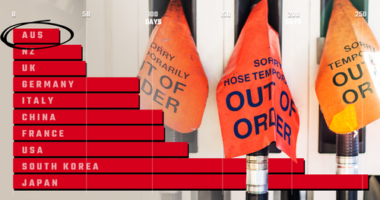
For now, supply looks secure. Bowen said on Saturday that Australia has 39 days of petrol (1.6 billion litres), 30 days of diesel (2.7 billion litres), and 30 days of jet fuel.
“What that tells me is that while the fuel is flowing strongly out the door, especially to regional Australia, it also continues to flow in the door — that every expected arrival has arrived and that our international supply chain remains secure at this point,” he said.
Every ship due in March has arrived, with six cancellations in April having been “more than replaced” by new bookings.
But the concern is what happens if the war drags on. Prices on the international market are volatile, and the cost of securing additional cargo has become increasingly risky for private companies to take on alone.
“Those companies are making those commercial decisions — they are buying cargoes, but at elevated prices,” Bowen said. “And if those prices continue to move around, there’ll be cargoes that Australia misses out on unless the government acts in close partnership.”
The government’s argument is that without some form of backing, Australia could miss out on available cargo simply because no private company is willing to take the financial risk.
“These powers will be used to help acquire the additional supply that’s so valuable for Australia’s fuel security, where it will be cost-prohibitive for private suppliers to source on commercial terms without government support,” Albanese said.
“The longer this war goes on, the more the impacts will be,” he said. “What we want to do is to be overprepared, and that is essentially the action that we’re taking now — to prepare and shield Australians from the potential implications.”
What about rationing?
Australia’s consumer watchdog on Friday reported average diesel prices in the five largest cities hit 303.5 cents per litre, rising 27.8 cents in a week, due to fuel shortages caused by the Middle East conflict.
Unleaded petrol prices hit 252.2 cents per litre. The trend was even more pronounced in regional Australia, where diesel prices averaged 307.6 cents per litre, a 28.6 cent weekly jump.
Despite the pressure, the government stopped short of mandated rationing or restrictions, instead urging “common sense”.
“The best way for us to operate is to work cooperatively, is to seek to have voluntary arrangements rather than any mandating from the top,” Albanese said.
Bowen said demand in rural Australia remained “exceedingly high” with agriculture in a busy period, and that despite additional allocations flowing to regional distributors, supply was “still not enough”.
The legislation will be introduced into the House of Representatives on Monday, when National Cabinet will also meet to coordinate a national response, rather than the fragmented state-by-state approach Albanese said created problems during COVID.
“How do we make sure that we act together?” he said. “That’s why I’m bringing National Cabinet together for a second time.”
Albanese also took aim at people stockpiling fuel in jerry cans, saying it was “not the Australian way” and warned it could be dangerous.
“This isn’t toilet paper that’s being piled up in some garages — it’s actually fuel, and that’s not sensible on a range of levels,” he said.
— With additional reporting by AAP.
For the latest from SBS News, download our app and subscribe to our newsletter.