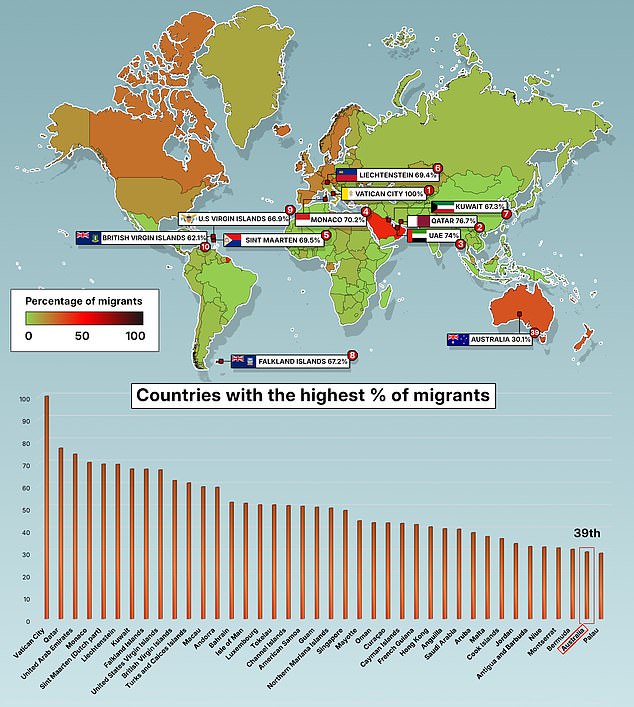

Australia stands out as the nation with the highest proportion of migrants in the Anglosphere, with United Nations data indicating that nearly one in three residents hails from overseas. This demographic shift positions Australia among the leading countries with significant immigrant populations in the developed world.
Currently, over 7.1 million people living in Australia were born abroad, propelling the country ahead of the United Kingdom, the United States, and Canada when considering the share of the population. Only a select few smaller European countries surpass Australia’s migrant ratio, often due to unique factors such as geographic location, labor market dynamics, or smaller population sizes.
Global Migration by the Numbers
According to 2024 data from the United Nations, global migration has reached significant levels, with 304 million individuals—accounting for 3.07 percent of the world’s population—living outside their country of origin.
The United States leads with the largest foreign-born population, hosting 52 million immigrants. This is followed by Germany with 17.8 million, Saudi Arabia with 13.7 million, France with 13 million, and the United Kingdom with 11.8 million foreign-born residents.
The US hosts the largest foreign-born population at 52million, followed by Germany (17.8million), Saudi Arabia (13.7million), France (13million), and the UK (11.8 million).
Australia sits just behind Russia with 7.1million immigrants, but when measured as a share of population, the story flips dramatically.
With 30.1 per cent of its population foreign-born, Australia outpaces major developed nations, including Switzerland (28.8 per cent), New Zealand (28.2 per cent), Austria (25.5 per cent), Iceland (25.1 per cent), and Ireland (23.1 per cent).

Australia ranks 39th in the world for percentage of migrants in their population however amongst advanced economies like the US, UK and Germany it outpaces all develop nations

The faithful celebrate Christmas Holy Mass in St. Peter’s Basilica at the Vatican where 100 per cent of its citizens are immigrants, the highest in the world
This makes Australia one of the most migrant-heavy societies among advanced economies, with only a handful of places sitting above it – and most are unique outliers.
At the very top are microstates like Vatican City, Monaco and Liechtenstein, along with Gulf guest-worker hubs like Qatar and the UAE at around 75 per cent, and mobility-driven territories like Singapore (48.7 per cent) and Hong Kong (41.3 per cent).
But these top‑ranking jurisdictions aren’t directly comparable to mainstream nations.
Their unusually high migrant shares reflect structural quirks such as tiny populations, special administrative status, or heavy reliance on temporary labour that naturally skew the ratios.
Once those outliers are set aside, Australia’s position becomes more striking.
Unlike the microstates and Gulf economies built on transient workforces, Australia’s migration program is designed for permanent settlement, helping place the nation firmly within the global top dozen.
That scale of long‑term migration is now feeding into a broader national conversation with a recent Resolve Political Monitor survey finding 53 per cent of voters want immigration paused.
Those concerns are emerging as the nation faces rapid population expansion.

Futurologist Rocky Scopelliti (pictured) said the next decade’s policy test is simple: can Australia scale housing, infrastructure and cohesion as fast as it scales population

Mr Scopelliti said housing was central to the politics of migration
Australia is on track to reach between 35 million and 38 million people by 2050, according to futurologist Rocky Scopelliti, who says the final tally will hinge heavily on net overseas migration.
Mr Scopelliti argued the key issue is not just the size of the future population, but its shape.
‘By 2050, Australia won’t just be bigger – it will be older, more diverse and more city‑concentrated,’ he said.
‘The big question is whether our housing and infrastructure systems evolve at the same speed as our demographics.’
Mr Scopelliti said housing was central to the politics of migration.
He said the next decade’s policy test was simple: can Australia scale housing, infrastructure and cohesion as fast as it scales population.
‘The housing story is the social‑licence story. If we don’t build enough homes fast enough, the politics of migration will be decided in the rental market,’ he said.
‘Migration isn’t the problem or the solution – it’s an amplifier. If the system is well‑governed, it amplifies prosperity. If housing and services are broken, it amplifies stress.’

Commuters tap on at Strathfield Station (pictured) in Sydney
He said Australia’s reliance on migration, while economically beneficial, risked becoming politically unsustainable when people felt systems around them were failing.
‘It’s usually not because people reject migration in principle, but because they experience system failure,’ he said.
‘Migration becomes politically unsustainable when people conclude the system has lost control, especially housing, even if the macroeconomics still add up.’
He said pressure points were already visible, pointing to long emergency department wait times, childcare shortages and overcrowded public transport.
‘When people feel economically secure and the system works, diversity reads as strength. When they feel squeezed, identity politics becomes a proxy battleground played out in workplaces, schools, suburbs and social media,’ he said.
Scopelliti described Australia’s dependence on migration as both a strength and a vulnerability, especially if global mobility slows or geopolitical tensions rise.
He added attitudes to diversity tend to shift depending on people’s economic security.
‘Australianness won’t disappear, it’ll be renegotiated. The risk of backlash rises when living standards and trust fall.’

Commentator Michael Yardney (pictured) said sharply rising concern over migrant numbers in Australia had led to an uplift in support for Pauline Hanson’s One Nation

Pauline Hanson (pictured) waving to her supporters during an anti-immigration rally in Melbourne in November 2025
Commentator Michael Yardney said Australia’s history with anti-immigration fears goes back as far as the Lambing Flat riots in New South Wales in 1860, when white miners attacked and drove off about 2,000 Chinese miners.
‘What characterises almost all these moments is a period of economic recession and rising unemployment,’ he wrote.
‘Generally, when unemployment rises, so does the number of Australians who feel migrant numbers are too high.’
He said there was a ‘burst of concern’ during the Asian Financial Crisis in the late 90s, coupled with rising concern about the number of asylum-seekers arriving by boat.
‘In that period Pauline Hanson was disendorsed by the Liberal Party and then founded the One Nation Party in 1997,’ he said.
‘There is currently sharply rising concern over migrant numbers in Australia, so it is not surprising that support for One Nation has risen.’
Immigration is expected to remain politically contentious, with the federal opposition keen to keep the heat on the government over the number of migrants entering Australia.
The Coalition, which is yet to release its migration policy, has flagged it will seek to include a tougher language test for aspiring migrants to Australia in its policy.
The ABS said on average, the overseas-born population has been growing at a faster rate than the Australian-born population, since the beginning of post-World War II migration.
The top five most common countries of birth for those not born in Australia are England, India, China, New Zealand, and the Philippines.