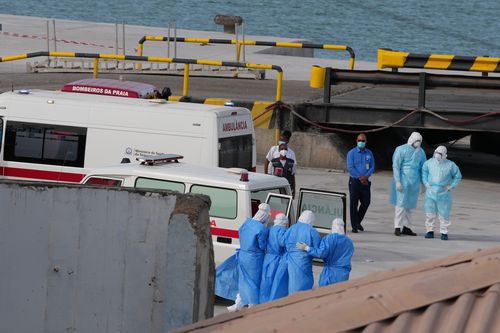
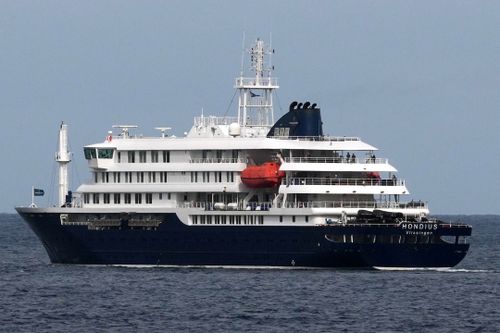
The Dutch-flagged ship, which has become the focal point of a recent outbreak, is scheduled to arrive at Tenerife, an island situated off the West African coast, around midday tomorrow local time, which corresponds to 9pm AEST.
Upon docking, passengers will be escorted to a “completely isolated, cordoned-off area,” as stated by Virginia Barcones, the head of Spain’s emergency services. This measure is part of the immediate response to ensure containment and safety.
Due to the restrictions, passengers will not be allowed to remain on the island or utilize commercial flights to return home. As a result, countries are expected to assist in repatriating their citizens from the island.
The Australian Centre for Disease Control is actively collaborating with states and territories to determine quarantine protocols, health surveillance, and testing procedures for the passengers.
According to a spokesperson from the Department of Foreign Affairs and Trade (DFAT), none of the Australian passengers have exhibited symptoms of the virus. The situation is being closely monitored to ensure their health and safety.
“DFAT consular officials are en route to Tenerife to offer consular support and coordinate response actions in conjunction with local authorities and international partners,” the DFAT spokesperson informed.
“We are considering options for the safe repatriation of the four Australians and permanent resident.
“Our priority is the safety of the community.”
Yesterday, the WHO said a flight attendant on a plane briefly boarded by an infected cruise passenger has tested negative for hantavirus.
Her possible infection had raised concerns about the virus’s potential transmissibility.
The flight attendant’s negative result should ease concerns among the public, said Christian Lindmeier, a WHO spokesman. “The risk remains absolutely low,” he said.
Hantavirus is usually spread by the inhalation of contaminated rodent droppings and is not easily transmitted between people.
But the Andes virus detected in the cruise ship outbreak may be able to spread between people in rare cases. Symptoms usually show between one and eight weeks after exposure.
Health authorities across four continents were continuing to track down and monitor more than two dozen passengers who disembarked the ship before the deadly outbreak was detected.
They were also scrambling to trace others who may have come into contact with them since then.
Countries scramble to track passengers who disembarked
On April 24, nearly two weeks after the first passenger had died on board, more than two dozen people from at least 12 different countries left the ship without contact tracing, Dutch officials and the ship’s operator said.
It wasn’t until May 2 that health authorities first confirmed hantavirus in a ship passenger, the WHO said.
The KLM flight attendant who tested negative for the virus was working on a flight headed from Johannesburg to Amsterdam on April 25 and had later fallen ill.
She was taken to an isolation ward at an Amsterdam hospital on Thursday.
The cruise passenger, briefly aboard that flight, a Dutch woman whose husband died on the ship, was too ill to stay on the international flight to Europe and was taken off the plane in Johannesburg, where she died.
The Dutch public health service is currently undertaking contact tracing on passengers from the flight who had contact with the ill woman before she left the plane.
On Friday, UK health authorities said a third British national who had been a passenger on the ship is suspected of being infected with hantavirus.
The UK Health Security Agency said the person is on the island of Tristan da Cunha, a remote British overseas territory in the south Atlantic, where the ship stopped in April.
There was no word on the condition of the person.
Spanish health officials said Friday a woman in the southeastern Spanish province of Alicante has symptoms consistent with a hantavirus infection and is being tested.
She was a passenger on the same flight as the Dutch woman who died in Johannesburg after travelling on the cruise ship and contracting the virus, Secretary of State for Health Javier Padilla told reporters.
Authorities in South Africa are working to trace contacts of any passengers who previously got off the ship.
They have focused mainly on an April 25 flight from the remote island of St. Helena in the South Atlantic to Johannesburg, the day after some passengers disembarked.
Spanish authorities detail disembarkation plans
Officials sought to reassure the public in the Canary Islands about possible exposure to the virus among the general population.
Spanish officials said that once the ship reaches Tenerife, passengers will be evacuated in small boats to buses only after their repatriation flights are ready to take them.
Passengers will be transported in isolated and guarded vehicles, officials said, adding that the parts of the airport they travel through will be cordoned off.
Spain has requested medically equipped aircraft in case passengers report symptoms, Barcones said, in order to avoid any contact with the general population, but it wasn’t known if those would be available.
The US agreed to send a plane to repatriate the 17 Americans on board the cruise ship.
Those passengers will be quarantined at the National Quarantine Unit at the University of Nebraska Medical Centre and Nebraska Medicine, the hospital said in a statement.
The dedicated biocontainment and quarantine unit in Omaha was previously used to treat Ebola patients and some of the first COVID-19 patients.
Nebraska Medicine is one of a handful of hospitals in the US with specialised treatment units for people with highly dangerous infectious diseases.
“We are prepared for situations exactly like this,” Dr Michael Ash, Chief Executive of Nebraska Medicine, said in a statement.
The British government also said it will charter a plane to evacuate the nearly two dozen British nationals on board.
NEVER MISS A STORY: Get your breaking news and exclusive stories first by following us across all platforms.


