
Share this @internewscast.com
Afghanistan finds itself at the lower end of the passport power spectrum, allowing its citizens entry into just 24 nations without needing a visa.
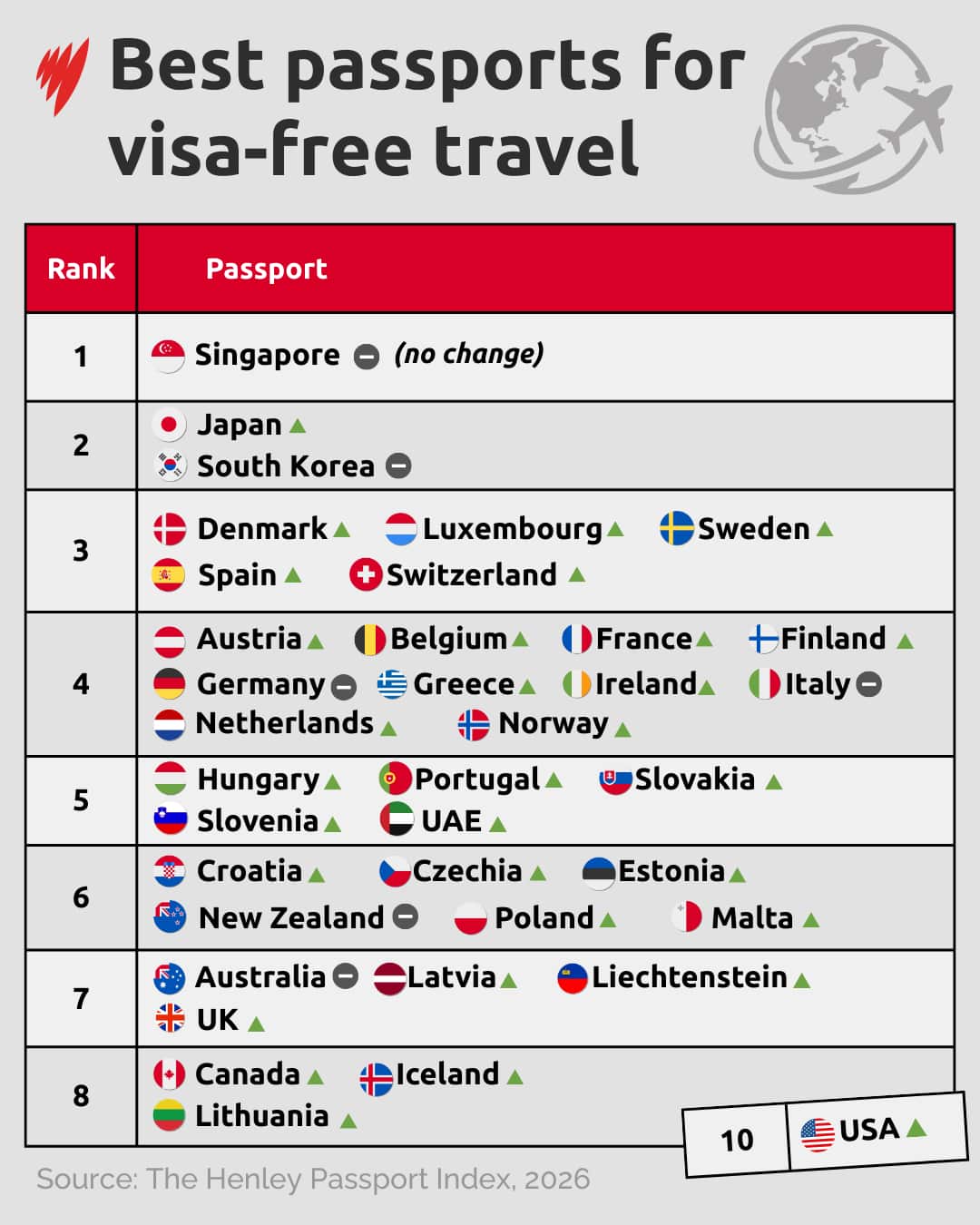
The latest rankings for the world’s most powerful passports have been unveiled. While Australia maintains its position, the United States and the United Kingdom have seen a dip in their standings.
In 2026, the list of top passport holders is led by Singapore, which grants access to 192 destinations. Following closely are Japan and South Korea, each with 188. A cluster of European nations, including Denmark, Luxembourg, Spain, Sweden, and Switzerland, holds the third spot with 186 destinations. Meanwhile, countries such as Austria, Belgium, Finland, France, Germany, Greece, Ireland, Italy, the Netherlands, and Norway share the fourth position with 185. Other notable mentions include Hungary, Portugal, Slovakia, Slovenia, and the United Arab Emirates, all providing access to 184 destinations. Croatia, the Czech Republic, Estonia, Malta, New Zealand, and Poland follow closely with 183. Australia shares a spot with Latvia, Liechtenstein, and the United Kingdom with 182 destinations. Canada, Iceland, and Lithuania come next, offering 181 destinations, while Malaysia provides access to 180. The United States trails with 179 visa-free destinations.
The disparity between the top and bottom-ranked passports has grown significantly over the last two decades, now standing at a gap of 168 destinations compared to 118 in 2006.
Ten European nations are tied for the fourth position, while New Zealand, a close neighbor to Australia, slightly outpaces it by ranking sixth.
The recovery of some passport standings comes with reservations, as the United States has experienced the second-largest drop this year—following the UK—losing visa-free access to seven countries.
How passports have changed over 20 years
The UK has seen the fourth-largest decline, dropping from third to seventh over the same period.