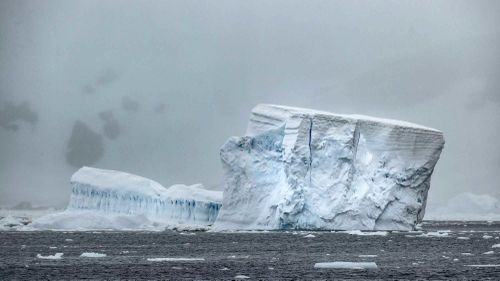

Glaciers in Antarctica on February 07, 2022. A new study suggests even if the world meets its climate targets it may not be enough to save the planet's ice sheets.
The world’s ice sheets are on course for runaway melting, leading to multiple feet of sea level rise and “catastrophic” migration away from coastlines, even if the world pulls off the miraculous and keeps global warming to within 1.5 degrees Celsius, according to new research.

A group of international scientists set out to establish what a “safe limit” of warming would be for the survival of the Greenland and Antarctic ice sheets.

They pored over studies that took data from satellites, climate models and evidence from the past, from things like ice cores, deep-sea sediments and even octopus DNA.

What they found painted a dire picture.
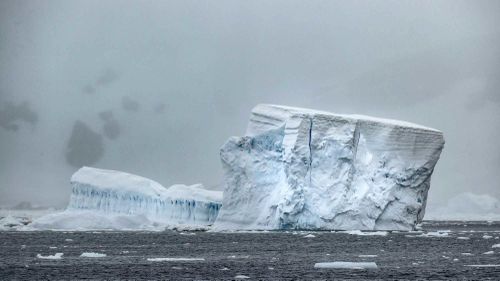
Glaciers in Antarctica on February 07, 2022. A new study suggests even if the world meets its climate targets it may not be enough to save the planet's ice sheets.
Glaciers in Antarctica on February 07, 2022. A new study suggests even if the world meets its climate targets it may not be enough to save the planet’s ice sheets. (Getty)

The world has pledged to restrict global warming to 1.5 degrees Celsius above pre-industrial levels to stave off the most catastrophic impacts of climate change.

However, not only is this limit speeding out of reach — the world is currently on track for up to 2.9 degrees of warming by 2100. But the most alarming finding of the study, published Tuesday in the journal Communications Earth and Environment, is that 1.5 might not even be good enough to save the ice sheets.

Even if the world sustains today’s level of warming, at 1.2 degrees, it could still trigger rapid ice sheet retreat and catastrophic sea level rise, the scientists found.

The Greenland and Antarctic ice sheets together hold enough fresh water to raise global sea levels by around 65 metres — an unlikely scenario but one that must be acknowledged to fully understand the risk.

Since the 1990s, the amount of ice they’ve lost has quadrupled; they are currently losing around 370 billion tonnes a year. Ice sheet melting is the dominant contributor to rising seas and the rate of annual sea level rise has doubled over the past 30 years.
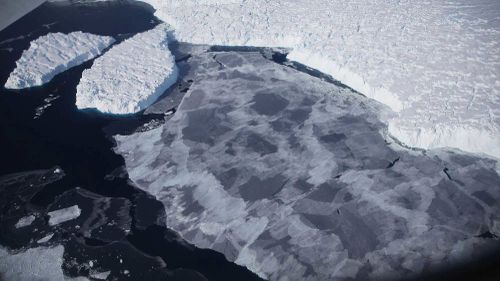
Ice floats near the coast of West Antarctica on October 28, 2016. Scientists are concerned the West Antarctic Ice Sheet may be in a state of irreversible decline directly contributing to rising sea levels.
Ice floats near the coast of West Antarctica on October 28, 2016. Scientists are concerned the West Antarctic Ice Sheet may be in a state of irreversible decline directly contributing to rising sea levels. (Getty)

Multiple studies suggest 1.5 degrees of warming is “far too high” to prevent rapid ice sheet retreat that would be irreversible on human timescales, and the world should prepare for many feet of sea level rise over the coming centuries, according to the study.

“You don’t slow sea level rise at 1.5, in fact, you see quite a rapid acceleration,” said Chris Stokes, a study author and glaciologist at Durham University.

It’s an existential threat to the world’s coastal populations. Around 230 million people live less than 1 metre above sea level. Even small changes in the amount of ice held in the ice sheets will “profoundly alter” global coastlines, displacing hundreds of millions of people and causing damage that stretches the limits of adaptation, the study found.

Seas could surge by 1 centimetre a year by the end of the century, within the lifetimes of young people now, the scientists found.

At this level, which equates to 1 metre a century, “you’re going to see massive land migration on scales that we’ve never witnessed since modern civilisation,” said Jonathan Bamber, a study author and glaciologist at the University of Bristol.

There are still huge uncertainties about where tipping points lie. The way climate change unfolds is not linear and it’s unclear exactly when warming might trigger rapid retreat and even collapse.

What’s hugely concerning, the study authors say, is that the best estimates of “safe” temperature thresholds for saving the ice sheets keep going down as scientists better understand their vulnerability to climate change.

Early modeling suggested temperatures would need to hit around 3 degrees of warming to destabilise the Greenland ice sheet, for example, but recent estimates suggest it would only take around 1.5 degrees.

To avoid the rapid collapse of one of more ice sheets means limiting global warming to closer to 1 degree above pre-industrial levels, the study authors concluded.

This would require drastic cuts to the amount of fossil fuels humans burn, something which looks exceptionally unlikely as countries including the US continue to embrace oil, coal and gas.

The world is already starting to see some of the worst-case scenarios play out in terms of ice loss, Stokes said.

“There’s very little that we’re observing that gives us hope here,” he said. “The absolute best-case scenario is that sea level rise is slow and steady,” he added.

The findings don’t mean the world should give up on climate targets, as every fraction of a degree of warming translates to worse impacts, Stokes said.

“Limiting warming to 1.5 will be a major achievement. It should absolutely be our target, but in no sense will it slow or stop sea level rise and melting ice sheets.”

You May Also Like

Bethany Survives Laos Methanol Poisoning Tragedy, While Friend Tragically Succumbs

READ MORE Coming to terms Simone out the front of the Nana…
Power outage caused by burst water main Melbourne CBD

Severe Carpark Flooding Triggers Widespread Power Outage in Melbourne

A mass power shutdown across Melbourne’s CBD triggered by a burst water…

Trump Advises Caution: Urges US Negotiators to Delay Iran Peace Agreement

In a world where imagery speaks louder than words, the power of…
Scott Morrison has delivered a concession speech to devastated Liberal supporters after calling Anthony Albanese to congratulate him on Labor winning power for the first time since 2013

Historic Shift: Scott Morrison Concedes in Australia’s 2022 Election Upset

Scott Morrison addressed a heartbroken crowd of Liberal Party supporters with a…
Six 'ISIS brides' and 14 children set to arrive in Australia tomorrow

Australian Return of Six ‘ISIS Brides’ and Their 14 Children Scheduled for Tomorrow

A second cohort of so-called ISIS brides is expected to soon arrive…

Iranian Diplomat Engages in Peace Negotiations in Qatar Amid US and Iran’s Tempered Expectations

In a stunning feat of athleticism and strategy, the recent showdown on…
Failed Australia Day bombing accused faces court

Australia Day Bomb Plot Suspect Faces Court: Latest Updates and Insights

A man accused of hurling a homemade explosive into a crowd during…

Tokyo Shopping Center Incident: Suspected Spray Attack Hospitalizes 24

IN BRIEF More than 25 people were taken to the hospital after…
Prime Minister Anthony Albanese during a press conference at Parliament House in Canberra.

Comprehensive Business Consultation on Tax Reform Initiated by Labor in Response to Mounting Criticism

The federal government is expanding its consultation on proposed tax reforms to…

Israel’s ‘TikTok Minister’: Unraveling the Controversial Past and Future of This Social Media Maverick

A ‘fringe figure’ with growing youth support READ MORE Ben-Gvir has often…
The victim of a horror shark attack in Far North Queensland has been identified as Cairns father Michael Jensz.

Cairns Spearfisher and Father Confirmed as Victim in Tragic Shark Attack

Michael Jensz, 39, was enjoying his lifelong passion of spearfishing with mates…
Alice Springs Police

Lidia Thorpe Emotional as Police Decide Against Charges in Custody Death Investigation

Nearly a year after the tragic death of Kumanjayi White while in…