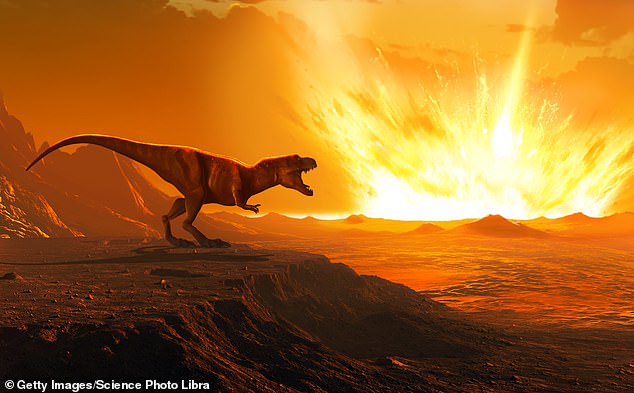

An in-depth exploration has unveiled a vivid depiction of the cataclysmic events triggered by the asteroid that led to the demise of the dinosaurs.
Approximately 66 million years ago, a colossal asteroid, known as Chicxulub, measuring six miles (10 kilometers) in diameter, collided with what is now Mexico.
This monumental impact is renowned for eradicating the dinosaurs, unleashing global chaos, and altering the trajectory of Earth’s history.
The collision generated a massive cloud of dust and soot, obscuring sunlight and causing temperatures to drastically drop. In its aftermath, more than half of Earth’s animal and plant species faced extinction.
Despite its destructive power, this event also set the stage for mammals to flourish and eventually led to the emergence of humans.
Professors Michael Benton from the University of Bristol and Monica Grady from The Open University have now provided a detailed account of the sensory experience during this historic impact.
‘The event triggered instant changes to our planet and its atmosphere and led to the extinction of the dinosaurs and about half Earth’s other species,’ they wrote on The Conversation.
‘But what would it have been like to experience such a gargantuan impact? Would you have died or survived? As experts on meteoritics and palaeontology, respectively, we’ve created a detailed timeline, based on decades of research, to take you right there.’
T–minus one day
The experts said that it would have been ‘pleasantly warm’, about 26°C (79°F), and wet at ‘ground zero’ at the time.
The asteroid, which has been visible in the sky at night for about a week, can now be seen in the daytime. It looks like a star or planet getting gradually brighter.
T=0 (impact)
A bright light is followed by a sonic boom as the asteroid hits the Yucatán Peninsula in southeast Mexico.
Anything near the impact site would have been incinerated instantly, the experts said.
‘The asteroid is so huge that it almost certainly hits the ground before any living creature near the impact zone has time to run for cover,’ they wrote.
Even if you were up to 1,242 miles (2,000km) from the epicentre, you’d have been killed quickly by thermal radiation and supersonic winds.
The impact famously wiped out the dinosaurs, who were the apex predators at the time, and caused worldwide devastation (file photo)
The Chicxulub asteroid slammed into a shallow sea in what is now the Gulf of Mexico around 66 million years ago
T–plus 5 minutes
Winds ‘ease’ to those of a category 5 hurricane, flattening everything within 1,500km (932 miles) of the impact.
Atmospheric temperatures in the region rise to 226.85°C (440°F) and the air fills with superheated steam.
‘Next come the tidal waves, triggered by the vast quantities of displaced rock and water,’ the experts said. ‘These 100–metre mega tsunamis first strike the shores of what is now the Gulf of Mexico.’
Anyone up to 1,864 miles (3,000km) away who survived the first few seconds would likely die from overheating, earthquakes, hurricanes, fires, tsunami–driven floods or being hit by impact melt.
T–plus one hour
‘Shockwaves on land and sea are only minor inconveniences compared with the fire that is still radiating down from the sky,’ they wrote.
A belt of dust has circled the globe. The skies begin to darken in places as far away as New Zealand and Denmark.
This artist’s reconstruction depicts North Dakota in the first months following the impact of an asteroid off Mexico’s coast 66 million years ago, showing a dark, dusty and cold world in which the last non–avian dinosaurs were on the edge of extinction
T–plus one day
Huge tsunamis move east across the Atlantic and west across the Pacific, still reaching 50m (164ft) high.
The burning sky triggers wildfires across the globe. In what is modern Europe and Asia, the skies continue to fill up with dust and soot. Temperatures start to drop as sunlight is blocked.
‘Trees and plants in general, including phytoplankton, close down as if for winter, unable to photosynthesise,’ the experts explained. ‘Any animals that rely on warm conditions ultimately hunker down and die.’
T–plus one week
It’s getting darker and darker, with a global drop in surface temperatures of at least 5°C (9°F).
‘This means that most of the dinosaurs and other large flying and swimming reptiles probably die from freezing within the course of this first week,’ they said. ‘Cooling temperatures and cloud cover also lead to rain. But not just any rain. Storms of acid rain fall across the Earth.’
Plants and animals on land and in shallow seas succumb to this corrosive rain while rotting vegetation, choking smoke and sulphur aerosols combine to make the planet stink.

Today, the event is marked by a thin layer of sediment called the K–Pg boundary, which can be found throughout the world in marine and terrestrial rocks, dated to 66 million years ago (pictured here in Zumaia, Spain)
T–plus one year
The atmosphere is still filled with dust and the sun hasn’t shone for a year. Average temperatures are now 15°C (27°F) lower than before the impact.
The rotted skeletons of dinosaurs and marine reptiles are scattered everywhere. Small animals like mammals the size of rats and insects nest in crevices. More than 50 per cent of plants have died out.
T–plus 10 years
Earth is still in the grip of a fierce winter. Inland lakes and rivers around the world are iced over.
‘Clearly, there were no humans about at this time – there weren’t even any larger mammals,’ the experts said.
‘But given the only species that survived were those that could burrow or live below water, it is unlikely that you could have survived this long.’
However, life slowly begins to rebuild far away from the impact site as turtles, smaller crocodiles, lizards, snakes, some ground–dwelling birds and small mammals repopulate.
T–plus 66 million years
It is estimated that half the species of plants and animals alive at the end of the Cretaceous disappeared.
But the extinction of the dinosaurs led to the successful spread and evolution of mammals.
‘It is salutary to think that without the asteroid collision, primates might never have reached the level we are at today,’ the experts concluded.
‘But it is equally salutary to consider that modern humans are causing some of the same changes to the atmosphere that ultimately killed our reptilian forebears and may one day also lead to our own demise.’


