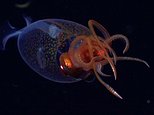


One of nature’s mightiest beasts has never before been documented in its natural environment – until now.
Scientists have captured the first ever footage of a live colossal squid – the largest invertebrate on the planet.
A breathtaking 4K video filmed in the depths of the ocean by California’s Schmidt Ocean Institute reveals a rare creature with a see-through body and eight pink tentacles.
Colossal squid can grow up to 23 feet (7 metres) and weigh as much as 500kg, making them the heaviest invertebrate on the planet.
But this specimen, which looks like a delicate glass sculpture, is just a ‘teenager’ – measuring 11 inches (30cm).
Dying colossal squid adults have previously been filmed by fishermen, but the species has never been seen alive at depth before.
Expedition chief scientist, Dr Michelle Taylor at the University of Essex, called the footage ‘stunning’ and ‘beautiful’.
‘The squid is a teenager and none have ever been filmed alive before in their natural habitat, juvenile or adult,’ she told MailOnline.
“Adult specimens typically avoid remotely operated vehicles. We probably encountered this juvenile off guard, and its reaction was to remain very still, hoping we weren’t predators.”
This sighting occurs 100 years after the colossal squid was first discovered and described in 1925, initially identified from specimens found in the stomach of a captured sperm whale.
This incredible new sighting occurred on March 9 this year during an expedition near the South Sandwich Islands in the South Atlantic Ocean.
Schmidt Ocean Institute’s remotely operated vehicle (ROV) SuBastian was at a depth of 1,968 feet (600 metres) as it was livestreaming the footage.
However, those watching, including Dr Taylor, did not know the significance of what they were seeing on the screen.
‘At the time, not being a squid expert and regrettably having none on board the ship, we did not realise that we had seen a colossal squid,’ Dr Taylor told MailOnline.
‘We knew it was a beautiful glass squid so paused on the descent to watch it; why would you not, it’s stunning.’
Only later when a team of scientists including Dr Bolstad and Dr Aaron Evans, an independent squid expert, reviewed the footage could its identity be verified.
Distinguishing characteristics of colossal squid are hooks on the ends of the two long tentacles and in the middle of each of the eight shorter arms.
When they saw the arm hooks, Dr Evans ‘started hyperventilating’, he told a press briefing announcing the footage on Tuesday.
Fortunately no attempts to catch the creature and bring it to shore were made, unlike other colossal squid specimens.
Back in 2007, the largest recorded colossal squid, a female, was captured by a New Zealand fishing boat in the Ross Sea off Antarctica.
The squid was dying when it was captured and photographed before its corpse was taken back to New Zealand for scientific study.
Dr Taylor said seeing a live specimen in its natural habitat is so important because we get to observe finally observe its biology and ecology.
‘For example, see how it holds itself in the water column, how is moves, its behaviours – none of this is possible with dead specimens,’ she said.
As well as being the world’s largest invertebrate, the colossal squid (Mesonychoteuthis hamiltoni) is the world’s largest squid species and a member of the glass squid family (scientifically known as ‘Cranchiidae’).
It is not to be confused with the giant squid (Architeuthis dux), which is similarly large and elusive but has been seen in its deep sea habitat before.
Little is known about the colossal squid’s life cycle, but eventually, they lose the transparent appearance of the juveniles, as seen in this new clip.
It comes shortly after the first confirmed footage of the glacial glass squid (Galiteuthis glacialis) in the Southern Ocean near Antarctica, taken in January.
G. glacialis is another glass squid species that has never been seen alive in its natural environment before – although adults only reach a maximum mantle length of 20 inches (50 cm).
‘The first sighting of two different squids on back-to-back expeditions is remarkable and shows how little we have seen of the magnificent inhabitants of the Southern Ocean,’ said Dr Jyotika Virmani, Schmidt Ocean Institute’s executive director.
‘Fortunately, we caught enough high-resolution imagery of these creatures to allow the global experts, who were not on the vessel, to identify both species.’


