Share this @internewscast.com
When Zac Altman returned to Australia, he didn’t foresee that a challenging path to getting rediagnosed with ADHD would lead him to create a business aimed at addressing system shortcomings.
Altman founded Kantoko, a telehealth platform that provides ADHD assessment and care through a subscription model. After his ADHD diagnosis in the United States, he came back to Australia, only to find that he had to restart his diagnosis process entirely.
“I was already diagnosed, already on the medication, and had the documentation. I assumed it would be straightforward. However, for me, it was quite challenging,” he shared with SBS News.
“If I had begun the process in Australia, I doubt I would have navigated it due to the significant obstacles and burdens involved.”

Altman’s experiences highlight a larger problem in Australia’s ADHD diagnosis and treatment landscape: Despite increased awareness and demand, the system is struggling to keep up, with some states trailing behind.

A young man in a black round-neck T-shirt is smiling.

Zac Altman says he would never have founded his ADHD telehealth business if he hadn’t struggled with the diagnosis process himself. Source: Supplied

A postcode lottery

All states and territories have different laws governing how stimulant medications — commonly prescribed to treat ADHD — can be prescribed and dispensed.
In some places, the process is more streamlined. In others, patients face stricter regulatory barriers — often accompanied by longer wait times and higher costs.
Dr Roger Paterson, a psychiatrist based in Western Australia, said there was “always a postcode privilege for all levels of healthcare”.
“ADHD treatment is no different,” he told SBS News.
He said ADHD diagnosis and treatment rates have surged in Australia — but not uniformly.
“We’re still below the prevalence rates … but some states and territories have caught up quicker than others.” Paterson told SBS News.
Patterson said South Australia, Tasmania, Victoria and the Northern Territory remain the slowest to catch up, while Western Australia — which once lagged behind — has now reached similar levels to Queensland.
“No-one really knows why [some states lag], beyond the NT not having many specialists — paediatricians or psychiatrists. But they are all gradually catching up to the ADHD prevalence rates.”
Prevalence refers to the proportion of a population that is affected by ADHD.

Although there are no Australian adult prevalence studies for ADHD using the latest DSM-5 criteria, research suggests that ADHD prevalence in Australia likely matches international figures — estimated between 2 and 6 per cent of the population, according to the Australasian ADHD Professionals Association.
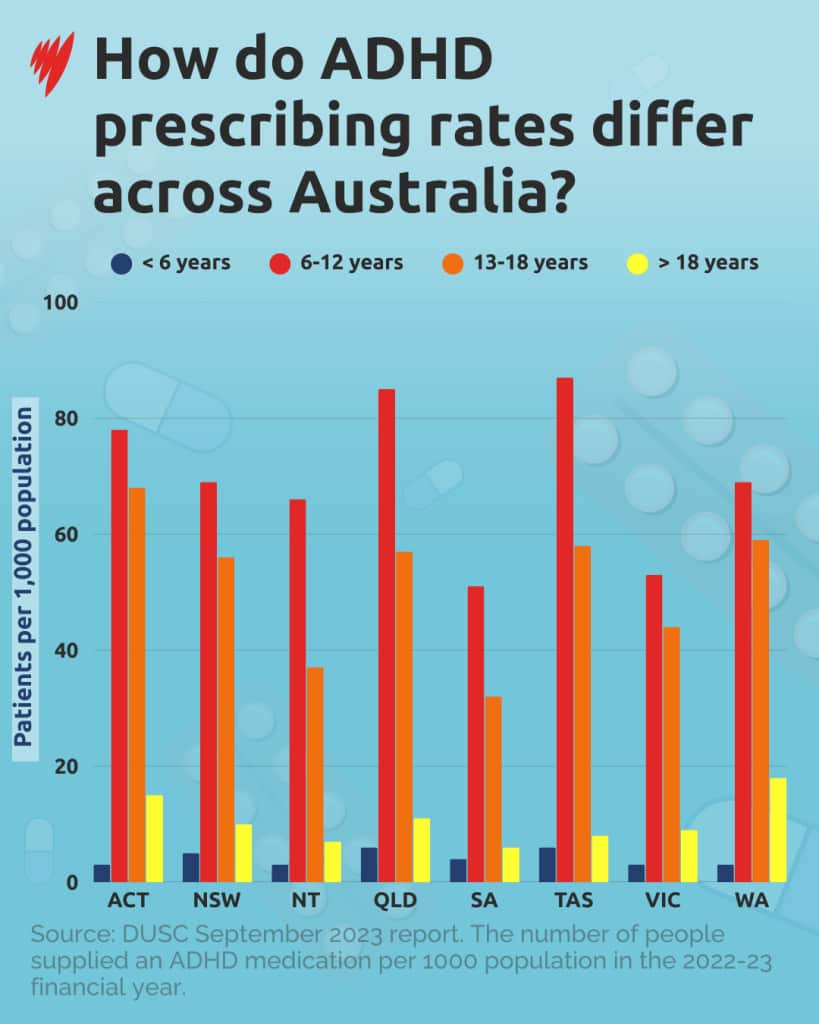
A graph showing ADHD prescribing rates across Australia.

Rates of prescribing vary across states and territories, reflecting the different jurisdictional laws about stimulant prescribing. Source: SBS News

Additionally, the federal government’s Drug Utilisation Sub Committee September 2023 report found differences in the rates of prescribing across states and territories, which the report says reflects different laws across jurisdictions.

Adult rates of prescribing were significantly higher in Western Australia and the ACT compared to the other states and the Northern Territory.
The federal Senate inquiry into ADHD, handed down in November 2023, examined the barriers to consistent, timely and best-practice assessment of ADHD.
It heard those living in regional and rural areas were subject to even more barriers to care, with reduced access to specialists, longer wait times and higher costs.
Altman said the differences were most pronounced in Kantoko clients moving interstate who had to navigate different jurisdictional regulations, sometimes requiring them to find an entirely new specialist.

“Expecting every psychiatrist to know each nuance across the country seems unrealistic… which is why I believe we should implement a national standard for these matters,” he stated.

A patchwork system with no national rules

Altman said going through the assessment process in Australia can feel like “a roll of the dice” due to a lack of national rules.
He said he paid about $1,500 out of pocket to be rediagnosed in his first year back in Australia — including an upfront $1,000 fee to secure a psychiatrist appointment in NSW. He said he was fortunate to have leftover medication from the US to tide him over in the months he waited, but he knows others aren’t so lucky.
“It’s the luck of the draw,” he said.

The inquiry heard that of those who did have positive experiences of ADHD assessment and diagnosis, “many attributed their experience to luck” or to doctors and psychiatrists who helped them access services.

There is no national framework for ADHD, despite it being a key recommendation in the inquiry.
The inquiry heard wait times were found to be “significant”, typically between six and 18 months for an initial appointment, while the Australian Association of Psychologists Inc said the number of mental health professionals has not kept up with the demand for services.
The public system rarely treats the condition except in children, pushing adults seeking a diagnosis to the private sector. As specialists set their own fees with no cap, people can be subject to high fees.

The ADHD Foundation said it had observed some professionals charge up to $5,000 for assessments.

‘Kantoko wouldn’t exist if Australia nailed it’

In response, ADHD telehealth services like Kantoko have cropped up. Operating completely online, these clinics promise shorter wait times — but sometimes at a greater cost.
Kantoko operates under a subscription model. Medicare does not cover any fees.
In exchange, patients are promised an ADHD assessment by a qualified psychiatrist, follow-up appointments with mental health doctors and prescription renewals.

“Kantoko wouldn’t exist if Australia had nailed it,” Altman said. “I wouldn’t have gotten so frustrated that I started this business and embarked on this journey if it were easy-to-access and affordable.”

But the Senate inquiry heard concerns about the growing telehealth service model, saying that while it was helpful for those in regional areas, it has also driven up risks associated with “inadequate assessment and misdiagnosis”, according to the Australian College of Mental Health Nurses.

The Canberra and Queanbeyan ADHD Support Group, a volunteer-run local group, said the clinics offered “exceedingly high fees delivering a quick turnaround” with concerns of “price gouging”.

The GP debate: solving shortages or lowering the bar?

As the system plays catch-up, a key recommendation from the inquiry was the development of uniform and nationally consistent ADHD prescribing rules — the only recommendation of the 15 that the government accepted in full.
But the government said the establishment of prescribing arrangements, including increased GP involvement, was a matter for state and territory governments.
NSW, ACT, SA and WA have committed to reforms that will allow specially trained GPs to prescribe ADHD medication independently from 2025 and 2026.
They’ll join jurisdictions like Queensland, where GPs have been able to prescribe certain ADHD medications for children without prior approval since 2017.

While some say it could ease bottlenecks and encourage holistic care, others warn it risks lowering the standards of care.

Paterson said the current model is for specialists to handle diagnosis and stabilisation, before shifting to a shared care arrangement with GPs — known as co-prescribing. He’s sceptical of political moves to shift ADHD treatment onto GPs in an effort to play catch-up.
“Some GPs have pushed for taking on initial, independent assessment and prescribing, and politicians push this along as a popular way of reducing waiting lists,” Paterson said.

“This creates a tension between reducing waitlists with more GP involvement on the one hand, but on the other hand, accepting that GP ADHD management may not have the nuance of specialist management.”

There are concerns that relaxing GP restrictions could open the door to so-called ‘dexy clinics’ — where stimulant medications such as dexamphetamines might be handed out too freely, similar to concerns seen with medicinal cannabis.
“There would be less concern about lower GP numbers who are highly trained, and more concern about higher GP numbers who are less trained,” Paterson said. “The worst case scenario is that stimulant medication becomes as accessible as cannabis from the medicinal cannabis clinics.”
But Dr Alison Poulton, a senior lecturer in paediatrics at The University of Sydney and member of ADHD Australia’s advisory board, pushed back against ‘dexy clinic’ fears, saying that ongoing relationships between GPs and patients would reduce risk and encourage more holistic care.

She criticised current restrictions requiring specialist endorsement and fixed dosage limits, arguing they undermine both patient autonomy and the ability of GPs to tailor care.


“It makes complete nonsense of patient autonomy,” she said. “Decisions should be made between the GP and patient, not based on a letter written five years ago.”
Poulton emphasised that GPs, who often have a long-term understanding of their patients, are well placed to make prescribing decisions that reflect changing needs, leading to better functional outcomes.
“I think the GPs are going to do a much better job if they know it’s up to them to make these prescribing decisions rather than to have to consult the specialist.”

Share this @internewscast.com
You May Also Like
The owner of a service station in Sydney has been left fuming after a truck driver stole close to $3000 worth of petrol in one hit.

Brazen Petrol Theft Sparks Outrage: Service Station Owner Fumes Over Fuel Heist

A Sydney gas station proprietor is up in arms after a truck…

Unpacking the Key Issues in the NDIS Overhaul

In Brief Roughly 160,000 Australians are set to lose access to the…
Michelle Stalimeros (pictured) grew up in a 'chaotic' home where alcohol was woven into family life

Weekend Wine Habit Triggered Blackouts and Anxiety, Straining Marriage; Reflecting on Three Years of Sobriety

At first glance, Michelle Stalimeros appeared far from someone struggling with alcohol.…
Benjamin Netanyahu

Israeli Prime Minister Netanyahu Discloses Secret Cancer Treatment Amidst Political Turmoil

Israeli Prime Minister Benjamin Netanyahu quietly underwent treatment for prostate cancer, he…
Ed Sheeran's LOOP world tour got off to a flying start, raking in a staggering £5million per show during its opening leg

Ed Sheeran’s LOOP Tour: Unveiling the £5 Million Per Show Phenomenon!

Ed Sheeran’s LOOP world tour has started with remarkable success, earning an…
Anzac soldiers

Partial Remains of Australian Soldiers from WWI Finally Laid to Rest Over a Century Later

The partial remains of eight Australian soldiers have been laid to rest…
The Australian soldiers who fought epic battle in the 'forgotten war'

Heroic Australian Soldiers Recall Epic Battle in the Overlooked Korean War

Anzac Day falls 75 years after Australian soldiers fought a bloody battle…
Ahead of the Budget delivery on Tuesday evening, Greens housing spokesman Max Chandler-Mather slammed the $9.3billion surplus as evidence of 'how little Labor cares about the housing crisis'

Budget 2024: Albo’s Challenger Unveils Key Oversight by Jim Chalmers

For the second consecutive year, Treasurer Jim Chalmers has announced a budget…

Woolworths Executive Announces Price Reductions Amid Evolving Inflationary Challenges

In brief: The supermarket giants are before Federal Court over accusations of…
Emma Sleep mattress

Mattress Industry Leader Faces $15 Million Penalty for Deceptive Online Advertising

Mattress company Emma Sleep has been ordered to pay a $15 million…
Treasurer Jim Chalmers handed down the Budget on Tuesday night, boasting of a $9.3 billion surplus driven by a strong labour market and increased commodity prices

Budget 2024 Unveiled: $300 Cash Boost for Australians, Student Debt Forgiveness, Tax Cuts, and New Travel Policies by Albanese Government

In a strategic move to garner voter support ahead of elections, the…

Australian Women Confront Tough Decisions Amid National Crisis

in brief Experts are warning that the cost of living crisis is…