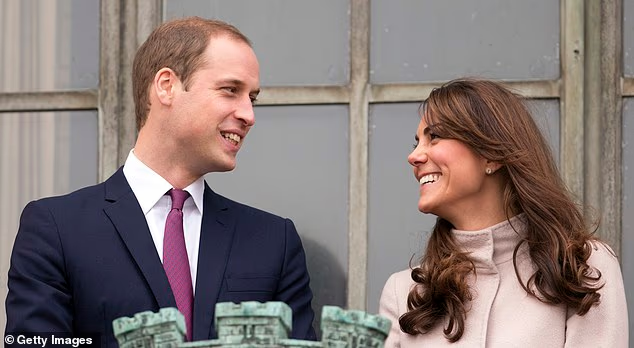

The contrast between father and son could scarcely be greater. King Charles is widely believed to have resented the immense popularity enjoyed by his wife, Diana, while a generation later, the then Prince of Wales William has consistently appeared happy to let Catherine command the spotlight.
A resurfaced clip from 2012 offers a striking example of their different approaches. At the time, Kate was pregnant with the couple’s first child, Prince George.
Royal admirers were captivated when Prince William told his wife, “It’s all you,” after they appeared on the balcony of The Guildhall during their first official visit to Cambridge as the Duke and Duchess of Cambridge on November 28, 2012.
The crowd erupted as Kate, glowing in a pale pink coat dress, stood beside William. Clearly pleased by the warm reception she received, the future King smiled and told her in a private exchange that she was the reason for the adulation—a moment fans viewed as a perfect reflection of their relationship.
The scene stands in sharp contrast to Earl Spencer’s claim that Charles was “extremely jealous of Diana’s star power,” detailed in his new book, Swan Song.
Diana’s younger brother has become embroiled in a bitter war of words with Buckingham Palace over claims that the King once said, “We’ll forget Diana soon enough.” In his book, Spencer described the couple’s 1983 tour of New Zealand and Australia as a decisive moment in their strained dynamic.
“While most husbands would have been delighted and proud to have such an asset for him and his royal brand, the [then] prince was extremely jealous of Diana’s star power.

Royal fans were captivated when Prince William told Kate, “It’s all you,” after they appeared on the balcony of The Guildhall during their first official visit to Cambridge as the Duke and Duchess of Cambridge.
“That much had been clear since the day in Sydney, in 1983, when Diana’s huge popularity with the Australian crowd had riled her husband.”
Spencer wrote that Diana, who was 21 at the time, “craved” Charles’s “support and approval,” but instead encountered an “envy she found perplexing and unfair.”
Buckingham Palace accused Earl Spencer of allowing “grief clouded reasoning” to shape his account after his explosive claims about the period following Diana’s death were reported by the Mail.
In an unusually pointed statement, the Palace said: “While we do not comment on books as a matter of principle, His Majesty is mindful that the pain of fraternal grief can cloud reason, affect judgment and colour memory in ways others do not recognise, even many years after such a loss.”
During his marriage to Diana, Charles allegedly found himself sidelined on several occasions as it became increasingly clear that his bride was emerging as the Royal Family’s biggest star.
On joint engagements, crowds reportedly queued for hours to see Diana, often showing greater enthusiasm for her than for Charles, who was then heir to the throne.
Diana’s popularity was so overwhelming that, during the couple’s first joint royal tour of Wales after becoming the Prince and Princess of Wales, Charles openly acknowledged to cheering crowds that his wife was the person they had come to see.
Throughout their marriage, Diana continued to attract the lion’s share of public attention. Her fashion sense, striking appearance and deep compassion for others made her a powerful presence wherever she went.

The moment contrasts sharply with Earl Spencer’s claim in Swan Song that Charles was “extremely jealous of Diana’s star power.”
Following the globally watched wedding of Charles and Diana, the couple made their first visit to Wales as husband and wife in October 1981.
Although millions had been captivated by the young Lady Diana on her wedding day, the trip is widely regarded as the first occasion on which she won over the British public in person, outshining her husband as he appeared to recede into the background.
Throughout the tour, crowds eagerly turned out to meet the newlyweds but displayed a particular affection for Diana. As the couple visited communities affected by high unemployment and new mothers in maternity units, members of the public were especially drawn to her warmth and presence.
Archive footage of the visit shows the couple being greeted by crowds, who can be heard chanting: ‘We want Princess Di!’
The Princess’s popularity was so stark, it even prompted Charles to tell some royal fans: ‘There’s the person you’ve come to see,’ ITV reports.
Two years later, the royal couple travelled across the world to visit Australia and New Zealand for the first time in a joint engagement.
Once again, Diana’s star shone brighter than her husband’s, as royal fans were desperate to catch a glimpse of the Princess over Charles.
In fact, the contrast in popularity was so stark, it was dramatised in an episode in series four of The Crown, where Josh O’Connor’s Charles shouts: ‘This was supposed to be my tour!’ at Emma Corrin’s Diana.
As a fictional depiction of real-life events, it is a scene that exaggerates the tensions between the pair.
However, the angry exchange is derived from an obvious wedge that had been driven between the couple during the 1983 visit, which may have been down to Diana’s soaring popularity.
The 40-day tour of Australia and New Zealand took place against an already tense background, as the royal visit clashed with a growing republican movement across Australia and serious calls were being voiced for the nation to leave the Commonwealth.
There were also concerns about new mother Diana taking Prince William with her, as she did not want to be separated.
However, aside from a few awkward moments upon arrival, Princess Diana was once again lauded by the local press during the tour, which saw the couple span 30,000 miles.
The Sydney Morning Herald said of Diana: ‘Despite the predictions, Diana, apart from some strain and tiredness, has fared well. She might be made of tougher stuff than many think.’
And as the tour continued it became clear that Princess Diana was the star of the show, with Charles walking in her shadow.
A news report from ABC at the time noted how communities in the Riverland had ‘come to see’ Diana – while also noting her professionality.
The broadcaster said: ‘The Princess seemed more anxious to meet the people than did her husband. She dispensed tidbits concerning Prince William’s health, the weather, and jokingly inquired of an elderly citizen if she had any whiskey in her picnic basket,’ as reported by Vogue.
Clips from the trip showed adoring fans holding up signs for Princess Diana, calling her ‘beautiful’.
Cracks soon began to appear in Charles and Diana’s marriage, with the Prime Minister John Major announcing their divorce in the House of Commons in December 1992.
Following the couple’s separation, Princess Diana’s popularity remained high among members of the public, who still gathered in swathes to meet her during appearances where she carried out charity work following her divorce.
Up until Diana’s tragic death in 1997 in a car crash, she remained popular, with her death itself prompting an outpouring of grief from an adoring British public, who lined the streets to pay their respects during her funeral procession.


