
Share this @internewscast.com
Sanae Takaichi, a staunch conservative who admires Margaret Thatcher, became Japan’s first woman prime minister on Tuesday, but analysts say her rise does not necessarily signal a feminist victory.
Instead, the 64-year-old, who won the ruling Liberal Democratic Party (LDP) leadership this month, has positioned herself as a hardliner focused on defence and economic security.

Following a last-minute coalition agreement, Takaichi was appointed by parliament on Tuesday as Japan’s first female head of government. This marks the country’s fifth leadership change in as many years.

Takaichi’s stance on gender issues positions her on the right wing of the already conservative Liberal Democratic Party (LDP). She is notably against changing a 19th-century law that mandates married couples to share the same surname—a regulation that predominantly results in women adopting their husband’s name.

Although her election represents “a step forward for women’s participation in politics”, she has shown little inclination to fight patriarchal norms, Sadafumi Kawato, professor emeritus of the University of Tokyo, told Agence France-Presse.

“This issue is unlikely to be resolved during her tenure,” remarked Kawato.

Takaichi has been married twice to the same man — a former member of parliament. During her first marriage, she took his name. In the second, he took hers.

Currently, more than 90 percent of cases see wives taking on their husbands’ surnames. Critics—including business groups and some liberal-leaning members within the LDP—argue that this tradition unfairly impacts women’s career prospects. Meanwhile, a small group of conservatives insists that the rule is crucial for maintaining family unity.

Conservative record, Ishin confluence

Like Italy’s first female prime minister Giorgia Meloni, Takaichi is not seen as a trailblazer for women’s rights in Japan, having closely aligned herself with the LDP’s socially conservative platform. Recent public polls show she is more popular among men than women.
“She is a woman who has advocated the LDP’s patriarchal model, in which men are supposed to overwork at the centre of society and women should support them through unpaid care work,” said Yayo Okano, a Doshisha University professor who specialises in feminist political theory.
One prime example is Takaichi’s defence of the legal restrictions that require married couples to share a single surname, Okano added.

The current rule means that wives take their husbands’ names in more than 90 per cent of cases. Critics, including business lobbies and even some liberal-leaning LDP members, say this disproportionately affects women’s careers, while the small group of opponents within the conservative circle calls it indispensable to family unity.

To secure Takaichi’s premiership, the LDP struck a partnership on Monday with the right-wing, small government-oriented Japan Innovation Party, known as Ishin.
Their social security policies, such as a stricter ability-to-pay principle, could tighten support for vulnerable groups including single parents and low-income earners, many of whom are women, said Yoko Otsuka, a professor of welfare policy and gender studies at Ritsumeikan University.

The parties also agreed to promote male-only succession of Japan’s imperial family, which would be “simply sexist” without a rational explanation, Otsuka said.

Nordic levels

As she took office on Tuesday, her surprisingly male-dominated cabinet and socially conservative track record have left some women ambivalent in a country that lags on gender equality.
Takaichi on Tuesday appointed only two female ministers in a 19-member cabinet, matching her predecessor and falling short of her previously announced plan to ensure women’s representation in top posts “not particularly lower than Nordic countries”.
Japan ranked 118th of 148 countries in the World Economic Forum’s latest Global Gender Gap Report, the lowest in the Group of Seven (G7) industrial nations and below most of its Asian neighbours including China, South Korea and the Philippines.
The standing reflects limited presence of women in legislatures, along with a vast pay gap. By contrast, Nordic states lead on political gender equality.
“The line-up she announced betrayed that promise from the outset,” said Tohko Tanaka, a media and gender studies professor at the University of Tokyo.

“This is extremely disappointing and offers no hope for women’s empowerment.”
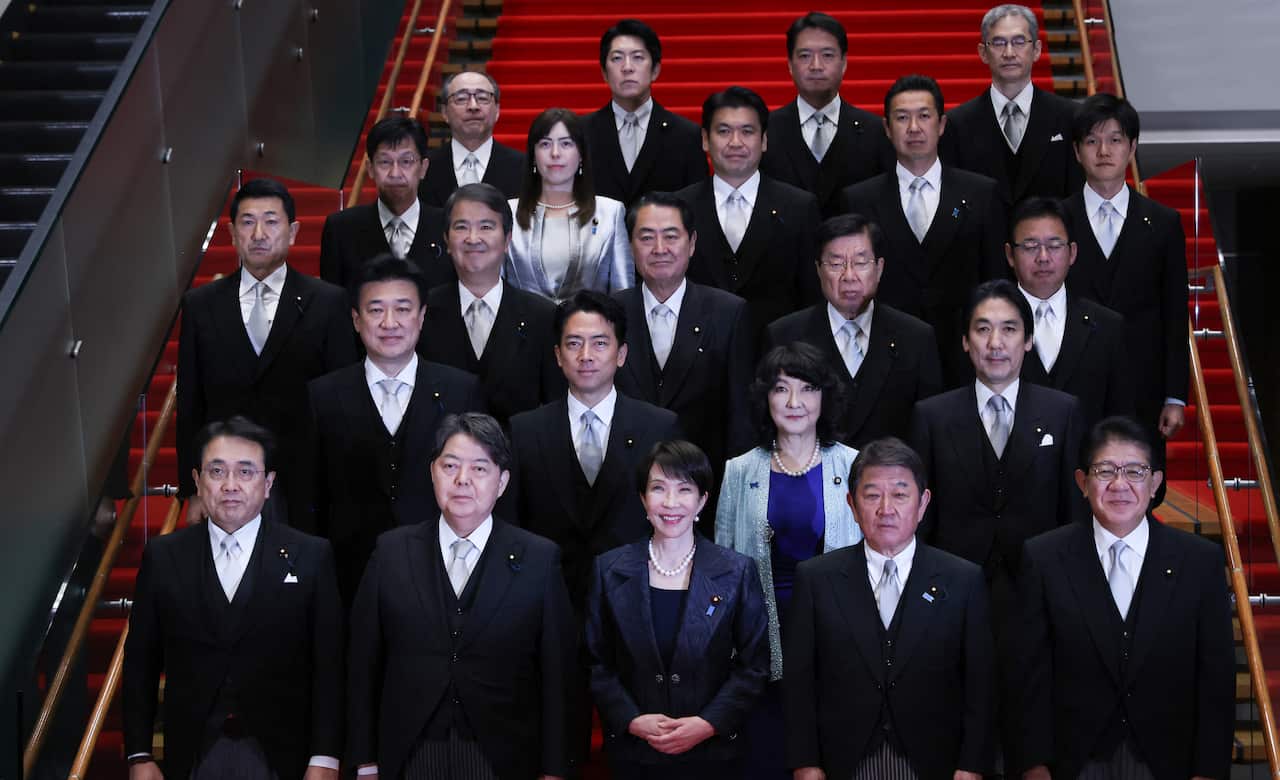
A group of people pose for a photo on a staircase

Sanae Takaichi’s new cabinet has only two women members. Source: AFP / Kaname Yoneyama

When asked about her cabinet’s gender imbalance, Takaichi told a Tuesday press conference that she “prioritised equal opportunity” and “assigned the right people to the right positions”.


Her options were limited, given that only 13 per cent of her Liberal Democratic Party (LDP) politicians are women. The party aims to raise the ratio to 30 per cent by 2033.
Female representation in Japanese cabinets has never topped 30 per cent, while women comprise much bigger portions of Nordic cabinets, ranging from Denmark’s 36 per cent to Finland’s 61 per cent.
Although Takaichi’s “Nordic” reference proved no more than campaign rhetoric, smashing the glass ceiling — alongside her finance minister Satsuki Katayama — was a symbolic step, said Tiina Airaksinen, a senior lecturer in Asian studies at the University of Helsinki.
“It has taken us more than 120 years to come into this situation,” Airaksinen said, referring to the fact that Finland achieved women’s suffrage in the early 1900s. Japan reached the milestone after World War Two.
“She can’t change everything in Japanese society immediately, but she can start the change.”

Share this @internewscast.com
You May Also Like
Beirut Rafik Hariri International Airport in Beirut, Lebanon

Flight Cancellations Leave Australian Travelers Stranded Amid Airspace Shutdown

The sudden closure of airspace throughout the Middle East has thrown travel…

Shamima Begum: Stateless ‘ISIS Bride’ Faces Permanent Exile from Home Country

In brief Shamima Begum made international headlines after travelling to Syria to…
Passengers seated inside an airplane cabin with visible seat belts, legroom, and personal belongings during a commercial flight

Middle East Conflict: What Travelers Need to Know About Potential Flight Cancellations

The intensifying conflict in the Middle East has led to significant disruptions…

Visual Highlights: Sydney Mardi Gras 2026 Celebration

Confetti, glitter, and an abundance of rainbow flags painted the scene as…
Iran has reportedly threatened to pull out of this summer's World Cup after US and Israeli airstrikes killed the country's Supreme Leader, Ayatollah Ali Khamenei (Pictured: Iran's national soccer team in March 2025)

Iran Considers World Cup Exit Amid US Tensions; FIFA Responds to Ayatollah’s Passing

Reports have emerged that Iran is considering withdrawing from this summer’s World…
'Will not be mourned': PM's brutal message after confirmed death of Iranian leader

PM Delivers Candid Response Following Death of Iranian Leader

Prime Minister Anthony Albanese has said Iran’s Supreme Leader Ali Khamenei “will…
'Iran can end this now': World leaders react to US-Israel strikes

Global Leaders Urge Iran to Act Amidst Escalating US-Israel Tensions: A Call for Immediate Resolution

The majority of European and Middle Eastern leaders are hoping to find…

Australian Travelers in the Middle East Advised of Potential Challenges Ahead

Foreign Minister Penny Wong has stated that the recent Iranian counterattacks, resulting…

US and Israel Launch Offensive Against Iran: Real-Time Updates and In-Depth Coverage

On Saturday, U.S. President Donald Trump announced that the United States has…
Fairmont Hotel in Dubai

Australians Advised to Reconsider Travel Plans Amidst Iran-Related Strikes

The Department of Foreign Affairs and Trade has issued a stern warning…

Australia Introduces New Visa Program to Support LGBTQI+ Refugees Seeking Asylum

A decade ago, Ali and his partner made the difficult decision to…
Persian Politicians; Dr. Muhammad Mossadeq -- Persia's Prime Minister and Minister of National Defence, photographed whilst delivering an impassioned radio address. June 10, 1953.

Decades of History Culminate in Attack and Leader’s Assassination

But the events leading up to the dramatic military action date back…