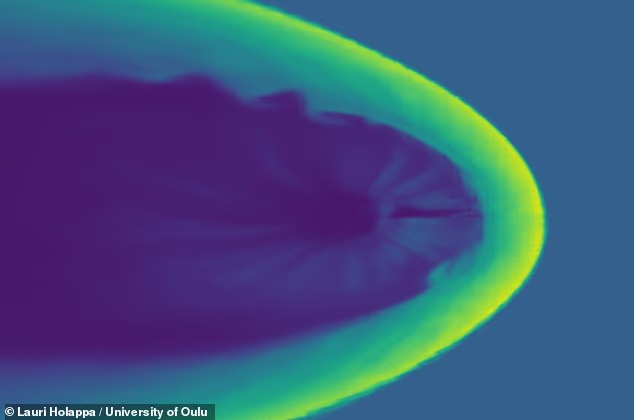

Space “tsunamis” have exposed weak points in Earth’s invisible magnetic shield, revealing where powerful solar storms may be able to penetrate most effectively.
Researchers at the University of Oulu in Finland found that the intense flow of charged particles and energy known as the solar wind does not sweep across Earth uniformly.
Instead, enormous waves develop along the outer boundary of the magnetosphere. These waves allow solar-wind energy to accumulate more intensely in certain parts of the planet’s protective magnetic environment.
The strongest activity appears to develop in the winter hemisphere—the side of Earth turned away from the Sun.
The precise location also depends on the direction of the solar wind’s magnetic field, with the energy becoming concentrated either on Earth’s dawn side or its dusk side.
As a result, higher-latitude countries such as the UK, Canada and Norway could face their greatest solar-storm risk between December and February.
In the Southern Hemisphere, lower-latitude nations including New Zealand, Chile and South Africa may be more exposed during the austral winter, from June through August.
Those regions could find themselves on the front line when severe solar storms strike Earth, potentially disrupting everything from navigation systems to power networks.

Space tsunamis have revealed the weak spots in Earth’s invisible magnetic shield, highlighting the regions where dangerous solar storms can ‘find a way through’
Life on Earth is made possible in part by the magnetosphere, the vast magnetic shield surrounding the planet.
Generated by swirling currents of molten metal deep inside Earth, this field helps deflect the potentially harmful stream of particles carried by the solar wind.
Yet the magnetosphere’s outer boundary is not completely sealed. Earth’s magnetic field is constantly interacting with magnetic currents carried through space by the solar wind.
These interactions drive space weather and create phenomena such as the glowing auroras visible at high latitudes.
When solar flares or eruptions of charged material known as coronal mass ejections reach Earth, however, the same activity can trigger intense geomagnetic storms.
Such storms pose a serious threat to critical infrastructure. The most powerful events can interfere with satellites and radio communications, while in extreme cases they can contribute to widespread power outages.
Their impact has been difficult to forecast partly because solar storms do not affect every part of Earth equally, and scientists have not previously understood exactly what causes that uneven distribution.
Direct observations are also limited because satellites only occasionally travel through the most active regions of the magnetosphere.

The Earth is constantly under bombardment from charged particles and energy in the form of solar wind, but is protected by the magnetic field (illustration not to scale)
For the new study, published in Geophysical Research Letters, the researchers used a computer model covering the entire magnetosphere to examine how these interactions unfold.
Their analysis focused on the waves that arise when the rapidly moving solar wind collides with—or brushes against—the outer edge of Earth’s magnetic field.
These are known as Kelvin-Helmholtz waves, and they can be found all around Earth and the solar system.
You can see Kelvin-Helmholtz waves in wind-whipped clouds, swirling river waters, and even in the clouds of Saturn.
Lead author Dr Lauri Holappa, of the University of Oulu, says: ‘In 2020, when I was visiting NASA as a postdoctoral researcher, I noticed unusual simulation images of the magnetosphere.
‘I later realised that they showed Kelvin–Helmholtz waves at the edge of the magnetosphere, and that the different behaviour of the waves on different sides was part of the same phenomenon.’
Dr Holappa and his co-authors discovered that these waves don’t form neat mirror images as they pass around Earth.
Instead, they appear asymmetrically on either side of the magnetosphere, with the more active areas putting more pressure on Earth’s defensive barrier.

Scientists discovered that the strongest activity forms in the winter hemisphere, which is facing away from the Sun (illustrated)

These findings could help space agencies protect satellites and critical infrastructure from massive solar flares or outbursts known as coronal mass ejections. Pictured: A large coronal hole on the sun that produced a dangerous volume of solar wind
Dr Holappa compares this to what happens when a powerful wave meets a breakwater; it doesn’t divide itself evenly but rather whips around one side more strongly.
In the case of Earth, this happens because the solar wind’s magnetic field is unevenly draped over the magnetosphere.
‘Asymmetries in the wave motion at the edge of the magnetic field have been observed before, but now we were able to show how they arise,’ says Dr Holappa.
These findings have important implications for understanding how space weather forms at the edge of the magnetosphere, and how that process is affected by the seasons.
The researchers say this should help to improve the accuracy of space weather forecasts in the future.
If space agencies have more advanced warning of a powerful geomagnetic storm, they can take measures to protect satellites and power grids from damaging effects.
So, knowing exactly where and when the worst effects will be felt could be critical to keeping the world’s satnavs, messaging services and internet connections up and running.


