Share this @internewscast.com
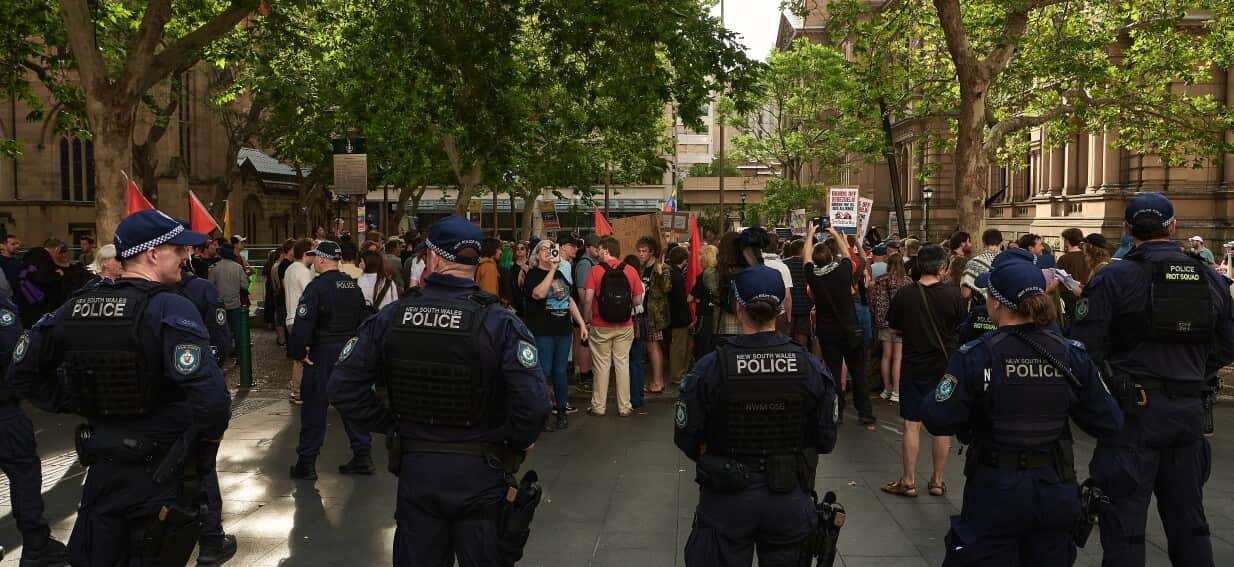
NSW Police commissioner Mal Lanyon announced his decision on Tuesday evening, claiming public assemblies at this time had the potential to “cause fear and public safety issues”.
“This is not about stopping free speech, it’s about making sure that the community has the time to feel safe,” he told reporters in Sydney.
“I urge everyone to demonstrate respect, exercise courtesy, and most importantly, maintain peace,” a spokesperson stated.
Laws rushed through NSW Parliament in the aftermath of a deadly mass shooting at Bondi Beach gave the commissioner the ability to ban protests in key metropolitan areas following a declared terrorist incident.
Lanyon deployed his powers almost immediately after they were granted, restricting protests for two weeks from Christmas Eve.
The declaration restricts public assemblies in Sydney’s southwest, northwest and central metropolitan areas and can be extended fortnightly for up to three months.
All public assemblies since the declaration was imposed have been unauthorised, leaving participants vulnerable to arrest for obstructing traffic or pedestrians.
Despite a ban, several rallies have still occurred, such as a march opposing US military actions in Venezuela. Civil liberties organizations and activists caution that prolonging this ban could hinder individuals from obtaining formal approval to hold protests.
“For all its faults, the [authorisation] process allows the community to have reassurance that they will be treated fairly by police,” NSW Council for Civil Liberties president Timothy Roberts told the Australian Associated Press.
“By not being able to do that, there’s an immediate anxiety about how the police will respond.
“That is a suppression of our rights when the community should be able to freely do that.”
The powers are expected to be challenged in the High Court.