
Share this @internewscast.com
Brief
- Professional mourners are becoming more common in western Kenya for funerals.
- An expert says it’s a result of urbanisation and family sizes shrinking.
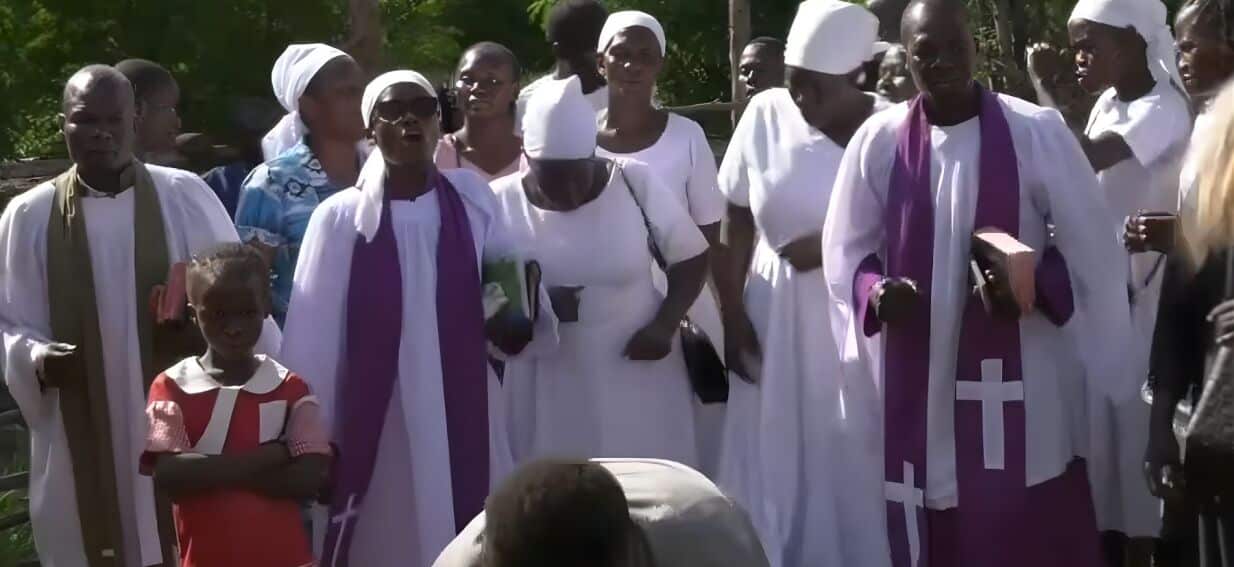
In the serene lakeside town of Rabuor, located in Kenya’s Kisumu region, Victor Ouma has carved out a unique career path as a professional mourner.
Facing challenges in the job market, Ouma discovered an unconventional yet meaningful avenue to earn a living by attending funerals and mourning for individuals with no family to bid them farewell.
“We saw this as a promising opportunity that could help us make a living while steering clear of crime and idleness,” Ouma explained.
But shedding tears is just one aspect of the service. Francis Oyoo, another mourner by trade, highlights that their offerings also include catering and setting up tents for the grieving family.
Their duties commence as soon as the deceased is taken from the mortuary, with the mourners singing heartfelt dirges and crying until the burial takes place.
Oyoo believes their services fulfill a crucial role for those who have few family members to mourn their loss.
“At times a person has no family, but has money, and at least they need somebody or people to come and be with them, stand with them, so that they can give their loved one a better send-off,” he said.
“It comes to a point where they need professional mourners and that is where we come in.”
‘We believe that his spirit is happy’
Georgina Achieng hired professional mourners to cry for her deceased uncle.
She’s a member of the Luo community, which views a crowded funeral procession as a status symbol.
“In our culture as Luo, we believe that if somebody is dead, if you don’t give him a good send-off, his spirit might hover around and maybe haunt some people, like the children or maybe even the family members,” said Achieng, whose late uncle had no immediate family of his own.
“So if you give him a good send-off, we believe that his spirit is happy.”
For the workers, emotions come easily even if the deceased is a stranger, according to Willis Omondi, who manages a group of professional mourners.
“We don’t have to be related to the person. We only have to get the feeling that a human being is dead and then start to cry,” Omondi said.
“Now we will be thinking if it were my relative. That is how it comes, that we can mourn someone who we are not related to.”
Owuor Olunga, a professor of anthropology at the University of Nairobi, said there has been a rise in the use of professional mourners, which reflects broader societal changes in Kenya.
“Urbanisation has sort of replaced our traditional roles,” she said, explaining that family sizes have shrunk as a result.
“So you find that when an individual passes on, the degree to which you have people related to you by blood in the urban centres may not be there,” Olunga said.
“So in such cases, depending on your standing in life, standing in position, in society, you may find that there are all manners of mourners, most of the time not hired by the family, but brought in by your friends or your social network to be able to show your worth.”
— Produced with reporting by the Associated Press
For the latest from SBS News, download our app and subscribe to our newsletter.