Share this @internewscast.com
About 170 years ago, a bundle of stone tools was deliberately buried, or “cached”, near a waterhole in far-west Queensland and never recovered. Why?
Our team’s investigation of this extremely rare site has revealed a long story of Indigenous trade and innovation in the Australian outback.

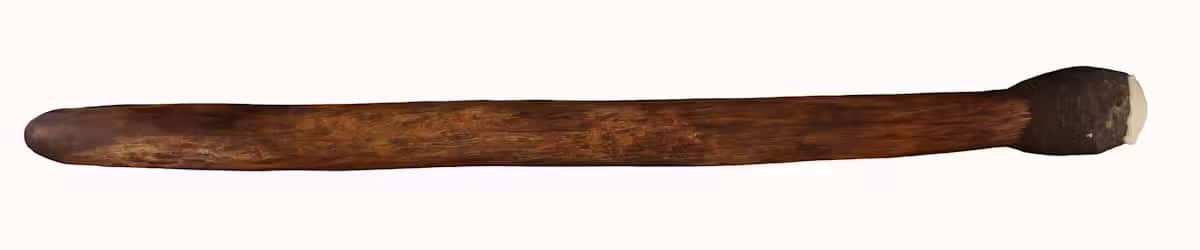
A fascinating example of a stone tula mounted onto a wooden handle using a lump of spinifex resin provides a glimpse into ancient techniques. This ethnographic artifact, captured by Mary-Anne Stone, showcases the ingenuity of its creators. The photograph, attributed to Mary-Anne Stone under a CC BY license, displays the detailed craftsmanship involved in these tools.
We excavated the site in 2023. A handful of stones poking out of the soil turned out to be a pile of 60 large Aboriginal stone “tulas”, deliberately cached just north of Boulia in far western Queensland.
We used scientific methods to analyse the tools, working closely with the Pitta Pitta, who hold Native Title for this place, and with approval from the station property owners.
A tula is a Wangkangurru word (from the Munga-Thirri/Simpson Desert) for a special flaked-stone tool that would be hafted onto a handle and used for woodworking. They were important tools, used across most of the continent to make objects such as boomerangs, wooden coolamon dishes, shields and clapsticks.
Aboriginal cache 2.jpeg

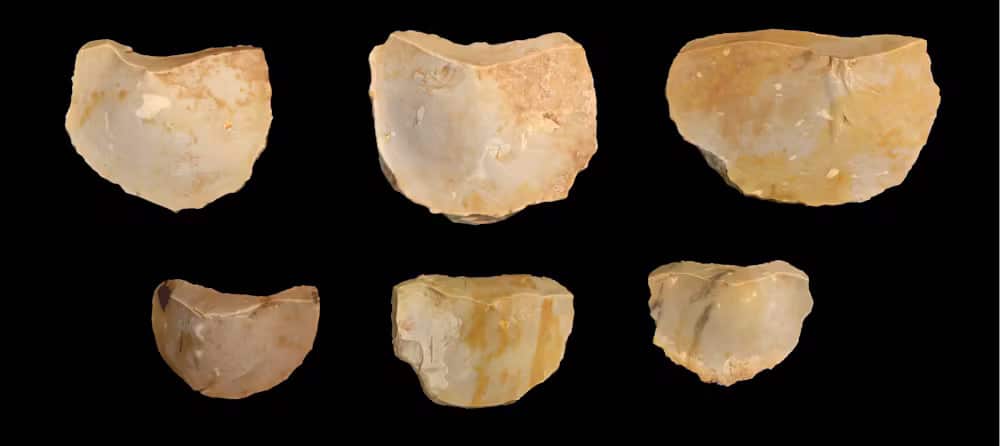
In addition to physical exhibits, 3D models of some of these cached stone tulas further highlight their intricate designs. These digital representations, also credited to Mary-Anne Stone, allow for a closer inspection of the tools’ features without risking damage to the originals. Such models are invaluable for educational purposes and for preserving the knowledge of these ancient practices.

Interestingly, historical accounts suggest that unhafted tulas were often exchanged, hinting at a sophisticated trade network. This particular cache might represent a collection of specially crafted artifacts intended for barter. The deliberate creation and exchange of these tools underscore their significance within the community.
This region’s climate is harsh. Even while we were excavating, bushfires raged to the north, preventing some of the team from joining us. Once we found the cache we knew were were in a race against time to recover the tools before they were washed away in the next flood.
Even when it doesn’t rain in the region, heavy rains in the north flow through the waterways towards Lake Eyre and slowly cover the land in a sea of brown water. After the floods, it dries again, until only the deepest pools hold any water.
The Pitta Pitta people built stone-based shelters as protection from the sun and winter winds. Innovation and connection helped them survive the region’s harsh climates. If they could not find resources locally, they bartered along vast trade routes.
Written and archaeological evidence shows traded goods included stone axes, ochre, pearl shells and more. People also traded a native tobacco called pituri – of which a couple of pounds was reportedly so valuable it could buy “two wives, husbands or many goods”.
Aboriginal cache 1.jpeg

The regularity of these findings indicates that the practice of caching unused stone tulas was not random but a consistent tradition. The act of burying these bundles reflects a deeper cultural or economic significance, ensuring that the knowledge and skills embedded in these tools were preserved and passed down through generations.

It’s also reported that unhafted tulas were exchanged, so it’s possible this cache was a bundle of specially made artefacts that were intended for trading.

The European invasion in the late 1800s was particularly brutal in this area, and disrupted many traditional practices. In Queensland, the Native Mounted Police were state-sanctioned forces sent to control Aboriginal people. At times they used extreme violence against men, women and children, and committed multiple massacres.

A uniquely familiar find

Incredibly, this isn’t the first time such a site has been found. In 1988, the year one of us (Yinika) was born, an archaeologist excavated a bundle of stone tulas less than eight kilometres from the one we worked on.
This discovery was unique, and provided priceless scientific data. But as an isolated find, the archaeologists were unsure whether the cache was a fluke, or evidence of a cultural practice. There was nothing else quite like it – until now.
The 1988 cache was similar to this one, but also different. It held 34 tulas and 18 other stone artefacts called flakes and retouched flakes, some of which might be unfinished tulas.
The more recent cache held nothing but 60 particularly large tulas, all of which were complete. Three pairs of the tulas in this cache fit back together, showing they were made at the same time and from the same piece of stone.

It is now clear this caching practice was no fluke. Burying bundles of unused stone tulas was a repeated practice here.

Stories in the sand

Using scientific methods, we are trying to figure out when, how and possibly why these tulas were buried.
Quartz grains in the soil can be dated using a method called optically stimulated luminescence, or OSL. This technique uses decay rates in quartz to calculate when the grains were last exposed to sunlight.
Using this method meant we had to collect samples from the centre of the cache on a dark and moonless night, to avoid exposing them to any kind of light.
Dating specialist Justine Kemp then dated the samples and found a 95% probability the tulas were buried sometime between 1793 and 1913. For context, the nearby town of Boulia was established around 1879, and the Burke River police camp operated from 1878 to 1886.
The tulas may have originally been buried in a container of kangaroo skin, bark, woven strings, or even cloth if the owners overlapped with European pastoralists.
To test this, the surfaces were examined under high-powered microscopes by specialist Kim Vernon.
No traces were found, but this might be because organic plant and animal matter does not survive well in desert conditions. We hope to continue this line of research, to look for other microscopic traces that can tell us about the lives of these tools.
We think the Pitta Pitta ancestors were likely planning to trade the tools in these caches when the time came, but for some reason never recovered them. Perhaps this was due to disruption caused by European arrival – but the dates aren’t precise enough to be sure.
The findings reveal how planning, resource management and collective cooperation allowed Aboriginal people to not only survive, but thrive, in this land of fire and floods.
Authored by Research Fellow Yinika L. Perston, Griffith University; Lorna Bogdanek, Indigenous Knowledge Holder, Pitta Pitta Aboriginal Corporation; and Professor Lynley Wallis, Griffith University.
Share this @internewscast.com
You May Also Like

Australia Steps Up: Tackling Fiji’s HIV Crisis with Urgent Support

While Australia is considered to be on track to virtually eliminate HIV…
Someone holding a handful of Australian cash.

Urgent Alert: Millions of Australians at Risk of Losing Thousands by Year-End – Here’s What You Need to Know

Millions of Aussies have no idea they could lose thousands of dollars…
Former Ernst & Young partner Leonard Nicita (pictured) lost his breach of contract case after being warned over inappropriate behaviour at a Miami Vice-themed office Christmas party

Aussie Workers Alerted: Christmas Party Misconduct Can Cost You Big, Warns Sacked EY Executive’s $1.3M Lesson

The dismissal of a high-ranking Ernst & Young partner has become a…
A man wades through a flooded road carrying a cat in Colombo, Sri Lanka, Saturday, Nov, 29, 2025. (AP Photo/Eranga Jayawardena)

Devastating Sri Lanka Floods: Death Toll Climbs to 132 Amidst Mudslide Havoc

The death toll in Sri Lanka from Cyclone Ditwah’s devastating floods and…
Fourteen people have been taken to hospital after a carbon monoxide leak at a pork processing plant in Melbourne's west.

Toxic Gas Leak at Melbourne Pork Factory Sends 14 to Hospital

A carbon monoxide leak at a pork processing facility in Melbourne’s western…

Devastating Southeast Asia Floods Claim Over 600 Lives: Ongoing Relief Efforts Struggle to Cope

More than 600 people have been killed in floods and landslides across…

Why Recent Interest Rate Cuts Aren’t Lowering Sky-High Home Prices: The Surprising Truth Revealed

Key Points Home prices rose ! per cent in November, lifting Australia’s…

Record $1 Trillion Revenue Surge for Global Arms Giants Amid Ukraine and Gaza Conflicts

The world’s weapons-producing companies are cashing in on the wars in Ukraine…

Trump Shuts Down Venezuelan Airspace Amid Rising Tensions: What It Means for Global Relations

US President Donald Trump has warned that the airspace above and near…
A 26-year-old Waterloo man was arrested, police will allege he is the leader of the group.

Four Individuals Charged in Connection with Global Criminal Network Allegations

Warning: This article contains sensitive content that may be distressing for some…

Government Stalled: Public Outcry as Critical Reforms Remain Unaddressed

The government is facing pressure to axe “dangerous” reforms to Australia’s freedom…
Rugby league great Nathan Wood (right) has opened up on being diagnosed with Chronic Traumatic Encephalopathy (CTE)

Football Star Courageously Shares Diagnosis of Severe Brain Disease with His Mother; Her Reaction is Profound

Former NRL athlete Nat Wood has courageously shared his struggle with thoughts…