
Fighting has reignited between Thailand and Cambodia in multiple areas at their disputed border, with both sides blaming the other and Thailand carrying out air strikes on what it said were Cambodian military installations.
Conflict erupted before dawn on Monday, with clashes in five border locations, according to Thailand’s army.
Each side blamed the other for starting clashes that broke out during the night and intensified before dawn and spread to several locations, with one Thai soldier and four Cambodian civilians killed, according to officials.

Cambodia has accused Thailand of engaging in “inhumane and brutal acts” following a series of aggressive actions. Despite these claims, Cambodia emphasized its decision not to retaliate. Meanwhile, Thailand justified its air strikes on military targets, stating that these were in response to Cambodia’s mobilization of heavy weaponry and repositioning of combat units.

The Thai air force said its fighter jets launched air strikes early in the morning, targeting military installations, based on operational assessments that showed Cambodia had mobilised heavy weaponry and re-positioned combat units.

In response to the tensions, Thailand announced the relocation of 380,000 individuals to safe shelters. Simultaneously, Cambodian officials reported that 1,157 families were being evacuated from the province of Oddar Meanchey.

This resurgence of conflict marks the most severe confrontation since a five-day skirmish in July, characterized by exchanges of rockets and heavy artillery. That previous conflict, which was the most intense in recent memory, resulted in at least 48 fatalities and the displacement of 300,000 people until a truce was facilitated by former U.S. President Donald Trump.

Thailand has accused Cambodia of laying new landmines, demanding an apology before considering the resumption of de-escalation measures. Cambodia, however, has consistently denied these accusations.

It is not immediately clear what sparked the latest unrest, but tensions have simmered since a Thai soldier was wounded by a landmine on 10 November, prompting Thailand to suspend de-escalation measures agreed in an enhanced ceasefire deal a few weeks earlier in Malaysia in Trump’s presence.

In October, a peace agreement was successfully brokered by U.S. President Donald Trump. This deal was signed by Thailand’s Prime Minister Anutin Charnvirakul and Cambodia’s Prime Minister Hun Manet. The signing took place on the sidelines of the 47th Association of Southeast Asian Nations (ASEAN) summit in Kuala Lumpur, Malaysia. Source: AP / Mohd Rasfan
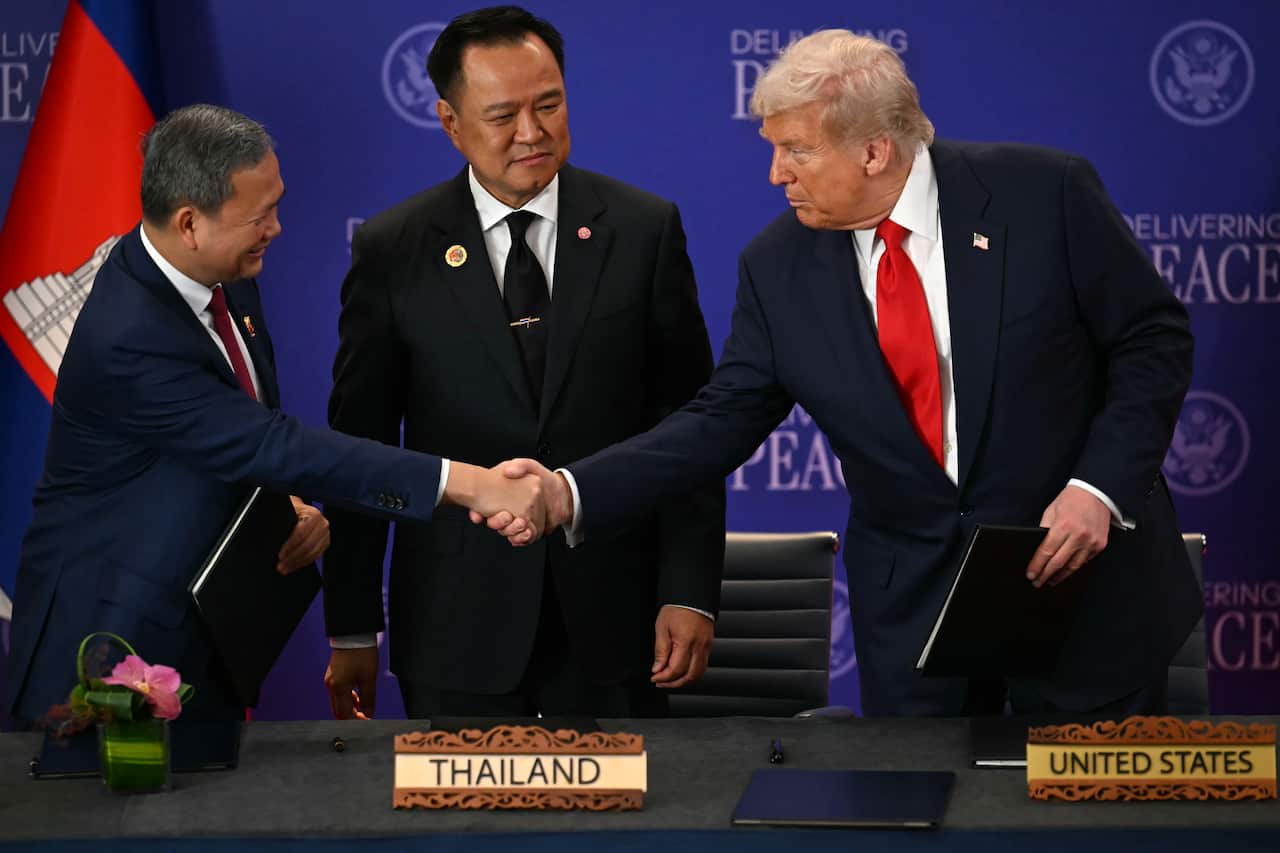
Thailand's Prime Minister Anutin Charnvirakul watches Cambodia's Prime Minister Hun Manet, left, and U.S. President Donald Trump shake hands on the sidelines of the 47th Association of Southeast Asian Nations (ASEAN) summit in Kuala Lumpur, Malaysia

US President Donald Trump (right) brokered a peace deal signed by Thailand’s Prime Minister Anutin Charnvirakul (centre) and Cambodia’s Prime Minister Hun Manet (left) in October. Source: AP / Mohd Rasfan

Trump, who Cambodia nominated for the Nobel Peace Prize, had made calls to leaders of both countries last month, urging them to stick to the ceasefire.

How do the two countries compare militarily?

Thailand has a large and well-funded military that dwarfs that of Cambodia, with triple the active armed forces personnel and a 2024 defence budget allocation that was four times bigger than its neighbour’s.
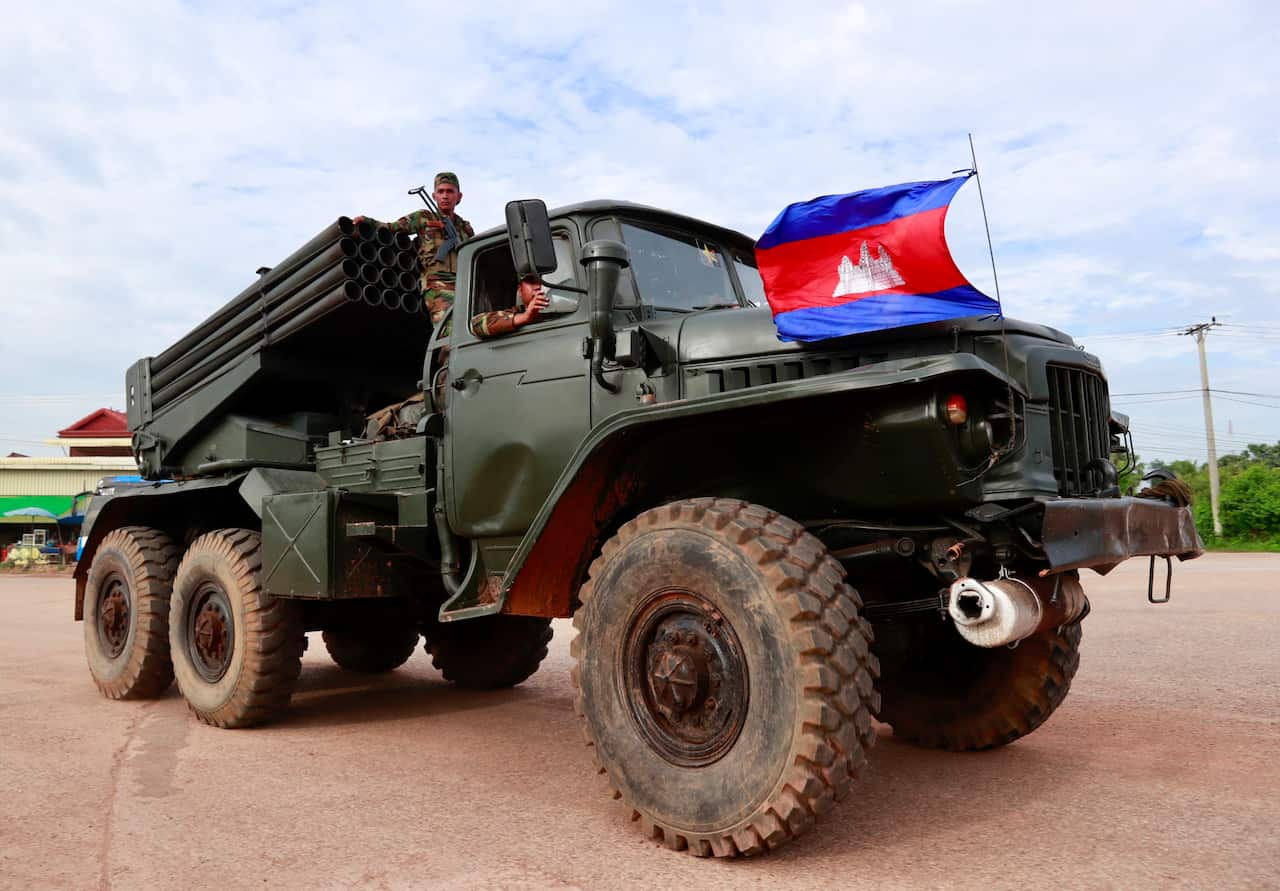
People flee Cambodia due to the armed border conflict with Thailand

Cambodia’s military budget is a quarter the size of Thailand’s. Source: EPA / Kith Serey

Cambodia’s army has 75,000 soldiers, more than 200 battle tanks and around 480 pieces of artillery, compared to the Thai army’s 245,000 personnel, around 400 tanks, more than 1,200 armoured personnel carriers and 2,600 artillery weapons.

Thailand’s air force has nearly 40 fighter jets and dozens of helicopters, while Cambodia has 16 multi-role helicopters but no fighter aircraft.

Where does the dispute originate?

Thailand and Cambodia have for more than a century contested sovereignty at various undemarcated points along their 817km land border, which was first mapped by France in 1907 when Cambodia was its colony.
That map, which Thailand later contested, was based on an agreement that the border be demarcated along the natural watershed line between the two countries.

In 2000, they agreed to establish a commission to peacefully address overlapping claims, but little progress has been made.
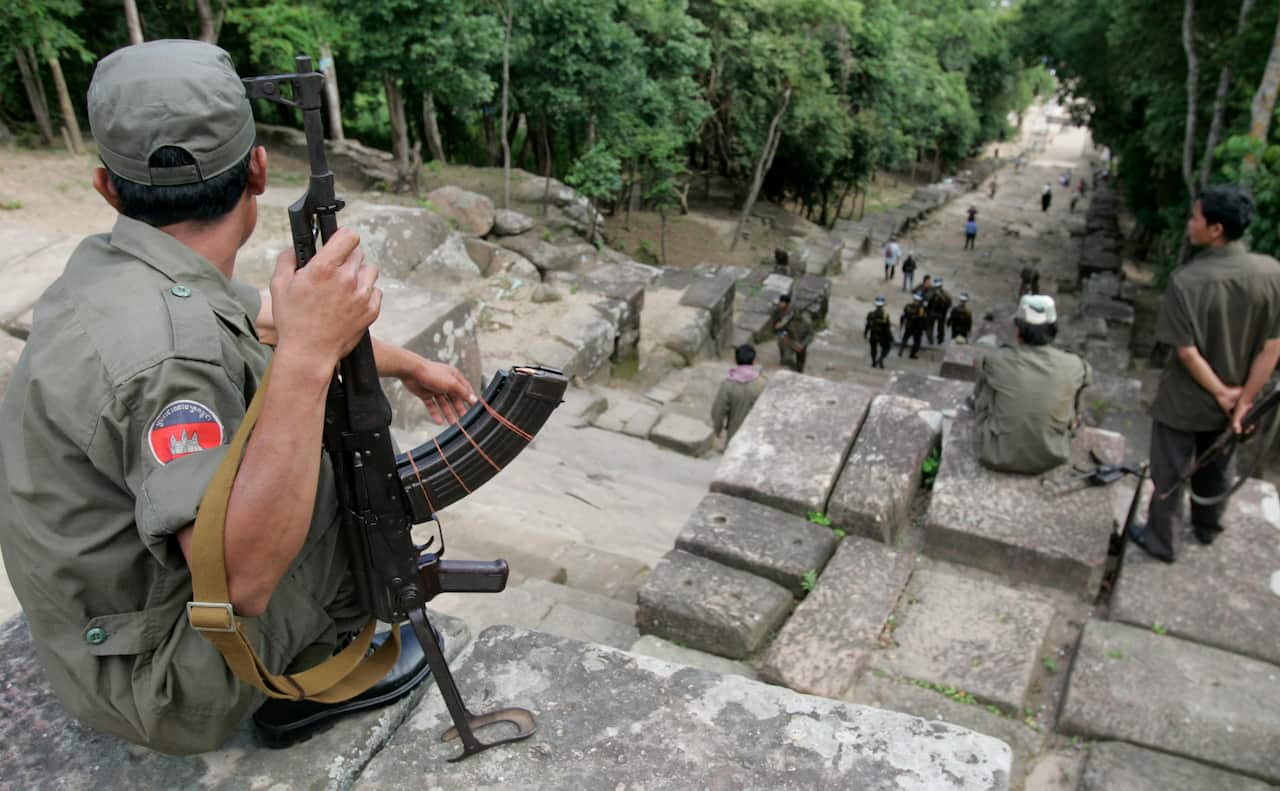
A soldier sitting guard

Cambodian soldiers on guard at Preah Vihear temple near Cambodia’s Thai border in July 2025. Source: AP / Mak Remissa

Claims over ownership of historical sites have raised nationalist tension, notably in 2003 when rioters torched the Thai embassy and Thai businesses in Phnom Penh over an alleged remark by a Thai celebrity questioning jurisdiction over Cambodia’s World Heritage-listed Angkor Wat temple.

The 11th-century Hindu temple Preah Vihear, or Khao Phra Viharn in Thailand, has been central to the dispute, with both countries claiming historical ownership.

The International Court of Justice awarded the temple to Cambodia in 1962, but Thailand continued to lay claim to the surrounding land. Tension escalated in 2008 after Cambodia tried to list Preah Vihear as a UNESCO World Heritage site, leading to skirmishes and at least a dozen deaths, including during a week-long artillery exchange in 2011.

What’s behind this year’s troubles?

Nationalist sentiments were stirred in Thailand in 2024 when conservatives questioned a government plan to negotiate with Cambodia to jointly explore offshore energy resources, warning that it could risk Thailand losing island territory.
In May, a Cambodian soldier was killed by Thai forces during a brief skirmish, prompting both countries to increase troops at the border. Around the same time, Cambodia referred disputes over temples in four areas to the ICJ.

You May Also Like

Urgent Call to Action: Scientists Demand End to Cruel Lobster Boiling Practices Amidst New Pain Sensitivity Findings

Recent research suggests the longstanding practice of boiling lobsters alive inflicts significant…

Government Plans Budget Reductions Amid Delayed Economic Shock Posing Job Risks

in brief The treasurer says the upcoming May budget will show “restraint”…

Skyrocketing Drug Costs Leave Families Struggling to Afford Essential Medications

Jade Hlucshniow faced a heartbreaking decision—selling her home to afford the necessary…

Jacinta Nampijinpa Price Slams Government Decision, Demands Justice for Indigenous Children Amid Rejected Royal Commission

Jacinta Nampijinpa Price has issued a fierce critique of the government’s decision…

Trump Considers Iranian Offer to Halt Ongoing Conflict

President Donald Trump announced he is currently evaluating a fresh proposal from…

Tragic Incident in Sydney: Suspect Apprehended Following Triple Family Homicide

A man is in custody after three of his family members died…

No Campaign Sets Sights on New Objective Following Voice Defeat; Leader Claims: ‘Australia Delivered a Lasting Blow

The No campaign against the Voice to Parliament has unveiled a new…

US Declares Troop Withdrawal from Germany

IN BRIEF Transatlantic tensions are simmering over Iran war and tariffs. The…

Discover the Common Fridge Staple That May Lower Alzheimer’s Risk

IN BRIEF Eating seafood twice a week may decrease the risk of…

Grandfather of Kumanjayi Little Baby Urges Community for Peace Amidst Tensions

WARNING: Aboriginal and Torres Strait Islander readers are cautioned that this article…

Unpacking Profits: How Pokémon Cards Are Revitalizing Australian Retailers

The surging price of Pokémon products has been no secret over the…

Melbourne Arson Case: Bail Refused for Duo Charged in Restaurant Blaze

Two individuals have been refused bail following charges related to the alleged…