Share this @internewscast.com
A decade ago, world leaders signed the Paris Climate Agreement to limit global emissions. Now, global leaders are meeting in Brazil for COP30, which will run from 10 to 21 November.

The Conference of the Parties, commonly known as COP, is an annual summit where nearly 200 nations gather to discuss climate change under the United Nations Framework Convention on Climate Change.
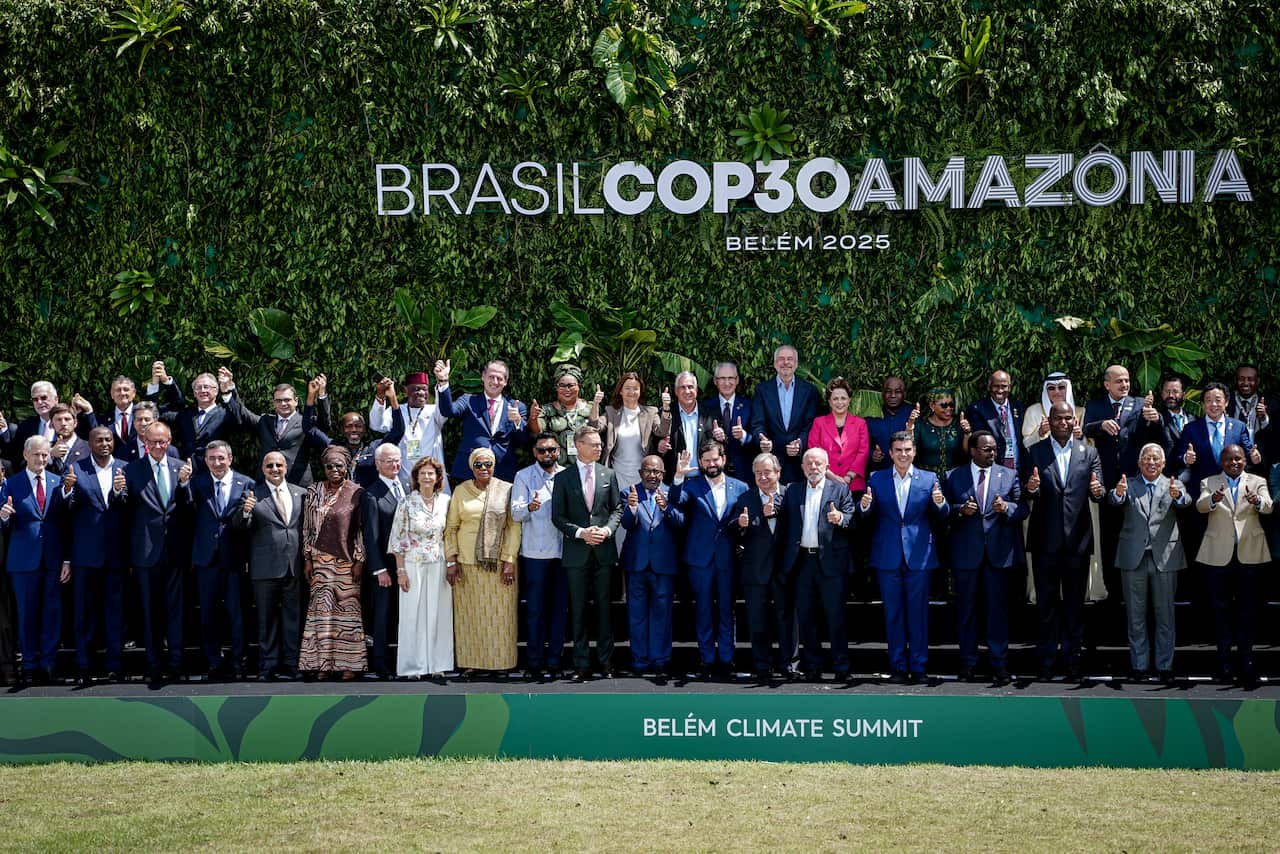
A large group of people stand on tiered stands in front of a sign that reads 'Brasil COP30 Amazonia'

This year, the leaders of the world’s top three carbon-emitting countries—China, the United States, and India—will not be present at COP30.

Viviana Santiago, who serves as the executive director of Oxfam Brazil, mentioned that there is significant anticipation surrounding this year’s conference.

Leaders of the world’s three biggest carbon polluters — China, the United States and India — are not attending and US President Donald Trump made his views on climate commitments clear at a meeting of the UN Assembly in September.

“Regardless of whether temperatures rise or fall, climate change is happening. In my view, it’s the greatest con job ever perpetrated on the world,” remarked Trump.

The gateway to the Amazon

The location of the meeting is also a source of controversy.

A small section of the Amazon rainforest was cleared for a road so Belém could host the conference, at a time when Brazil continues to grant new licences for oil and gas exploration.
Belém is considered the gateway to Brazil’s vast Amazon rainforest and Indigenous protesters gathered ahead of the climate summit.
A flotilla carrying Indigenous leaders and activists made its way down the Amazon River to the city, where the groups plan to deliver a list of conservation demands to world leaders.

The meeting also marks ten years since the Mariana dam collapse, Brazil’s greatest environmental disaster, which released toxic mud that devastated local communities.

Indigenous leaders like Célia Xakriabá issued a warning that speaks to the urgency of environmental protection.

“Even as we understand the process of reparation, we recognise there is something you cannot bring back. You can’t bring back the 19 lives or the clean, healthy river,” she said.

The goals of this year’s COP

Forest protection will be a significant part of this year’s COP, with the launch of a global fund to pay developing countries for every hectare of forest kept standing.

Brazil has also laid out a plan with other leaders to scale climate finance for developing countries to $2 trillion dollars.

However, the major focus is on emission targets.
Under the Paris Agreement, 195 countries have agreed to limit global temperature rises to 1.5C above pre-industrial levels, and well below 2C.
But the United Nations Environment Programme (UNEP) has warned the world is already on the brink of reaching 1.5C and beyond.

Greenpeace Australia Pacific COP31 leader Dr Simon Bradshaw said the continued rise in global temperatures is a wake-up call for leaders.

“When you add up all national climate plans, we’re headed for under 3C of warming. Now, that’s still catastrophic, and so we need to bend that emissions curve down much further and faster,” he said.
While signatories to the Paris Agreement were supposed to submit updated targets for reducing greenhouse gas emissions in order to reach the 1.5C goal, only a third of parties have done so.

Based on those submissions, the UN projects emissions will fall ten per cent by 2035 — but that’s still far short of the 60 per cent decline in emissions needed by the same year to keep global warming to 1.5C, according to the UNEP.

These shortfalls have led to tension about the desired outcomes of the summit, with some countries like host nation Brazil calling for a focus on delivering current pledges and others, like the Pacific Island nation of Palau, pressing for more ambitious commitments.

Australia has a target to reduce emissions by 62 to 70 per cent by 2035, which is slightly lower than Europe’s goal of 66 to 72.5 per cent.

Australia’s bid for COP31

Prime Minister Anthony Albanese has drawn criticism for not attending the summit this year, despite Australia bidding to co-host next year’s meeting alongside Pacific Island nations.


Last week, Albanese wrote a letter to the President of Türkiye Recep Tayyip Erdoğan, who has launched a competing bid.
Hosting rights for the 2026 event will be decided during this year’s COP summit and Bradshaw says Albanese’s absence sends a confusing signal.
“If ever there was a moment for Australia, for the prime minister, to show up, this is it. Because we are an important player in the scheme of things, we’re an influential middle power, we’re a major energy producer; we really need to be there helping set an ambitious agenda,” he said.

Share this @internewscast.com
You May Also Like

Donald Trump Confronts Internal Criticism Over Epstein Document Redactions

Extensive redactions and the partial release of documents related to convicted sex…
FILE PHOTO: The U.S. Coast Guard's logo is seen on an helicopter on the deck of the Coast Guard Cutter Hamilton at Port Everglades, in Fort Lauderdale, Florida, U.S. November 22, 2021. REUTERS/Marco Bello/File Photo

Breaking News: US Seizes Another Vessel Near Venezuela – What It Means for International Maritime Policy

Personnel from the United States boarded and seized a vessel off the…

Why Swiss Commuters Are Taking the Plunge: A River Commute Revolution That Australia Might Need

Each summer in Switzerland, families, leisure-seekers and commuters pack their dry bags…
Aussies in one state to face public transport fare hike within days

Brace Yourself: Major Public Transport Fare Increase Looms for One Australian State

Starting January 1, commuters will face an additional 40 cents daily as…

NSW Premier Seeks Royal Commission and Proposes Ban on Controversial Chant

NSW Premier Chris Minns has announced his government will introduce new laws…
The world's longest flight recently took its first journey, taking 29 hours and covering 12,400 miles. And while it may seem like a nightmare to some, it has been celebrated as a landmark success for long-haul travellers who no longer need to take a connecting flight. Launched on December 4, the China Eastern Airlines route sets off from Shanghai and lands in Buenos Aires. The flight from China to Argentina takes more than 25 hours, with the return journey taking four hours longer.

Record-Breaking 12,400-Mile Flight Sets New Benchmark for Longest Journey

The world’s longest commercial flight has officially taken off, marking a significant…

Bondi Lifesaver Ahmed Al-Ahmed Questions Merit of $2.5 Million Donation

Ahmed Al-Ahmed, the tobacco shop owner who was wounded after disarming one…

Australia’s Rising Terrorism Threat: Global Factors Leaving the Nation Vulnerable

As the first shots rang out on Sunday afternoon, Francisco “Paco” Chumacero…

Epic Father-Son Journey: Inside the 14,000km England-to-Australia Bike Adventure

Growing up in Manchester, United Kingdom, Jamie Hargreaves and his brother were…
PM orders review into law enforcement and intelligence agencies

Prime Minister Initiates Comprehensive Review of Law Enforcement and Intelligence Practices

Prime Minister Anthony Albanese has announced a review will be conducted into…
Launched on December 4, the China Eastern Airlines route sets off from Shanghai and lands in Buenos Aires. The flight from China to Argentina takes more than 25 hours, with the return journey taking four hours longer (stock image)

Historic 12,400-Mile Nonstop Flight Successfully Lands After 29-Hour Journey

The aviation world has reached a new milestone with the debut of…
ITV News Arts Editor Nina Nannar has detailed her 'agonising' trip to New Zealand to scatter her late husband Steve's ashes after losing him to kidney disease in 2022

ITV News Arts Editor Nina Nannar’s Heartfelt Journey to New Zealand: Honoring Late Husband’s Memory Amidst Kidney Disease Battle

Nina Nannar, the Arts Editor for ITV News, recently shared the emotional…