Share this @internewscast.com
With millions of native animals killed on Australian roads each year, researchers warn that governments are not doing enough to monitor and implement road-safety measures that could protect vulnerable fauna.
A range of interventions exist — including tunnels, rope and land bridges, exclusion fencing and other structures that help wildlife move safely around roads.
But new research from Griffith University has identified “systemic” gaps in how these measures are applied across the country.
Fauna-sensitive road design standards are largely optional, the researchers warn, and without a national framework with clear rules, their deployment will likely remain “patchy and insufficiently supported by policy”.

Collisions between vehicles and wildlife pose significant challenges, impacting not only native animal populations but also affecting drivers, rescue personnel, and veterinary teams.

Wildlife Victoria has reported a 288 per cent increase in calls about wildlife collisions with vehicles over the past 10 years. The organisation says it has helped 311 species hit by vehicles, with kangaroos representing 50 to 60 per cent of cases.
The Royal Automobile Club of Victoria (RACV) said it received nearly 7,000 claims last year involving animal impacts.
Some estimates place Australia’s annual wildlife toll as high as 10 million.

“The numbers are staggeringly high,” remarked Christopher Johnson, a road ecologist and the lead author of the study, during an interview with AAP.

In Victoria, guidelines tend to use suggestive language rather than mandatory regulations, which limits their enforceability.

Queensland and Victoria are the only states with wildlife-sensitive guidelines embedded in their road designs, although those standards are voluntary.
In an analysis of Queensland’s Fauna Sensitive Road Design manual, the study identified 99 statements that used the terminology “should”, while only 64 used “must”.

While kangaroos and other large creatures are often the most noticeable casualties in these accidents, countless smaller animals also perish, their deaths frequently going unreported.
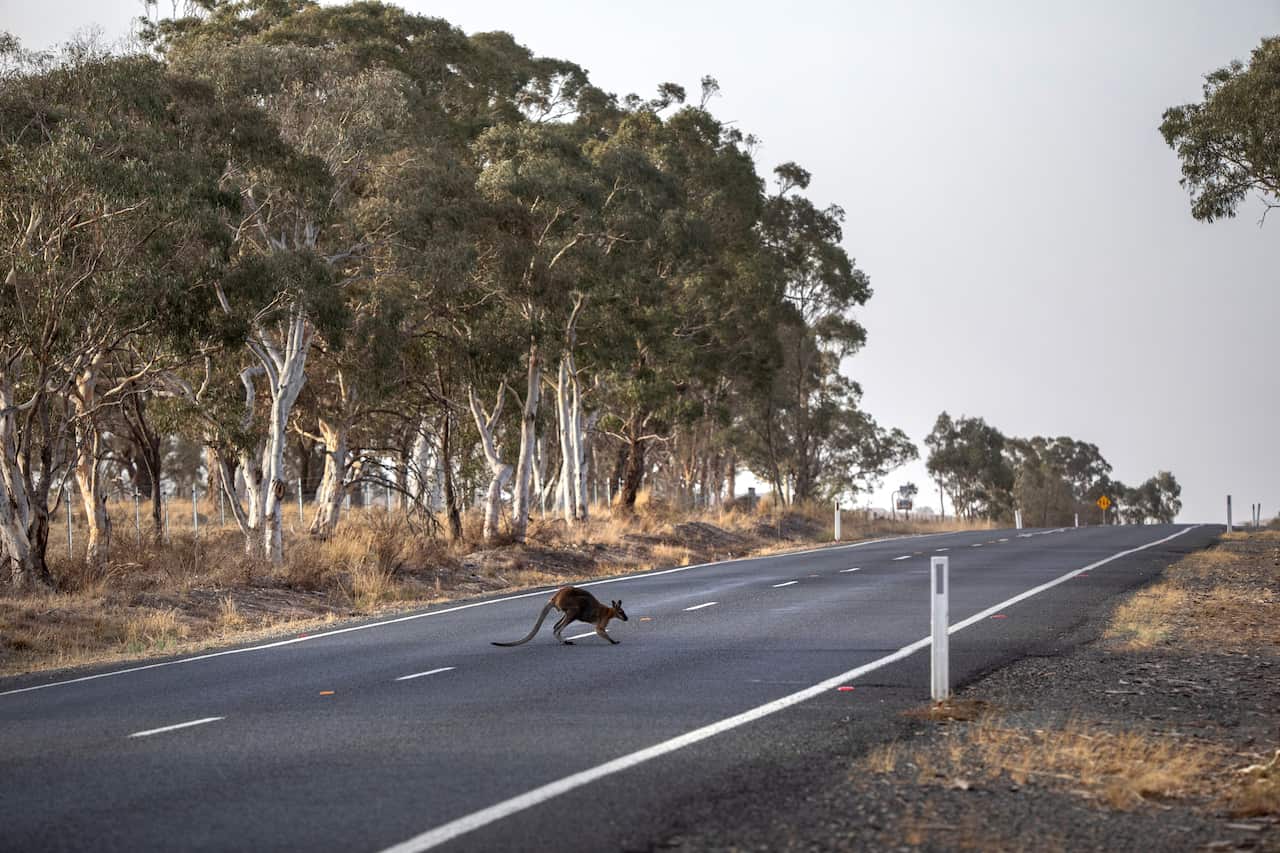
Kangaroo on a road in a bush area

The study emphasized the importance of placing biodiversity at the forefront of infrastructure development, advocating for clear guidelines rather than leaving it subject to interpretation.

The study called for biodiversity to be at the core of infrastructure planning, rather than being left open to interpretation.

“If we treated building a wildlife bridge with the same approach as we would a pedestrian bridge, we’d have a lot better outcomes,” Johnson said.

“Nice-to-haves don’t always make it through to the end of the project.”

What are some of the ways to protect wildlife around roads?

Kylie Soanes is a research fellow in urban biodiversity at the University of Melbourne who has done extensive research on road ecology and wildlife crossings.

She told SBS News it’s all about understanding the impacts of a specific stretch of road on the local ecosystems.

“We think more ecologically about what’s in the entire area and what’s likely to come into contact with the road and what its response is going to be when it gets there, rather than just reacting to where maybe someone hit a kangaroo with their car,” she said.
Fencing, when designed properly, can be “really effective” in preventing wildlife deaths on roads, she said.
However, it can block important pathways for animals, making it difficult for them to reach certain areas where they can breed or feed.

That’s when wildlife crossing structures can be useful tools to help animals move across safely.

“Maybe there’s a pond on one side of the road and a forest on the other. So animals are frequently crossing to access,” she said.
Animals that are attracted to roads and that lack the skills to evade cars are particularly susceptible to accidents, she said.
“Snakes and lizards that might come out warm themselves up on nice hot bitumen and then not be able to move away in time,” she said.

“Turtles, things that move along the ground relatively slowly, they tend to be at a really big risk.”

Reality of death tolls ‘probably worse’ than estimates

There is no national database that tracks the extent of wildlife road deaths.
“We are terrible at recording this information,” Soanes said, noting that Australia faces challenges compared to some other countries, which do have databases, due to its size.

Estimates are often extrapolated from figures reported by insurance companies or wildlife rescue groups.
That means they’re likely “an underestimate, when you think beyond kangaroos and koalas and wombats, but also include turtles and lizards and frogs … and all the things that we hit and we don’t see and we don’t record,” Soanes said.
“It’s probably worse, unfortunately.”
— With additional reporting by the Australian Associated Press.

Share this @internewscast.com
You May Also Like
Queensland rain

Queensland on High Alert: Double Cyclone Threat Looms – Prepare Now!

Records are tumbling in outback Queensland as days of rain cuts off…
A picture of an unidentified child at a childcare centre.

Nine Childcare Centers at Risk of Losing Funding After Falling Short of Standards

One childcare centre has closed and nine face suspension or funding cuts…

Discover the Timeline to Achieve Your Dream Property ‘Pinch Me’ Moment

In brief Patricia Nicula has just bought her first home in Queensland,…

US-Iran Negotiations Show Promising Progress: Will a Historic Deal Emerge?

IN brief Iran and the United States have ended talks in Geneva…
WFH and four-day weeks impacting CBD businesses

The Decline of Friday Night Socials: Pubs Face Challenges Amid Remote Work Trend

A sharp rise in Australians choosing to work-from-home on Fridays is having…

Controversy Persists Over Allegations of Racism in Incoming NT Administrator David Connolly’s Past Social Media Posts

In Brief David Connolly is being sworn in as the Northern Territory’s…
Shark warning after Sydney deluge floods city

Shark Alert Issued Following Sydney Flooding

Sydney swimmers are urged to be wary of sharks after the city…
General view of Yallourn Power Station (Luis Enrique Ascui/Australian Financial Review)

Firefighters Combat Intense Blaze for Five Hours at Victorian Power Station

Firefighters have spent nearly five hours battling to control a blaze inside…
Hillary Clinton

Hillary Clinton Faces Congress: Denies Knowledge of Epstein’s Activities

Former US Secretary of State Hillary Clinton told US House lawmakers on…
Raymond Reddington, Sharon Fulton

Justice Served: Husband Found Guilty in Decades-Old Cold Case Murder of Wife

It’s been nearly 40 years since Sharon Fulton went missing in Western…
Sussan Ley addresses the media following a Liberal party meeting at Parliament House in Canberra on Friday 13 February 2026. fedpol Photo: Alex Ellinghausen

Veteran Politician Sussan Ley Steps Down After 25 Years in Public Service: Impact and Legacy

Former Liberal leader Sussan Ley has officially stepped down from her political…

Tragic Fungal Outbreak Claims Two Lives at Prominent Sydney Hospital: Health Authorities on High Alert

IN BRIEF Sydney’s Royal Prince Alfred Hospital confirmed six patients were caught…