
Share this @internewscast.com
Australia may soon face fuel rationing, a scenario that could unfold in a matter of weeks, according to an expert, despite Energy Minister Chris Bowen’s assurances of an extended supply.
Ben Fahimnia, a logistics and supply chain specialist from the University of Sydney, has highlighted Australia’s precarious position in the global market, given that the nation imports 90 percent of its fuel.
Although the Albanese government has mentioned rationing as a last-resort option for extreme situations, Fahimnia believes it’s not a matter of if, but when Australia will need to take this step.
“Fuel rationing is inevitable; it’s something we can’t avoid,” Fahimnia stated in an interview with The Daily Telegraph.
“If the current conflict continues beyond this week, I anticipate that we will enter a formal period of fuel rationing,” he warned.
“The reasoning is straightforward—our lack of control over the supply chain leaves us vulnerable,” Fahimnia explained.
‘If the conflict escalates and Hormuz remains closed, we definitely move into a crisis within the next couple of weeks.’
His warning comes after Bowen reassured Australians on Monday the fuel supply had been extended beyond mid-April and ‘into May’.

An expert has warned that Australia will be forced to start rationing fuel within weeks despite Energy Minister Chris Bowen revealing supply had been secured into May

Logistics and supply chain management expert Ben Fahimnia said he believes Australia will go into ‘formal fuel rationing’ if the conflict drags beyond this week
Mr Fahimnia said better national coordination to monitor likely and emerging shortages is needed to avoid a ‘very ugly May’.
‘We have to think of this as a systemic shock rather than an oil supply issue,’ he said.
Newly released figures show demand for fuel in NSW was five times higher than normal in the days after the Iran war began, with that demand now 100 per cent higher than normal.
Attorney-General Michelle Rowland told Sunrise on Tuesday the Albanese government was not considering fuel rations.
‘We are focused on security of supply. And work has been done across industry, but also, again, with international partners to ensure that supply continues,’ she said.
Bowen said on Monday normal fuel supplies had been guaranteed from major exporters in Japan, South Korea and Singapore.
‘All the orders are locked in, contracted,’ he told ABC’s Radio National.
‘Once it’s contracted, the fuel belongs to the Australian company that’s bought it, so that is legally locked in. That’s encouraging.’

Energy Minister Chris Bowen said fuel supplies have been secured into May
However, he could not guarantee beyond that, acknowledging overseas refiners would ‘come under pressure’ if the Strait of Hormuz remains shut.
Petrol imports are dominated by Singapore, which supplies about 54.7 per cent (5,974.7 megalitres), followed by South Korea at 22.5 per cent and India at 11.5 per cent, with Malaysia contributing a further 10 per cent.
Smaller volumes come from countries such as Japan, Brunei and several European nations.
Diesel supply is also concentrated among a handful of key partners, led by South Korea at 28.8 per cent (8,716 megalitres), followed by Singapore at 15.4 per cent and Malaysia at 14.4 per cent.
Australia now has fuel reserves equivalent to 39 days’ worth of petrol, 29 days’ worth of diesel and 30 days’ worth of jet fuel, with over 50 fuel shipments due to arrive in the next month.
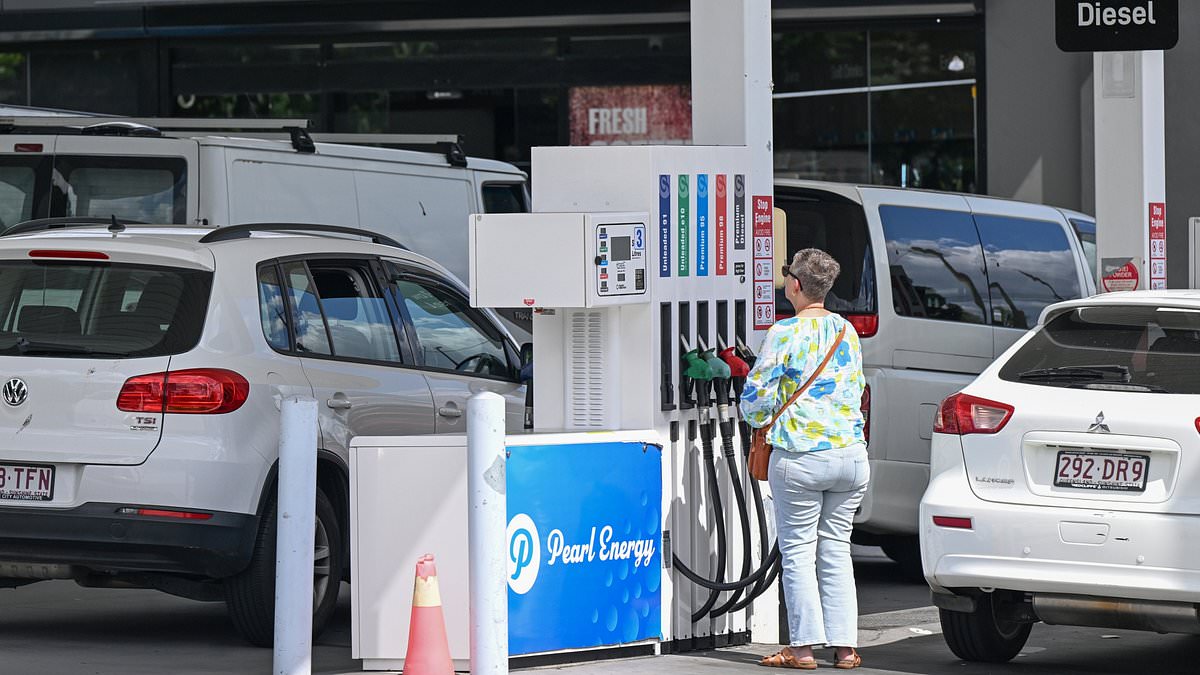
On Monday, 142 service stations in NSW were without diesel, 39 with no fuel.
Nationwide, 3.4 per cent of service stations were without diesel – in Victoria, 51 without diesel, 30 without fuel, in Queensland, 38 were without diesel, 32 weer without fuel and in South Australia, nine were without diesel and five without fuel.
Western Australia had 19 stations without diesel and 29 with no fuel; Tasmania had seven without diesel and seven without fuel; in the ACT, four were without diesel and two without fuel.
‘NSW has been higher because farmers are seeding and sowing, and they’ve been prioritised,’ Bowen clarified.
‘We’ve also had fuel companies increase truck fleets by 20 per cent over Easter.’
Meanwhile, relief from crippling fuel costs has begun to flow after the Albanese government temporarily halved taxes on petrol and diesel, while states also agreed to pass on an expected GST windfall due to higher takings on sales.
But the 30c-a-litre savings haven’t offset soaring global oil prices, with just a trickle of tankers now making it through the blockaded Strait of Hormuz.