
Authorities are currently searching for seven individuals involved in Saturday’s pro-Palestine Nakba Day protest, while also revealing that 43 people were arrested during opposing demonstrations, part of a £4.5 million policing effort.
Saturday saw between 15,000 and 20,000 participants in the Nakba Day event, which coincided with Tommy Robinson’s Unite the Kingdom march, drawing an estimated 60,000 attendees, according to the Metropolitan Police.
In total, 43 arrests were reported by the police, with 12 arrests related to the Nakba rally and 20 connected to the Unite the Kingdom march.
The remaining 11 arrests have not been specified in terms of their association with either gathering.
The demonstrations, which took place in London, were monitored by 4,000 police officers deployed across the city.
The Metropolitan Police also reported that four officers were assaulted and six were victims of hate crimes during these events, as shared on their X platform post.
Eleven arrests were made for hate crime related offences, including those motivated by race, religion, sexuality and disability.
The force said of the 11 arrests, two are allegedly affiliated with the Nakba Day rally and nine to Unite the Kingdom.
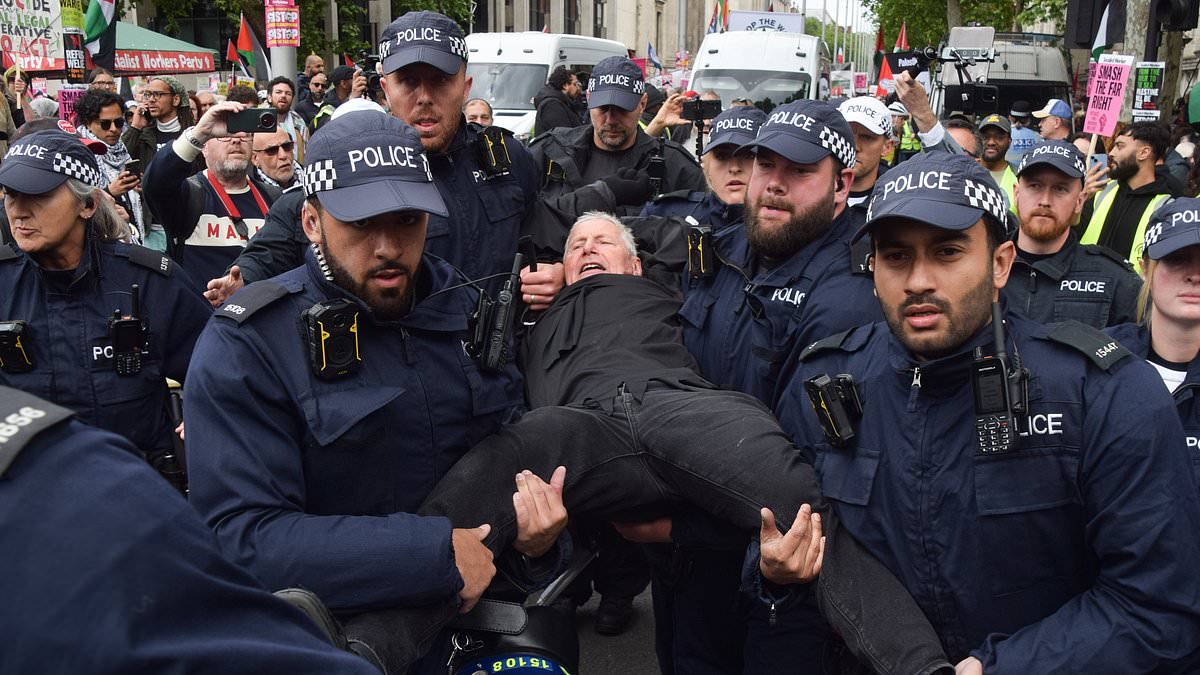
Police made 43 arrests on Saturday of protestors from both of the major rival demonstrations. (Pictured: a man being arrested in South Kensington)
Tommy Robinson’s Unite the Kingdom march was said to be attended by around 60,000 people
A further seven hate crime offences – all from the Nakba Day protest – remain under investigation with outstanding suspects.
The force added that three additional arrests were resulting from the use of live facial recognition. All three were people wanted for failing to appear at court and none were linked to the day’s protests.
Speakers at the Unite the Kingdom rally included Tommy Robinson – real name Stephen Yaxley-Lennon – alongside Ant Middleton, Katie Hopkins, Laurence Fox and former Conservative MP Andrew Bridgen.
In a post to X, Mr Robinson said: ‘Keir Starmer, the country’s awake, your days are numbered.’
In another post, he alleged millions attended the march.
Siobhan Whyte – mother of Rhiannon Whyte, who was murdered by a Sudanese asylum seeker – told the demonstration that Prime Minister Sir Keir Starmer ‘failed my daughter.’
Dominik Tarczynski, a Polish politician who has claimed to have been banned by Sir Keir from entering the UK before the rally, appeared on stage via videolink.
Organisers of the Nakba pro-Palestine rally estimated at least a quarter of a million people attended.
4,000 officers were deployed to control the protests taking place in London on Saturday
Protesters hold placards up as they march through London in solidarity with Palestinians
MP Diane Abbott said the group faced a ‘common enemy’ – which she described as the ‘far Right’.
Of the Unite the Kingdom group, she said: ‘They are viciously Right-wing, viciously racist, they are anti-black, anti-Muslim, and viciously antisemitic.
‘We have to come together… to fight the racists, to fight the fascists, to fight the antisemites.’
Zarah Sultana, who is the co-founder of Your Party, was in attendance and told protesters that Andy Burnham was ‘not an alternative’ to Sir Keir.
She labelled Mr Burnham as ‘another establishment politician cut from the same Zionist cloth’.
Former Labour leader and Your Party co-founder Jeremy Corbyn was also present.
He told supporters at the pro-Palestine rally that Westminster needs a change in ‘policy’ and not ‘personalities’.
Prosecutors were previously warned to consider whether protest placards, banners and chants viewed on social media may amount to offences of stirring up hatred during the protests.
Police detaining a person during the pro-Palestine march

Another woman is detained during the Nakba Day pro-Palestine march
New guidance has urged demonstrators to assess if slogans, symbols or chants may influence audiences if they are filmed and shared online.
The Crown Prosecution Service (CPS) said the revised advice reflects ‘the changing international context’ and follows separate guidance issued earlier this month concerning the fast-tracking of hate crime prosecutions.
The guidance asks prosecutors to account for the wider context around protests, including increasing tensions linked to events both nationally and internationally.
Recent criminal cases include people being charged after shouting ‘death to the IDF (Israel Defence Forces)’ and ‘globalise the intifada’.
Eleven foreign nationals labelled by Sir Keir as ‘far-Right agitators’ have also recently been blocked by the Government from entering the UK ahead of the Unite the Kingdom rally.
Both demonstrations were monitored by drones, and officers in Wembley monitored CCTV feeds from the FA Cup final to identify supporters heading toward any protests.
And, for the first time under official protest restrictions, organisers of each rally will face prosecution – as well as any speakers who break the law by using the events as a platform for hate speech or extremism.